

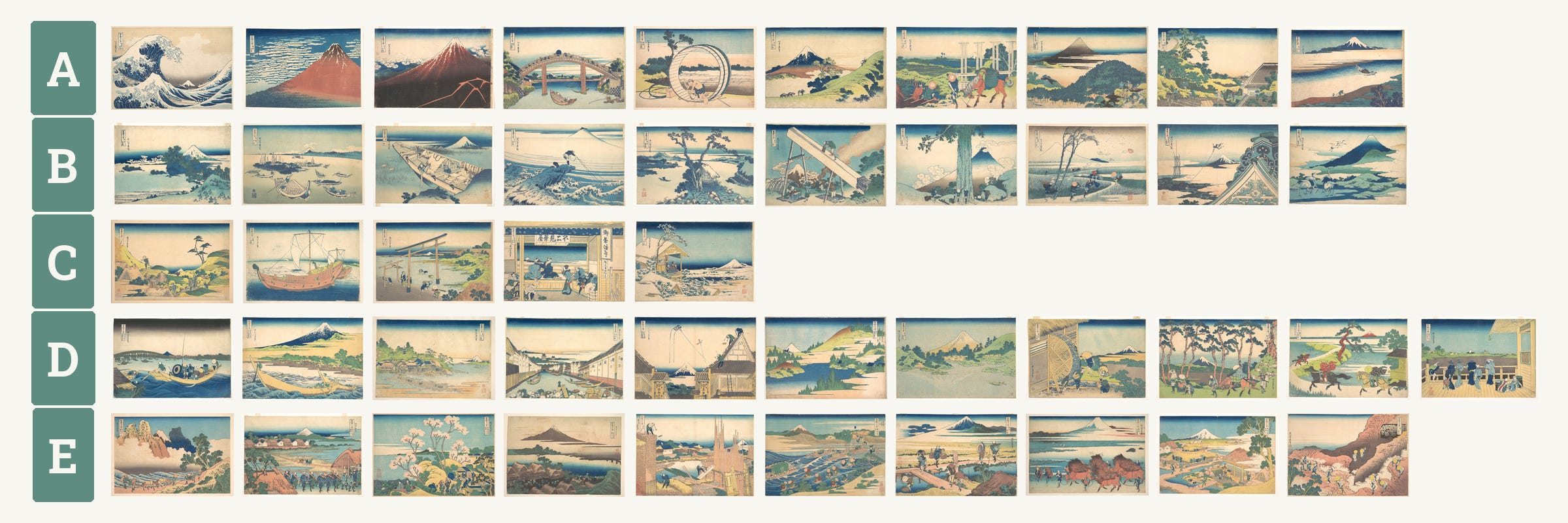
Katsushika Hokusai’s “Thirty-six Views of Mount Fuji” says “thirty-six” in its title, but there are 46 prints in all.
It is a series of woodblock prints, sold one at a time in Edo, today’s Tokyo, from around 1830. The famous print of the great wave and the print of the red Fuji are both among them. Mount Fuji is the highest mountain in Japan, and it lies to the west of Tokyo. To the people of Edo it was a special mountain, so much so that pictures of the city almost always included it.¹
Who planned the series, in what order did the prints come out, why were 10 more added, and why did it stop at 46? Those are the stories this article looks at.
Who published it
The publisher, that is, the shop that issued the prints, was Eijudō, in Bakurochō, a district of Edo. Its owner was Nishimuraya Yohachi. It was a long-established publisher.²
Hokusai, who drew the series, was by then past 70.² He was already a famous master.
Of all Hokusai’s series of large-format color woodblock prints, this one has the most prints.³ That is “Thirty-six Views of Mount Fuji.”
At first, it seems, eight prints were planned
The story goes back to 1823.
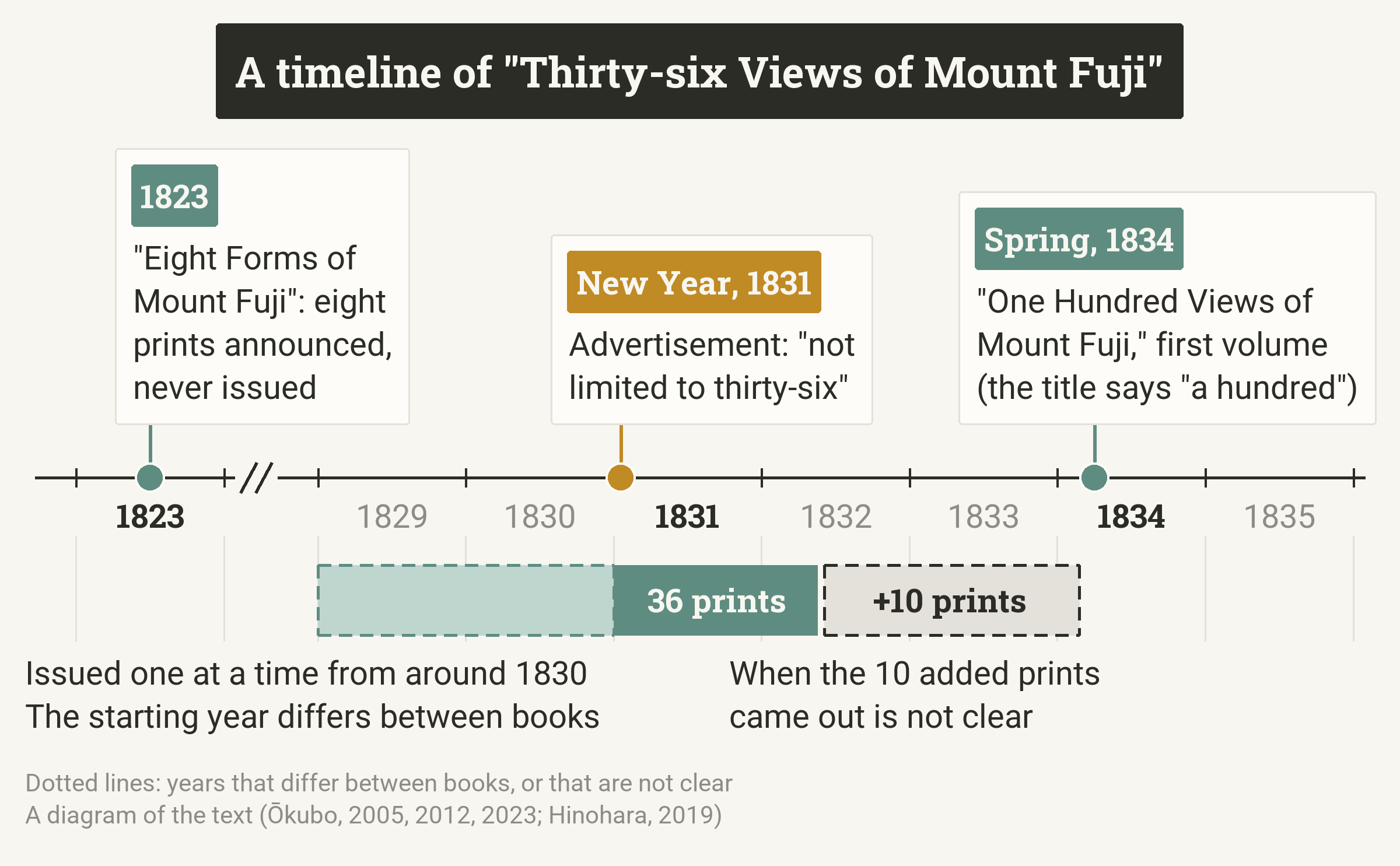
That year, an illustrated book by Hokusai, published by Eijudō, carried a list of the shop’s publications at the back. Among them is a title, “Eight Forms of Mount Fuji.” The seasons, fair weather, rain, wind, snow, mist. The announcement promised pictures showing how the view changes as nature changes.⁴
“Eight Forms of Mount Fuji” was announced, but it never came out.
The book that carried the list is a book of designs for combs and tobacco pipes. In it are eight combs decorated with Mount Fuji. Fuji in summer, Fuji in winter, Fuji at dawn, Fuji seen from the far side, Fuji under a bridge, Fuji in fine weather, and so on. The scholar Ōkubo Jun’ichi suggests that Hokusai may already have had many of the designs for the later series on hand.⁴
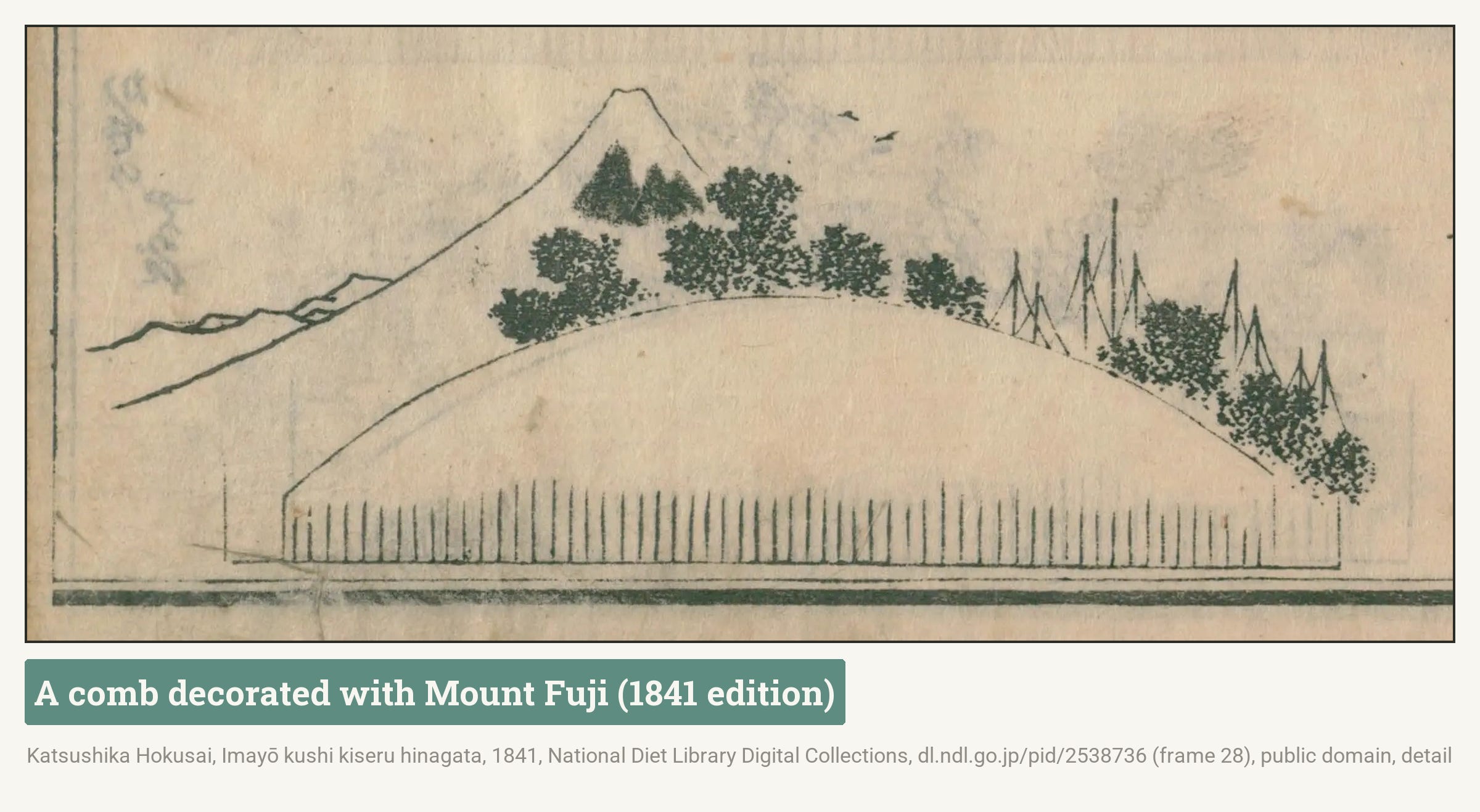
Ōkubo sees the vision behind the unrealized “Eight Forms of Mount Fuji” as having come to life a few years later, on a larger scale.⁵
An illustrated book from 60 years earlier: Hyaku Fuji
Hokusai had a model.
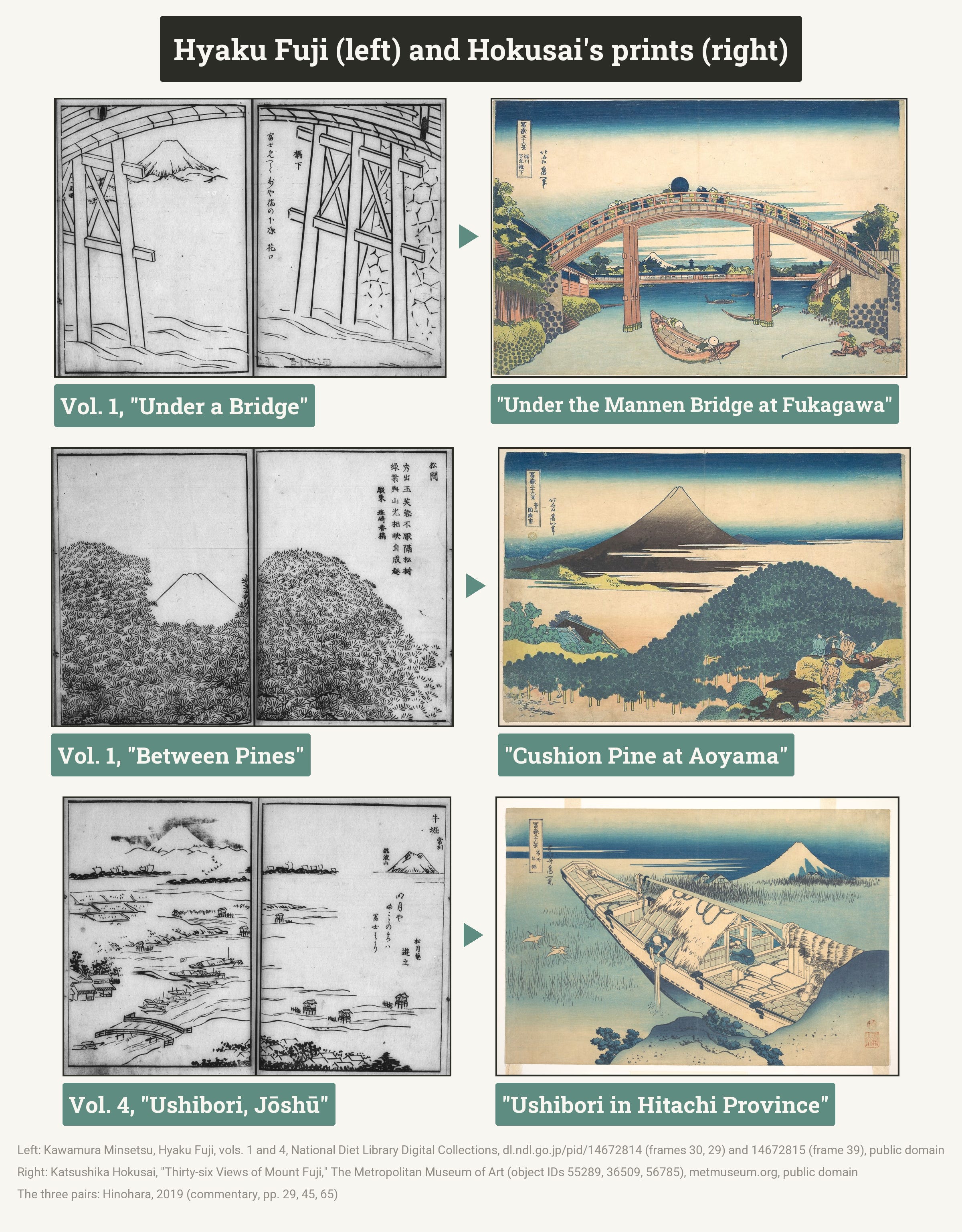
It was Hyaku Fuji, “A Hundred Fujis,” an illustrated book by a man named Kawamura Minsetsu. It came out in the second half of the 18th century. Minsetsu wrote haikai verse, the short poems from which haiku later grew, and drew many of the illustrations for books of such verse. He was long considered a mystery figure among artists of ukiyo-e, the woodblock prints sold in the city of Edo, but in recent years much more has come to light.¹
Peering at Fuji from under a bridge. Seeing Fuji between the needles of a pine. It was pointed out early on that compositions like these in Hyaku Fuji lay behind Hokusai’s prints.⁴
It is not only the compositions. Hyaku Fuji is in four volumes, divided by where Fuji is seen from: Fuji from Edo and nearby, Fuji along the Tōkaidō, the highway between Edo and Kyoto, and so on. Sort the 46 prints of “Thirty-six Views of Mount Fuji” by place, and they correspond to this division remarkably well.⁵
Places that could hardly be called famous spots for viewing Fuji appear in the series again and again. Ushibori, in Ibaraki Prefecture to the northeast of today’s Tokyo, is one of them. It was chosen because Hyaku Fuji has a picture of the same place, both Ōkubo and the scholar Hinohara Kenji write.³,⁵
The quality of the work, though, is another matter. Hyaku Fuji never rises above the level of an amateur, Ōkubo writes.⁵
The advertisement of 1831: “Not Limited to Thirty-six”
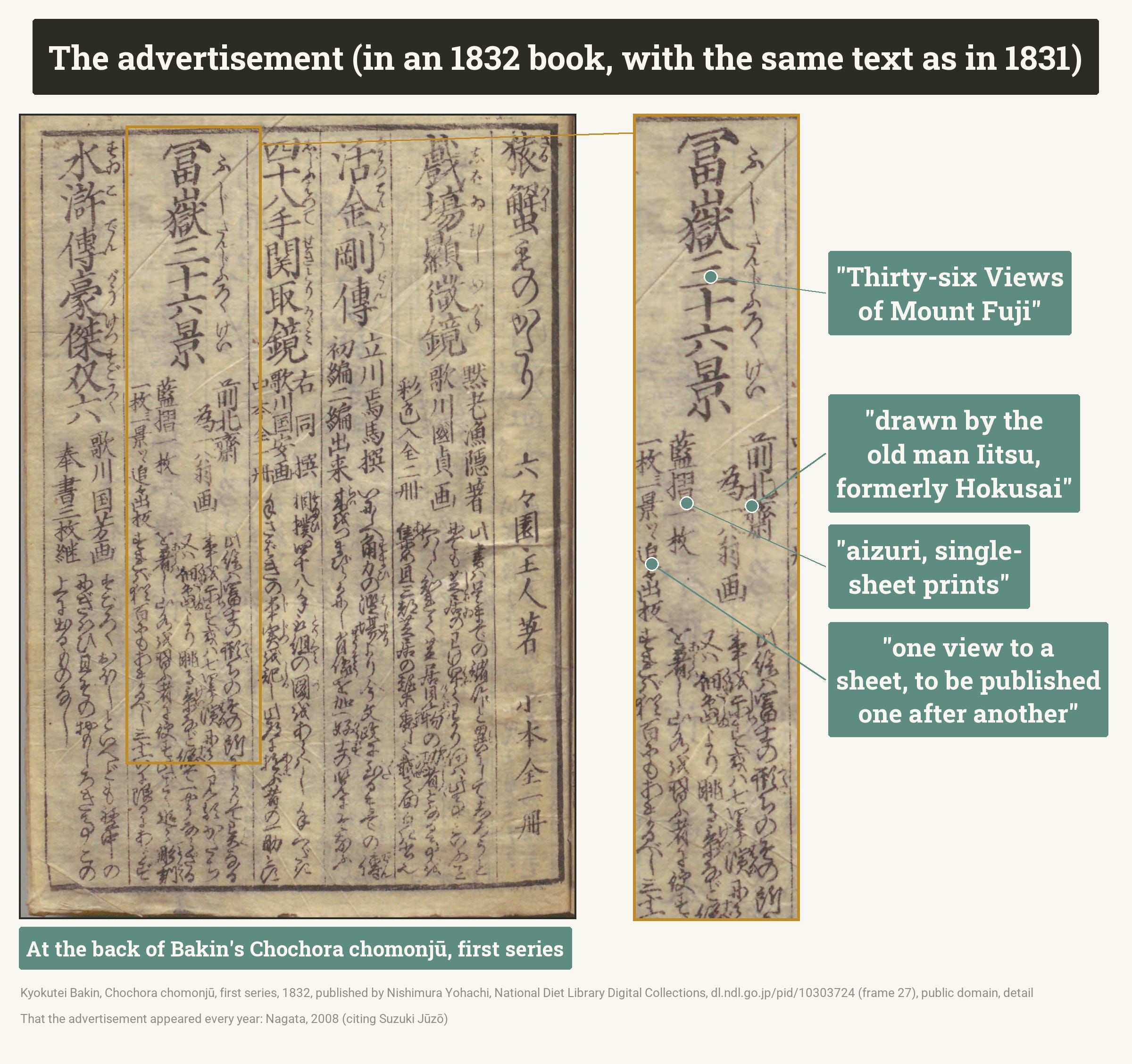
At the New Year of 1831, an advertisement appeared at the back of a novel published by Eijudō.
“Thirty-six Views of Mount Fuji,” drawn by the old man Iitsu, formerly Hokusai. Aizuri, single-sheet prints. One view to a sheet, to be published one after another.
Single-sheet prints, printed in blue. One view to a sheet, brought out a little at a time. It goes on to say this. These pictures show how the shape of Fuji differs from place to place: the shape seen from Shichirigahama, the view from Tsukudajima. They will be useful to those learning to paint sansui, mountains and water. If blocks continued to be carved in this way, the prints would go past a hundred. They are not limited to thirty-six.³,⁴
The woodblock for the advertisement was carved in the 11th month of the previous year, as the scholar Henry Smith reads it. The reason is that the colophon of the book gives the era name as it stood before it was changed in the 12th month.⁶
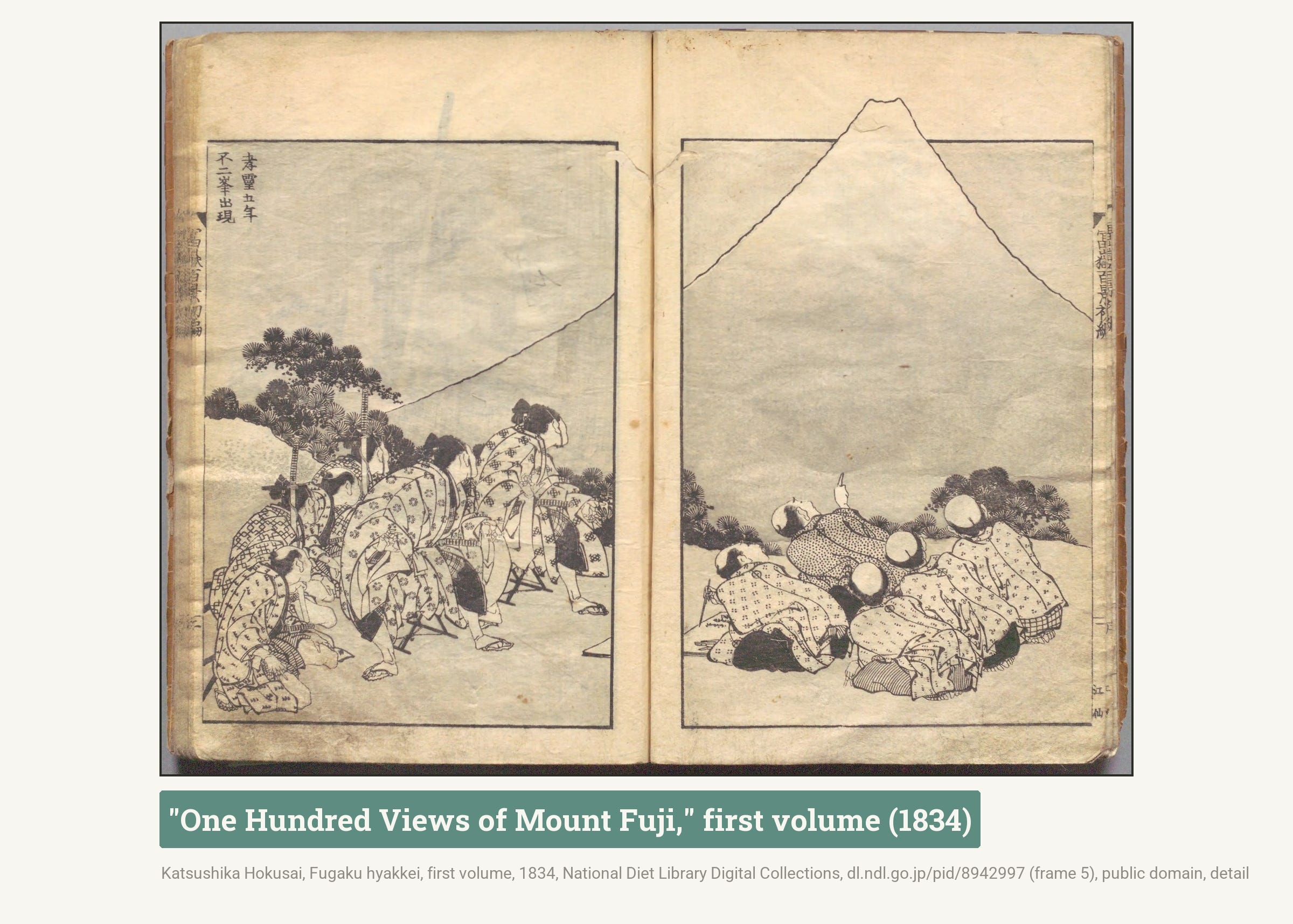
This advertisement is known to have kept appearing every year after that, until 1835.³ In 1834, the first volume of “One Hundred Views of Mount Fuji,” an illustrated book that could be called a sequel of sorts, came out.
The blue the advertisement speaks of is an artificial pigment, born in Berlin, that entered Japan through the port of Nagasaki. In English it is called Prussian blue; in Japanese today it is called “bero-ai.” I have told the story of this blue in another article, “Hokusai’s Blue Came from Berlin”.
Prints of famous places were not strong sellers
At the time, the popular color woodblock prints in Edo were prints of kabuki actors and prints of beautiful women. Actor prints above all. Prints of famous places, that is, pictures of landscapes, were a far less visible field, and publishers did not put much effort into them.⁵
A later picture shows the front of a print shop, a store that sold woodblock prints. Actor prints hang in the most eye-catching spot, prints of beautiful women come next, and prints of famous places are off in a corner.⁷
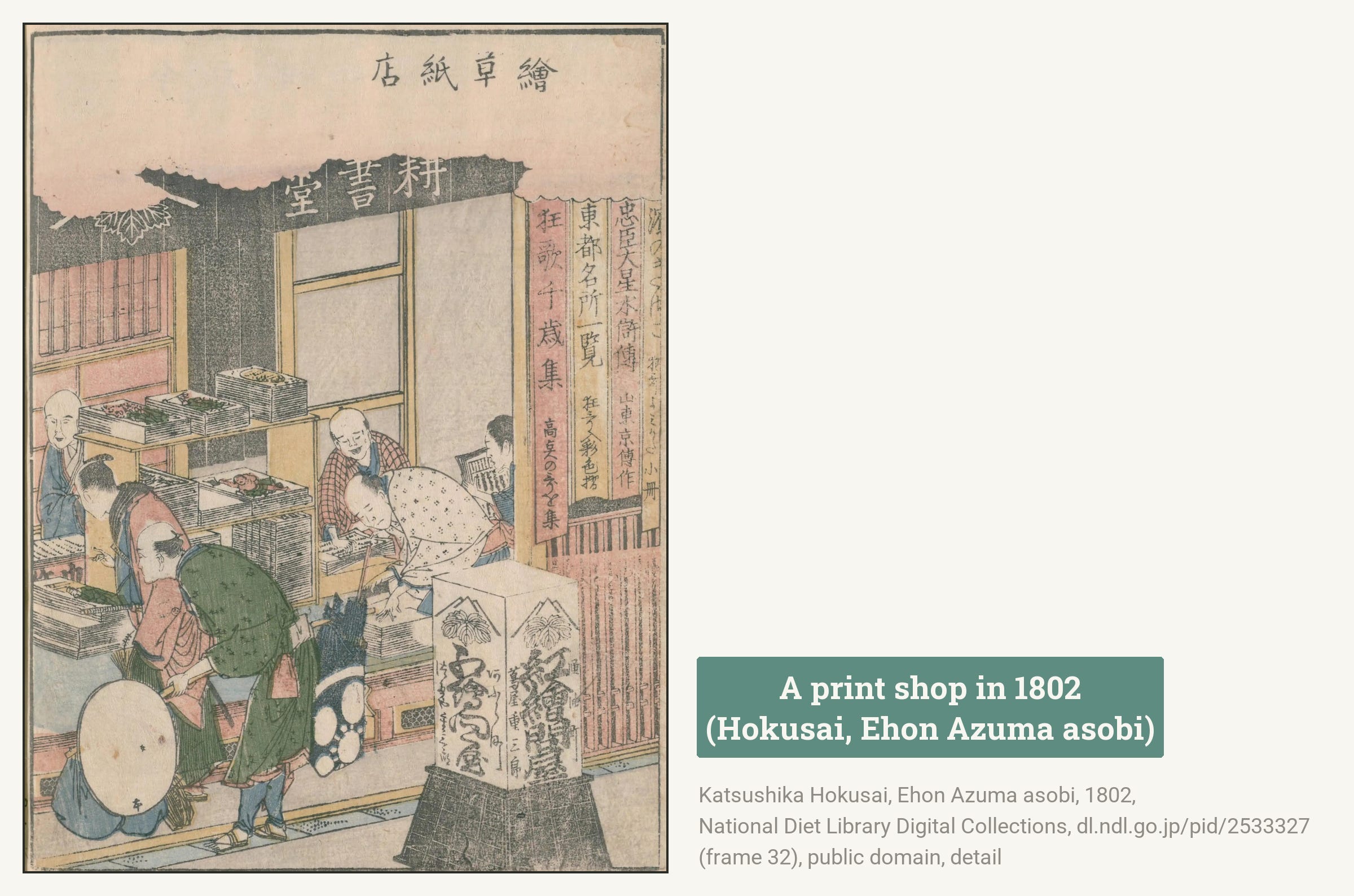
Then this series became a great hit. In his book of recollections, Masaki no Katsura, Seisōdō Tōho, a man who lived through those years, wrote the following after describing the craze for round-fan prints in a single blue. Eijudō printed Hokusai’s Fuji in the same blue and issued it. “This too was a great hit, twice that of the fans.”³
Ōkubo Jun’ichi calls this a “landmark event.” Prints of famous places could sell perfectly well. Publishers and other artists would surely have seen that, he says.⁵
The ground had been prepared. The highways were in good order, people had more to spare in their daily lives, and interest in travel and famous places was rising. From 1780 on, guidebooks to famous places came out one after another, and in 1802 a comic novel about a journey along the Tōkaidō was a great hit.⁵ The Fuji kō, associations whose members worshipped Mount Fuji as a god and climbed it together to pray, were also thriving.²
Even so, a large series of 36 prints was a risky venture: if it did not sell, the loss would be heavy, and ordinarily it was not a business to take on lightly. That the series could boldly put “thirty-six” in its title from the start was probably because of the pairing of the master Hokusai and the long-established Eijudō, Ōkubo Jun’ichi writes.¹ Had Hokusai not been the one to draw it, Eijudō would not have taken on the venture either, he adds.⁵
Five groups by signature, and no settled order
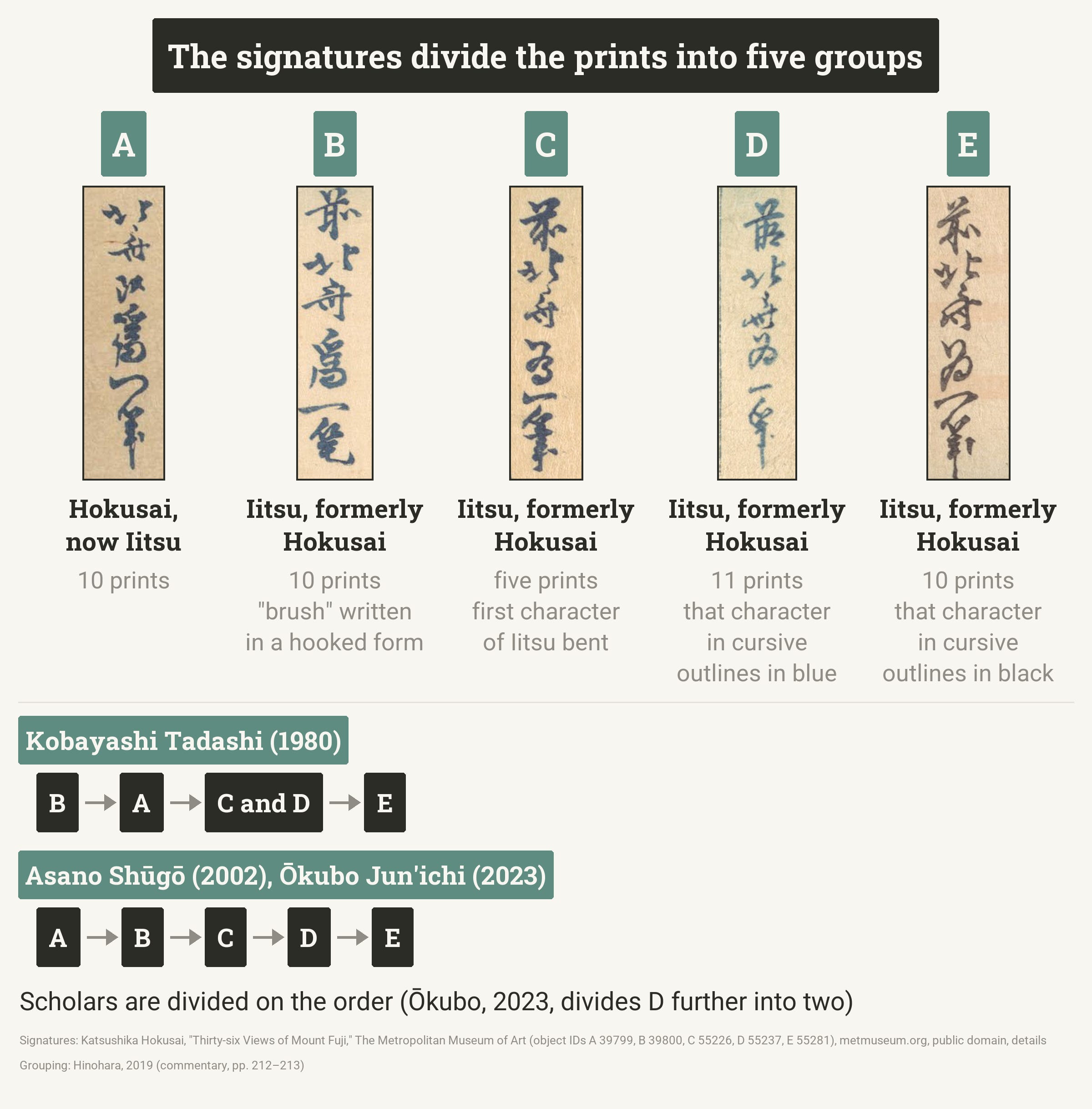
All 46 prints carry Hokusai’s signature. By the form of the characters, they can be divided into five groups.³
A: signed “Hokusai, now Iitsu,” 10 prints (including the famous print of the great wave and the print of the red Fuji) - B: signed “Iitsu, formerly Hokusai,” with the character for “brush” written in a hooked form, 10 prints (printed in blue alone, or nearly so) - C: signed “Iitsu, formerly Hokusai,” with the first character of “Iitsu” written in a bent form, five prints - D: the same signature, with that character in cursive, and outlines printed in blue, 11 prints - E: the same signature, with that character in cursive, and outlines printed in black, 10 prints
Which group came first? Here the scholars are divided.
The scholar Kobayashi Tadashi sees B as the first. That is because B’s 10 blue prints are the closest match to the advertisement’s prints in blue. His order, set out in 1980, is B, A, C and D, E.³
The scholar Asano Shūgō sees A as the first. That is because, set beside Hokusai’s other works of the same years, the signature moves naturally from “Hokusai, now Iitsu” to “Iitsu, formerly Hokusai.” His order, set out in 2002, is A, B, C, D, E.³
Smith takes Kobayashi’s side, and divides B further into two. He puts the five printed in blue alone in late autumn of 1830, and the five with pale red and green added at the New Year of 1831. After them, he proposes, came the group with the great wave and the red Fuji.⁶
Hinohara Kenji wrote in 2019 that there was still no clear conclusion as to which is the more certain.³
In his 2012 book, Ōkubo Jun’ichi writes that Asano’s view has been gaining support. In his 2023 book, he divides D’s 11 prints further into two by the form of the character for “formerly,” making six groups, and offers as his own proposal the order A, B, C, the two halves of D, and then the 10 prints with black outlines. In the same book he also calls the question “a maze to which no complete answer may ever be found.”¹
Prints without seals, and the album hypothesis
Woodblock prints of the time ordinarily carry two seals. One is the censor’s seal, a seal with the character kiwame (極), “approved,” showing the print had passed inspection; the other is the seal of the publisher.
Yet 24 of the 46 prints have no such seals.¹ The 10 prints of group A, the famous print of the great wave among them, lack both.² A publisher’s seal was an advertisement that the print came from that shop. There was no reason to leave it off.
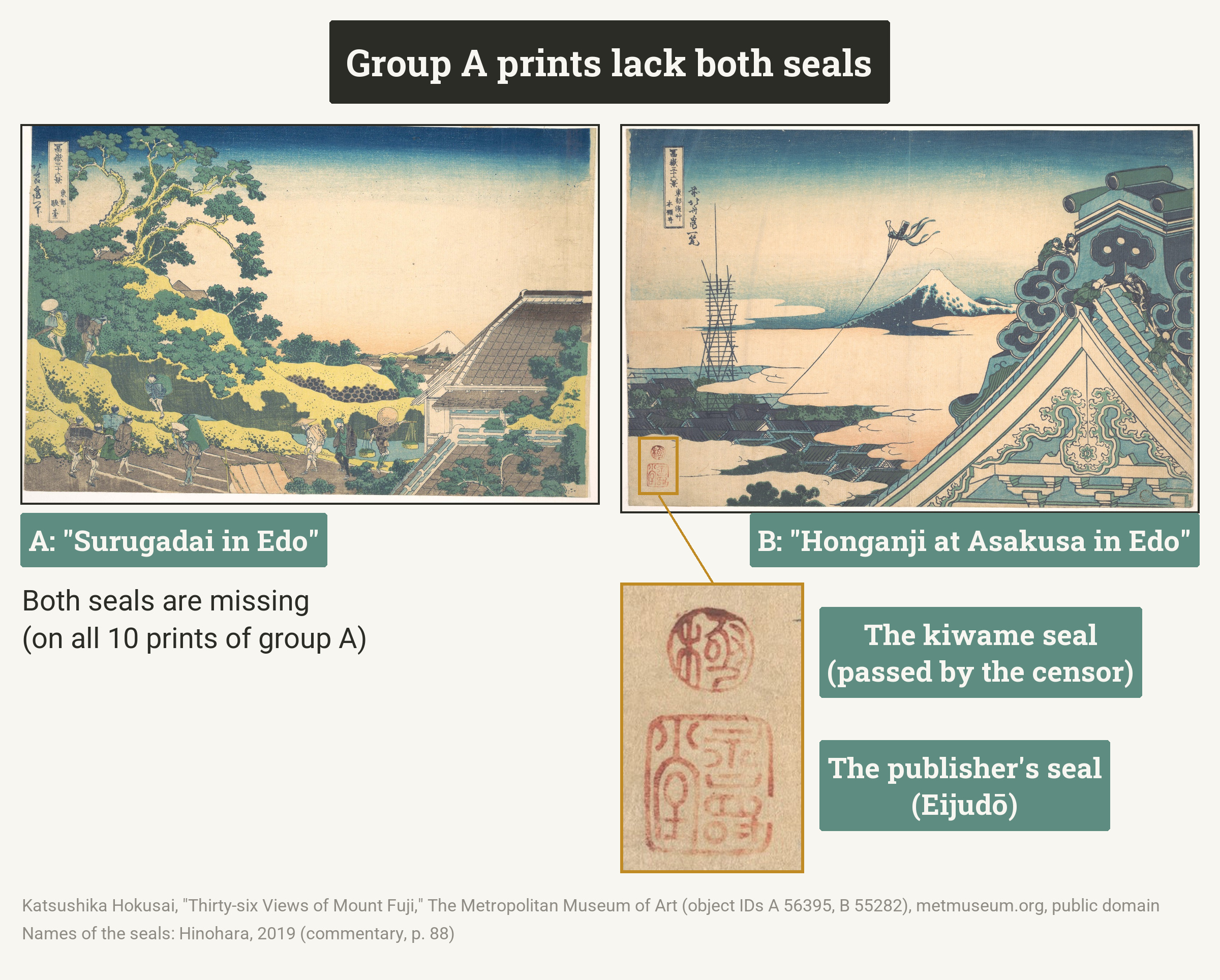
Ōkubo Jun’ichi reasons as follows. Might the 10 prints of group A have been passed by the censor together, rather than one by one? If they were meant to come out not as loose single-sheet prints but as an album, several prints bound together as one volume, then the absence of seals on each sheet would not be strange. Might “Eight Forms of Mount Fuji,” which ended as an announcement, also have been planned as an album?¹,²
There is a precedent. “Eight Views of Edo,” a series by the artist Utagawa Toyohiro that was first issued as an album, has neither the publisher’s seal nor the censor’s seal on its pictures, and some even lack a signature.¹
The presence of unfamiliar places can be explained along the same lines. A print of a place that is not famous is hard to sell on its own. If the whole set was to be bound into an album and sold together once it was complete, that worry would weigh less.⁵
Ōkubo himself cautions that this album idea is a somewhat bold hypothesis.⁵
The 10 prints after the 36
After the 36 came out, 10 more were added in response to their popularity. That is group E. They are called “Ura Fuji,” literally “the back of Fuji,” but that does not mean pictures of Fuji seen from behind.⁴
What tells them apart is the outlines. In the first 36, the outlines are printed in blue. In the 10 that were added, they are black.³,⁴
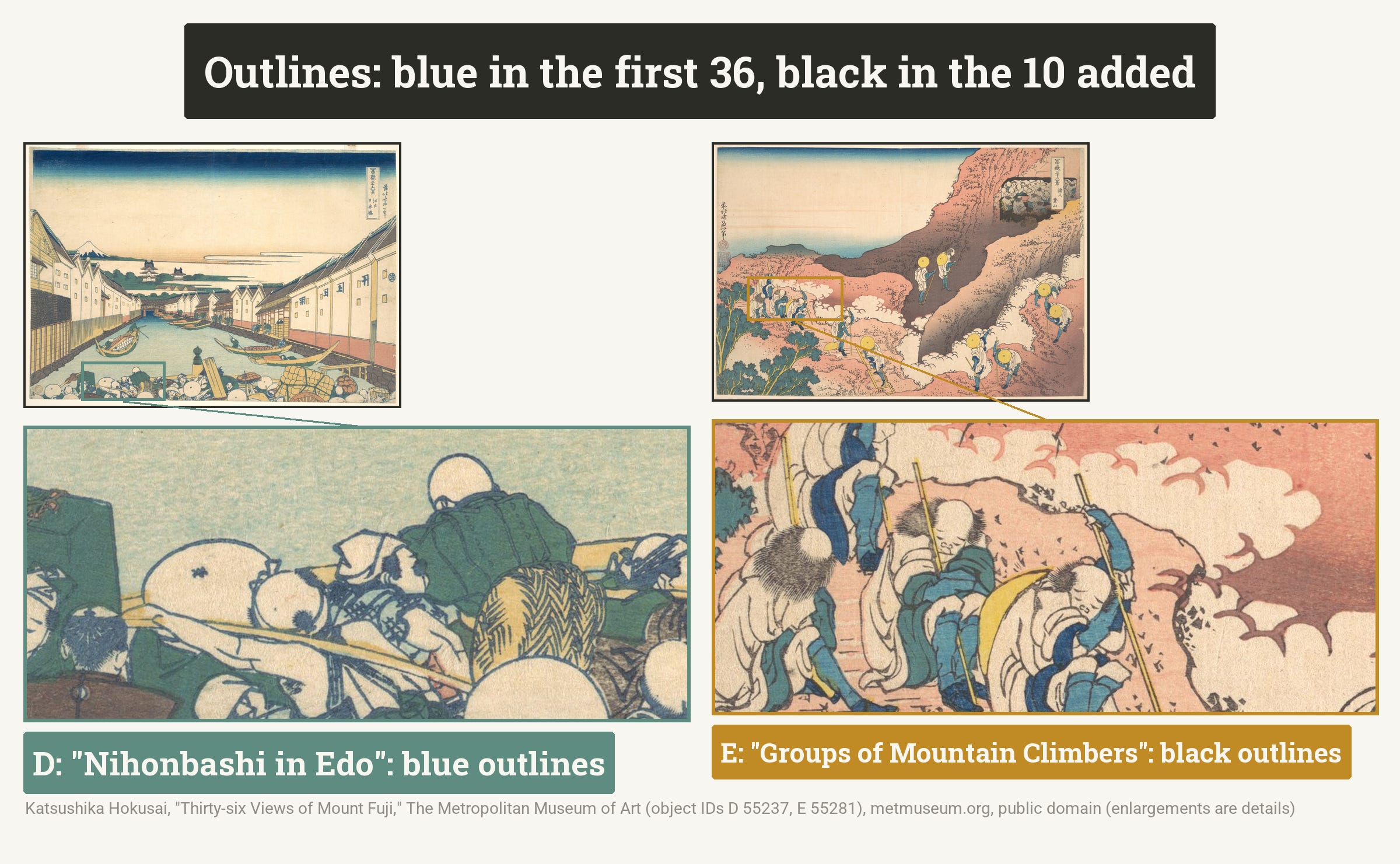
It is not clear when the 10 came out. They were long thought to have been finished by 1833, but publication may have continued into early 1834.¹
That 10 prints were added at all. That, Ōkubo writes, is evidence that the series succeeded as a venture.⁵
Still, the series stopped at 46. Trouble at the publisher is one candidate for the reason. In the spring of 1836, the novelist Kyokutei Bakin wrote about the publisher, Nishimuraya, in a letter. It was short of money and had been unable to have woodblocks carved for a long time; the year before, it had seemed about to close its doors, but it had arranged to pay off its debts year by year and was somehow carrying on.⁸ Whether the series ended at 46 because of the publisher, because of sales, or because of Hokusai himself is not clear, the scholar Nagata Seiji cautions.⁸ Nor is it known whether 46 is the finished form or a series left unfinished.¹
It sold for a long time
How well did it sell? There is a yardstick for how woodblock prints of the time sold. According to a letter by Bakin from 1841, publishers stopped printing even a print that sold well at about 2,000 impressions, and the usual run was 1,000 or 1,500.⁷
Prints of famous places sold differently. For actor prints, the time to sell was only while the play was on stage. Actor prints, sold off in a short time, rarely include impressions pulled after the blocks had worn. “Thirty-six Views of Mount Fuji” has quite a few impressions with worn, broken lines. That is because it did not sell explosively in a short time, but was printed again and again over many years, as Ōkubo sees it.⁷ The scenery of famous places, unlike a play, does not change quickly.
No comparable series on the subject of Fuji came out for a long time afterward. The first complete one came in 1852, after Hokusai’s death, about 20 years later.⁷ While a bestselling series was on the market, publishers traded stock with one another and could put it in their own shops, so there was little need to go to the trouble of making something similar.⁷
What came after
Hokusai went on to issue a series on waterfalls and a series on bridges. That was around 1833 to 1834.¹
Until then, a series of prints of famous places had depicted a single region, as in “eight views of Edo.” Hokusai built each series around a single subject: Fuji, waterfalls, bridges. Later the artists Utagawa Kuniyoshi and Utagawa Hiroshige both followed Hokusai’s lead and produced 36 views of Fuji of their own.²
Seeing the great hit that “Thirty-six Views of Mount Fuji” had become, other artists and publishers moved into prints of famous places. Hiroshige’s great hit with his series on the Tōkaidō came soon after.²
The advertisement of 1831 had said that if blocks continued to be carved in this way, the prints would go past a hundred.
The series ended at 46 prints.
In the spring of 1834, Hokusai brought out the first volume of the illustrated book “One Hundred Views of Mount Fuji.” This time, the title said “a hundred.” It was a book without color, printed in black and pale gray ink.¹ At the end of the volume is a signature reading “aged seventy-five,” that is, in his seventy-fifth year by the traditional Japanese count.⁸
I think most Japanese people have heard the name “Thirty-six Views of Mount Fuji” by Katsushika Hokusai somewhere. Learning that even prints as famous as these started out in a genre that wasn’t very popular made me feel that you never know until you try.
How I researched this
The three people who have written in detail about how this series came to be are Ōkubo Jun’ichi, Hinohara Kenji, and Nagata Seiji. Of Ōkubo’s books, I read those of 2005, 2012, 2013, 2022, and 2023. Even with the same author, the view shifts from book to book. His 2005 book puts the start of publication at 1830, or the following year at the latest. His 2012 book says that Asano’s view, that the first 10 prints came out at the end of the 1820s, has been gaining support. His 2023 book offers his own proposal for the order, then calls the question a maze. In the text, I cited each with its year.
I have not read Kobayashi Tadashi’s or Asano Shūgō’s own writings on their views directly. I am relying on the accounts given by Hinohara and Ōkubo. Bakin’s letters I read in Nagata’s paper. Nishimuraya’s troubles themselves are also described in Ōkubo’s 2023 book. The reading that puts the end at 46 down to the publisher is Nagata’s alone.
The album idea is Ōkubo’s hypothesis alone. For the year Hyaku Fuji came out, one book gives 1771 and another 1767. In the text I have said “the second half of the 18th century.”
There is a question of whether this series should be called “landscape painting” at all. The advertisement said the prints would be useful to those learning to paint sansui. In this view, they were models showing the varied shapes of Fuji, published for a different purpose from prints of famous places. The viewpoints of the red Fuji and the Fuji with lightning cannot be identified, and the famous print of the great wave is out at sea, so they do not hold up as prints of famous places. The very idea of “landscape painting,” Nagata Seiji writes, is a modern one.⁸ Kobayashi Tadashi writes that he was inspired by this view of Nagata’s, and on Hiroshige’s side he sees the tradition of prints of famous places: places made famous by classical poetry, and pictures of the four seasons.⁹ In this article I have leaned to neither side and simply called it a “series.”
The images of the prints are those made public by the Metropolitan Museum of Art in New York¹⁰ and by the National Diet Library, Japan’s national library (public domain).¹¹,¹²,¹³,¹⁴,¹⁵
Notes
Japanese names in this article are written in the Japanese order, family name first (Katsushika Hokusai, Ōkubo Jun’ichi).
The print of the great wave is “Under the Wave off Kanagawa,” the print of the red Fuji is “South Wind, Clear Sky,” and the Fuji with lightning is “Storm below Mount Fuji” (the English titles used by the Metropolitan Museum of Art).
Kobayashi Tadashi’s view of 1980 and Asano Shūgō’s view of 2002 are given as Hinohara Kenji describes them (note 3).
The English titles below are my own translations of the Japanese titles, given for convenience. The original Japanese details follow each.
References
¹ Katsushika Hokusai: The Master Who Perfected the Ukiyo-e Landscape Print (2023) — 大久保純一『葛飾北斎 浮世絵風景画の大成者』山川出版社(日本史リブレット人 055)・2023
² Hokusai: The World of Nisshin Joma Zu, the Daily Exorcisms (2022) — 九州国立博物館 編・著『北斎 HOKUSAI 日新除魔図の世界』講談社・2022(総論=大久保純一)
³ Hokusai: Thirty-six Views of Mount Fuji (2019) — 日野原健司 編『北斎 富嶽三十六景』岩波文庫・2019
⁴ Hokusai’s Thirty-six Views of Mount Fuji: A Thousand Variations (2005) — 大久保純一『千変万化に描く 北斎の冨嶽三十六景』小学館・2005
⁵ Hokusai, Color Edition (2012) — 大久保純一『カラー版 北斎』岩波書店・2012
⁶ The “Blue Revolution” in Ukiyo-e (1998) — ヘンリー・スミス「浮世絵における『ブルー革命』」樋口一貴 訳・『浮世絵芸術』128 号・1998
⁷ On Ukiyo-e Publishing: “Art” Mass-Produced and Mass-Consumed (2013) — 大久保純一『浮世絵出版論 大量生産・消費される〈美術〉』吉川弘文館・2013
⁸ A Study of “One Hundred Views of Mount Fuji” (Unfinished Draft) (2008) — 永田生慈「『富嶽百景』考(未定稿)」2008=『北斎絵手本集成 別巻 富嶽百景』芸艸堂・2022 所収
⁹ Reading Edo Ukiyo-e (2002) — 小林忠『江戸浮世絵を読む』筑摩書房(ちくま新書)・2002
¹⁰ Images of the 46 prints of “Thirty-six Views of Mount Fuji” — The Metropolitan Museum of Art, New York (object IDs in each figure’s credit line); public domain
¹¹ Imayō kushi kiseru hinagata, a book of designs for combs and pipes, 1841 edition — 葛飾北斎『今様櫛[キセル]雛形』1841・国立国会図書館デジタルコレクション pid 2538736(パブリックドメイン)
¹² Hyaku Fuji, by Kawamura Minsetsu — 河村岷雪『百富士』・国立国会図書館デジタルコレクション pid 14672814・14672815(パブリックドメイン)
¹³ Chochora chomonjū, first series (1832), with the advertisement at the back — 曲亭馬琴『千代褚良著聞集』第 1 輯・1832・国立国会図書館デジタルコレクション pid 10303724(パブリックドメイン)
¹⁴ Ehon Azuma asobi (1802), with a picture of a print shop — 浅草庵 作・葛飾北斎 画『画本東都遊』1802・国立国会図書館デジタルコレクション pid 2533327(パブリックドメイン)
¹⁵ One Hundred Views of Mount Fuji, first volume (1834) — 葛飾北斎『富岳百景』初編・1834・国立国会図書館デジタルコレクション pid 8942997(パブリックドメイン)
Video credits
Old pictures: Thirty-six Views of Mount Fuji, by Katsushika Hokusai (ca. 1830–32), all 46 prints, with a second impression of Ushibori in Hitachi Province (JP1848) — The Metropolitan Museum of Art; Kirifuri Waterfall at Kurokami Mountain in Shimotsuke, from A Tour of Waterfalls in Various Provinces, by Katsushika Hokusai (ca. 1832) — The Metropolitan Museum of Art; The Arched Bridge at Kameido Tenjin Shrine, from Remarkable Views of Bridges in Various Provinces, by Katsushika Hokusai (ca. 1830) — The Metropolitan Museum of Art; One Hundred Views of Mount Fuji (富嶽百景), a later printing (ca. 1849) — The Metropolitan Museum of Art; Eight Views of Edo (江戸八景), an album by Utagawa Toyohiro — The Metropolitan Museum of Art; View of Mount Fuji from Seven-ri Beach, Province of Sagami, from Thirty-six Views of Mount Fuji, by Utagawa Hiroshige (1858) — The Metropolitan Museum of Art; Sudden Shower at Shōno, from Fifty-three Stations of the Tōkaidō, by Utagawa Hiroshige (1834–35) — The Metropolitan Museum of Art; Satta Peak in Suruga Province, from Thirty-six Views of Mount Fuji, by Utagawa Hiroshige (1852) — Art Institute of Chicago; The Actor Ichikawa Ebizo IV as Takemura Sadanoshin, by Tōshūsai Sharaku (1794) — Art Institute of Chicago; Takashima Ohisa, by Kitagawa Utamaro (ca. 1793) — Art Institute of Chicago; Imayō kushi kiseru hinagata (今様櫛[キセル]雛形, 1841 edition), by Katsushika Hokusai — National Diet Library, pid 2538736; Hyaku Fuji (百富士), by Kawamura Minsetsu — National Diet Library, pid 14672814 and 14672815; Chochora chomonjū (千代褚良著聞集, 1832), by Kyokutei Bakin — National Diet Library, pid 10303724; a print shop, from Ehon Azuma asobi (画本東都遊, 1802), by Katsushika Hokusai — National Diet Library, pid 2533327; One Hundred Views of Mount Fuji, first volume (富岳百景, 1834), by Katsushika Hokusai — National Diet Library, pid 8942997; a portrait of Katsushika Hokusai, from Katsushika Hokusai den (葛飾北斎伝, 1893), by Iijima Kyoshin — National Diet Library, pid 992198; a portrait of Kyokutei Bakin, from Shōzō oyobi denki (肖像及伝記, undated) — National Diet Library, pid 898641. All in the public domain. “Mount Fuji on a Fine Day Seen from the Sea off Tsukudajima,” from Thirty-Six Views of Mount Fuji from the Eastern Capital, by Utagawa Kuniyoshi, Tokyo National Museum — Created based on the information available on ColBase (https://colbase.nich.go.jp/collection_items/tnm/A-10569-2535). Pictograms: ICOOON MONO, Silhouette Illust, and Material Symbols. Map outlines: Natural Earth.
Music: “Seoto” (瀬音) by Miyagi Michio (1894–1956), in the public domain, newly arranged for this video.
The Stories Behind Old Japan brings you stories of old Japan, drawn from Japanese-language books, researched by hyt, who lives in Japan, and edited and translated with help from AI.
The story of a single print of people climbing Mount Fuji: The Mount Fuji Print with No Mount Fuji in It


