

There is a picture of a timber yard in Edo, under falling snow.
“Timber Yard, Fukagawa” (Fukagawa kiba), by the artist Utagawa Hiroshige. It is a woodblock print, put on sale in 1856 in Edo, today’s Tokyo. A canal with logs floating in it zigzags away into the distance. Only the middle of the canal is a deep blue; toward the banks, the color grows paler.
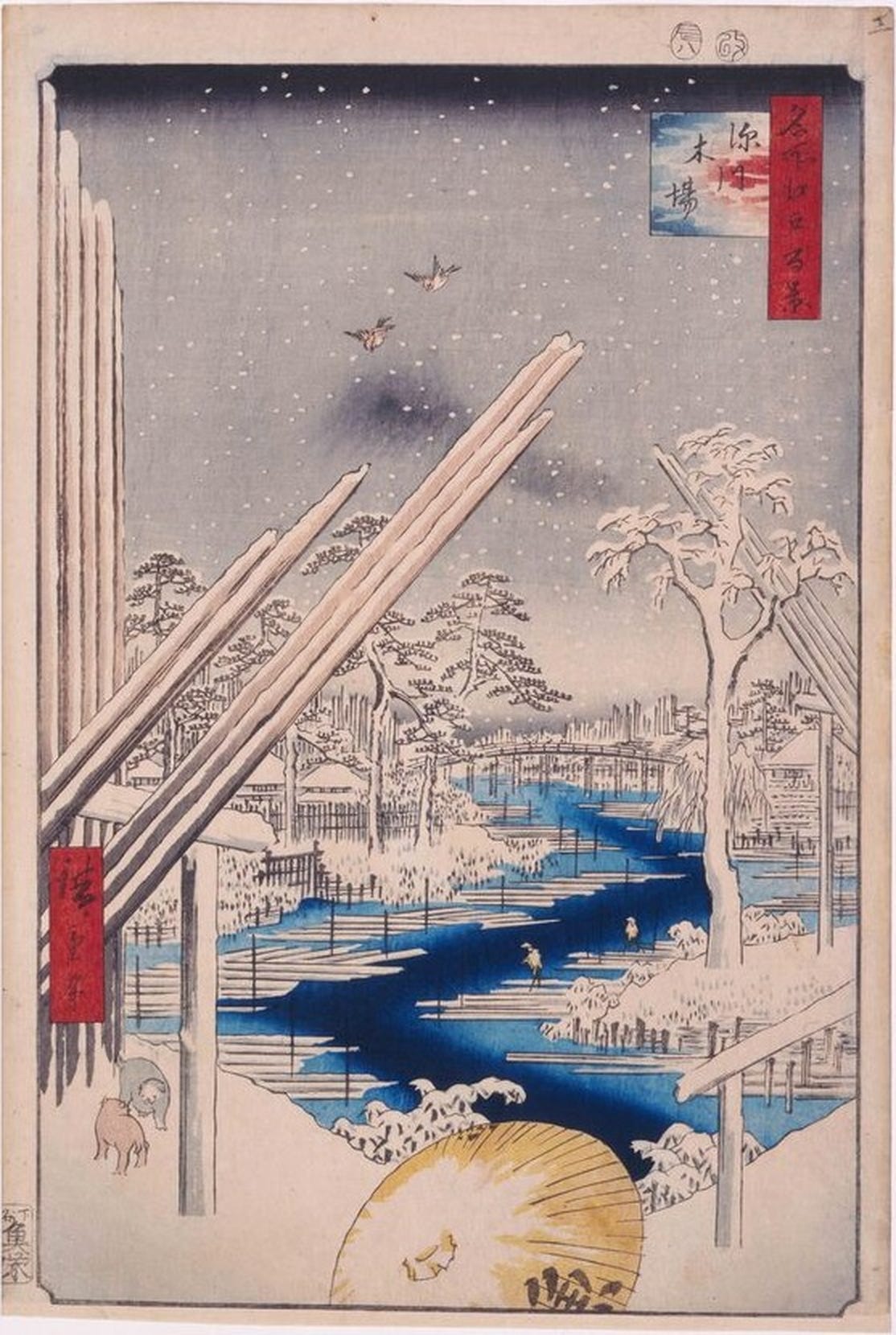
This shift from dark to light is not carved into the woodblock. The printer makes it by hand, every time an impression is pulled.
Prints built by layering areas of color struggle with gradation
Color ukiyo-e, the woodblock prints sold in the city of Edo, combine outlines in black ink with areas of color. One woodblock is carved for each color in the picture.¹ An area of color normally prints flat, in one even tone.
In a painting done with a brush, the pressure of the brush tip can give any gradation you like. There, a print cannot help falling behind. Even so, clever ways of carving and printing, possible only with woodblocks, widened the range of what a print could express.¹
One of these is “bokashi,” a smooth shading from dark to light. The color starts deep, grows gradually paler, and at last fades to nothing. That is how a 1929 book that set down the techniques of printing explains this shading.²
Two ways to do it: shade by carving, or shade by printing
There are, broadly, two ways of making this shading.¹
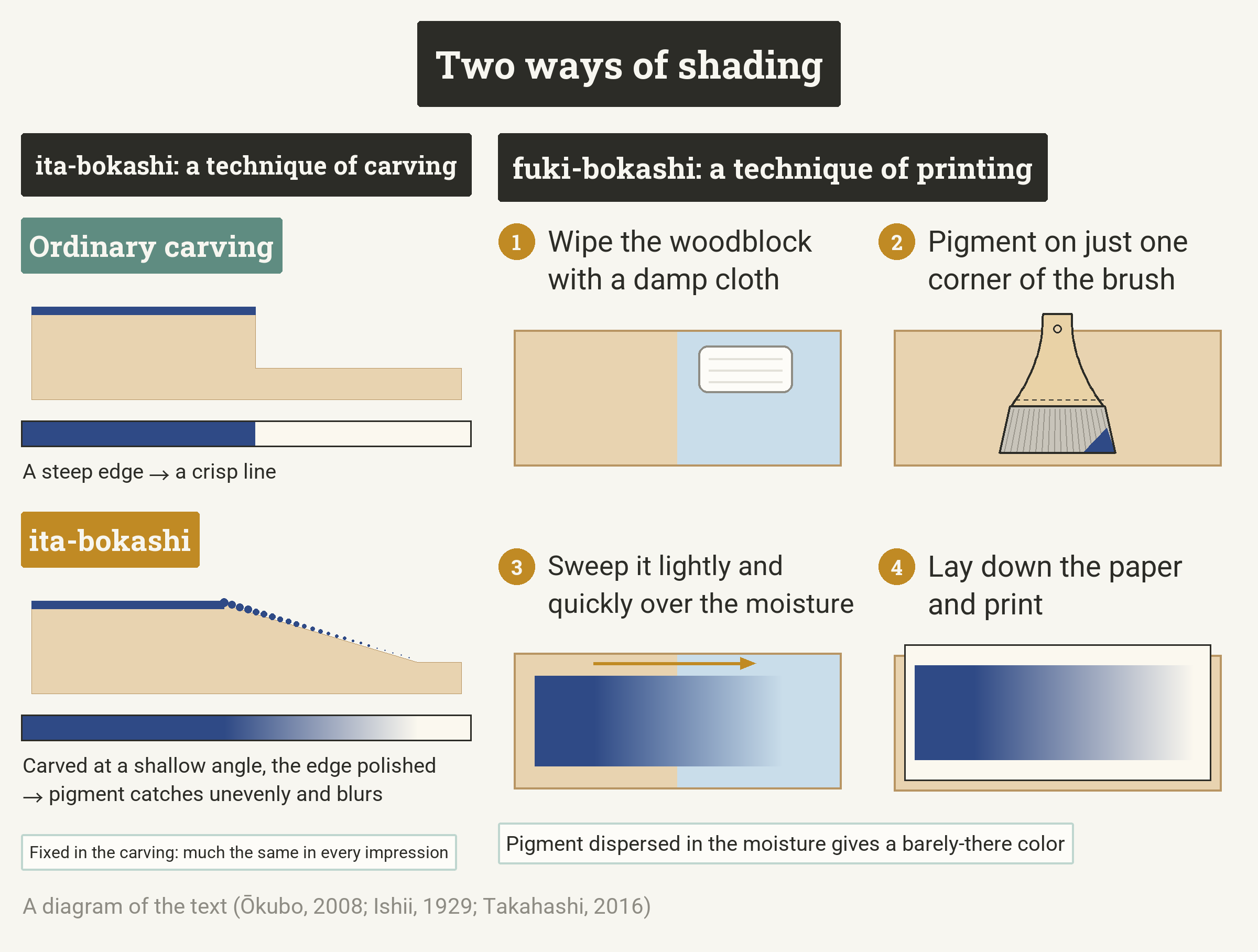
One is “ita-bokashi.” It is a technique of carving. Part of the woodblock for a color is carved at a much shallower angle than usual, and the edge is polished smooth. For the polishing, carvers used grasses that worked like sandpaper, or the leaves of trees.²,³ Pigment catches unevenly on the sloping surface, so when the block is printed, the color blurs there. Because the shading is fixed in the carving, the tone comes out much the same however many impressions are pulled. It suits the folds of rocks, the shade under trees, and fine waves.¹
The other is “fuki-bokashi.” It is a technique of printing. The printer wipes the part of the woodblock to be shaded with a damp cloth, leaving moisture on the wood. Pigment goes onto just one corner of a dampened brush, and the brush is swept across that moisture. Then the paper is laid down and the impression is taken. The pigment, dispersed in the moisture, comes out as the barely-there color of dawn or dusk.²
The brush moves lightly, and quickly. Never press hard. For some pictures, the same spot was printed over three or four times.²
Most of the shading in ukiyo-e is this fuki-bokashi.⁴
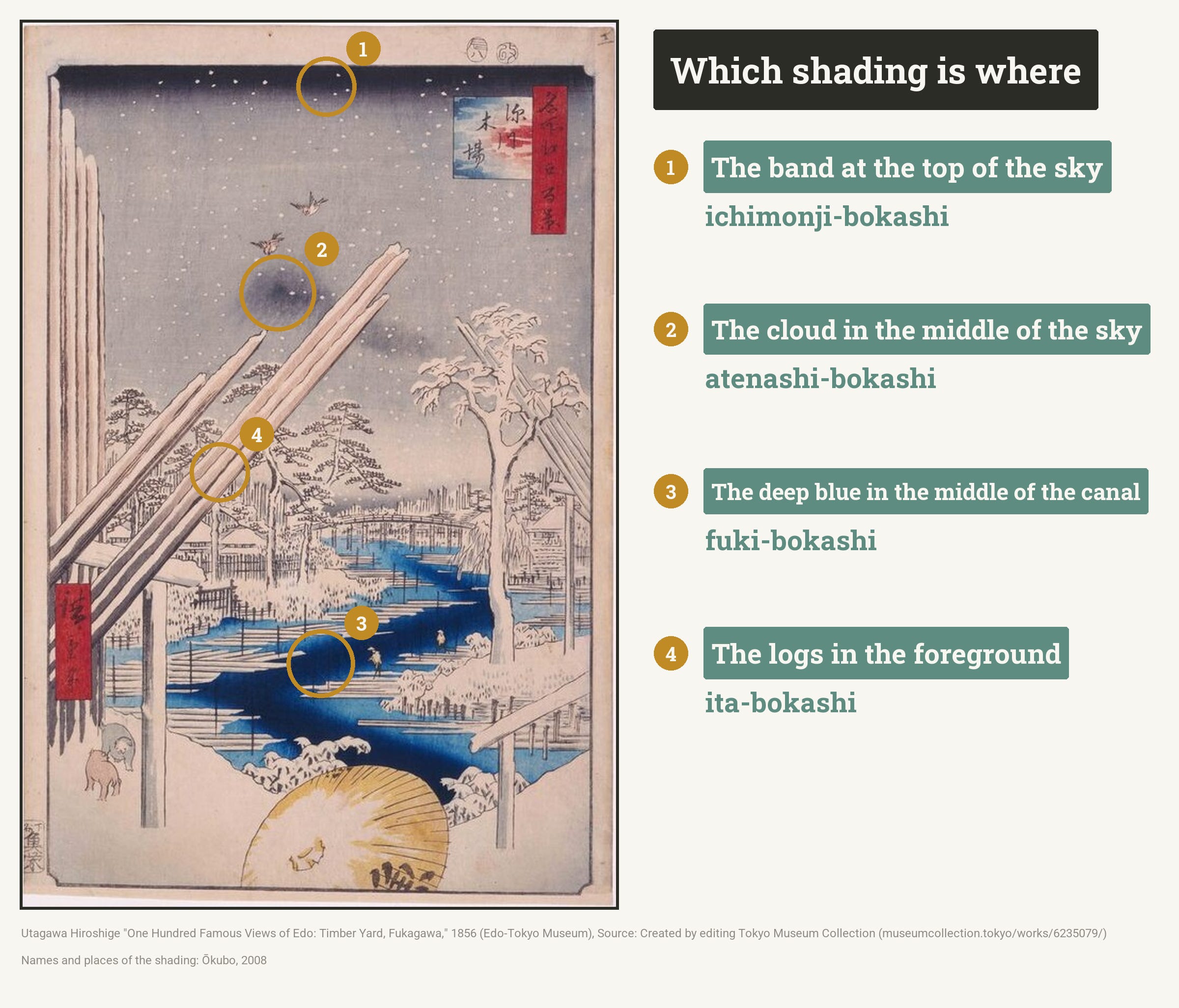
The deep blue in the middle of the canal in “Timber Yard, Fukagawa” is fuki-bokashi. On the logs in the foreground, ita-bokashi is used. Compared within the one print, fuki-bokashi has the wider range from dark to light, and the finer gradation.¹
Early examples of color printed with this fuki-bokashi appear in illustrated books of 1767 and 1774.² That is some sixty years before the 1830s, when the artists Katsushika Hokusai and Hiroshige brought out their landscape prints.
The band of blue at the very top of the sky
Look at a few ukiyo-e landscapes and you notice, at the very top of the sky, a band of deep color running straight across. A band that fades smoothly as it goes down.
This is “ichimonji-bokashi,” named for the character for “one,” a single straight stroke. It is a kind of fuki-bokashi.¹,²
Keep the width even, and finish it dead straight. It was a skill that took long practice.² Sometimes the deep part, the pale part, and the shaded part were printed in about three separate passes. After several impressions, pigment begins to creep into the shaded part. Each time, the printer wipes it off with a cloth and starts again.²
A workshop that still makes woodblock prints in Kyoto today writes that the heart of this technique is shading to the same width from the left edge of the block to the right. It comes down to a buildup of fine adjustments: how much water the cloth holds, where the paste and the pigment are placed, and the angle and pressure of the brush.⁵
Shading from the top down is called “wiping down.” Shading from the bottom of the picture up is called “wiping up.”⁴
In “Timber Yard, Fukagawa,” this band runs across the dark, snow-laden sky.
Clouds that come out different in every one of a hundred impressions
There is one more, unusual kind of shading. It is called “atenashi-bokashi.”
This shading has no carved shape at all. The printer drips a little water onto the woodblock, lets a drop of pigment fall into it, and prints wherever it spreads. So print a hundred impressions, and each of the hundred comes out a different shape.²
There is no counting on what pattern will come. The name “atenashi” means just that: no fixed rule, nothing to count on.²,⁶
The artist wrote the word “atenashi” on a test print of the outlines, marking only where it should go.² How the pigment bleeds is left largely to chance. Even so, the printer probably had a rough idea of how it would spread, writes the scholar Ōkubo Jun’ichi. That is exactly why it was often used where it could be counted on to work: ragged clouds crossing the moon, or clouds heavy with rain.¹
In “Timber Yard, Fukagawa,” the single mass of cloud floating in the middle of the sky is done this way.
How far to shade was the printer’s call
At the drawing stage, the artist marks roughly where the shading should go. How far to shade seems often to have been left to the printer.¹
Woodblocks for color from the late Edo period, in the 19th century, still survive. Written on them in black ink are the words “shade downward” and “shade upward.” They do not say how far.¹
The artist looks over the first impressions to come off the blocks. The balance of color and the degree of shading were then adjusted by the printer.¹
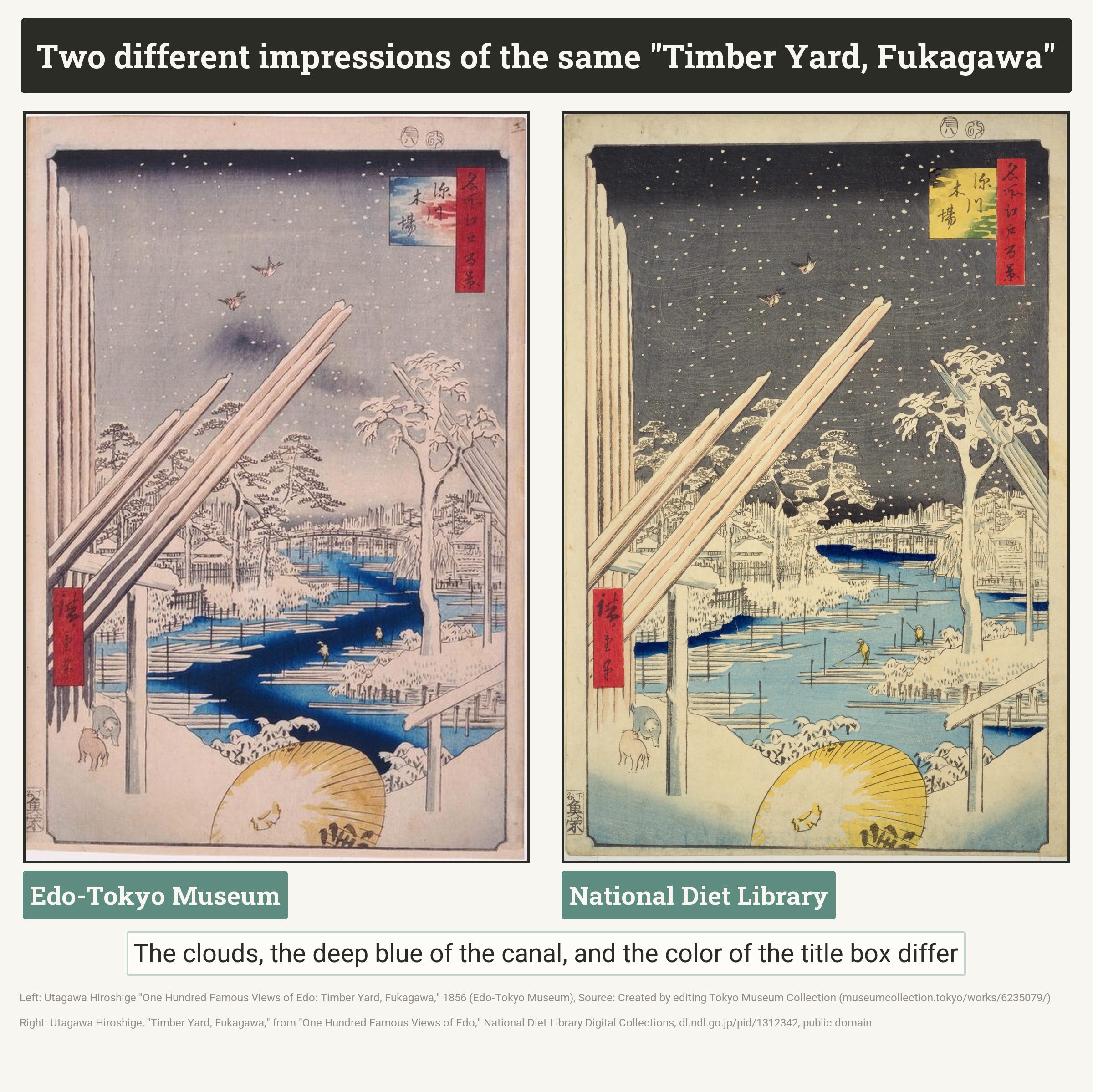
So even for the same picture, impressions pulled at different times differ in the width of the band in the sky and the depth of the shading in the water. One book sets two impressions of “Timber Yard, Fukagawa,” from different printings, side by side. Only the shading differs, and yet the whole picture feels quite different. It shows how large a part this technique played in making the ukiyo-e landscape what it was, writes Ōkubo Jun’ichi.¹
The printer has one more duty. To keep printing the same picture the same way. The Kyoto workshop of today writes that its aim is not one masterpiece, but 100 impressions that come out exactly alike.⁵
In a letter to a book publisher, Hokusai wrote this about the printing of an illustrated book. Fuki-bokashi comes out well up to about the first 200 impressions, but after that it does not.⁷ Ukiyo-e, it is said, were printed in runs of about 200 impressions. That number and Hokusai’s 200 agree.⁷
Often left out in later impressions
Fuki-bokashi takes time and effort. It adds one more step to the printing.
Woodblocks, too, wear down as printing goes on. To print 1,000 impressions, the advice was to split them into five runs of 200, resting the blocks for some days in between.²
When a print sold well, it was printed again and again from the same woodblocks. In later impressions, time-consuming steps like shading were often left out.⁷,⁸ In some cases it was replaced by the easier ita-bokashi. In Hiroshige’s series on the Tōkaidō, the highway between Edo and Kyoto, the clouds in the first print, “Nihonbashi,” are fuki-bokashi in the early impressions. In later impressions, they have been replaced with ita-bokashi.¹
Still, later impressions are not always inferior. A record kept in Edo in 1853 mentions a print for which an impression of the very finest quality was issued about a year after it first went on sale. It also records that impressions of three grades, top, middle, and ordinary, existed at the same time. The view that earlier impressions are better and later ones worse is basically not wrong, but it does not hold every time like a theorem in mathematics, writes Ōkubo Jun’ichi.⁷
Why blue worked for shading the sky and the water
Sky and water, shaded in blue. From around 1830, when a blue pigment born in Berlin came into wide use, such pictures gradually became the usual thing.¹,⁴
Until then, blue had come from plants. The blue of indigo, called “ai” in Japanese, does not dissolve in water. It has to be rubbed into the fibers of the paper, which makes it hard to print. And it does not spread on a damp woodblock, so it was not suited to shading.⁴
Then came an artificial blue pigment, born in Berlin. Prussian blue in English; “bero-ai” in Japanese today. Its color is strong, it prints easily, and it does not fade. It gives everything from the palest sky blue to a deep navy, and it shades with ease. By shading the blue of sky and sea, prints could now show what was near and what was far.⁴
Ukiyo-e are pictures without cast shadows. On a surface with no shadows, shading gave a sense of depth.⁴
Around 1829, the artist Keisai Eisen brought out a round-fan print in this one blue alone. It was printed seven or eight times over, one woodblock after another. A block for the dark outlines, two or three blocks for paler tones, and on top of that, the shading of the sky. It took the method of ink painting, which builds a picture from the dark and light of a single black ink, and carried it out in a single color, writes the scholar Henry Smith.⁹
Then Katsushika Hokusai had “Kajikazawa in Kai Province,” from his series of Mount Fuji prints, printed in shades of blue alone. From the deep blue in the foreground to the faintest blue of Mount Fuji in the distance. I have told that story in another article, “Hokusai’s Blue Came from Berlin“.
The 1929 book on printing tells this story.
A museum in Boston, in the United States, asked Japan for a full set of the tools used to make color woodblock prints, so that it could put them on display. From Japan came woodblocks, paper, pigments, and the tools for printing.
For applying the pigment: a few brushes about 3 centimeters wide. For pressing and rubbing the paper: one tool, or two. Beyond that, some rags and a few small bowls.
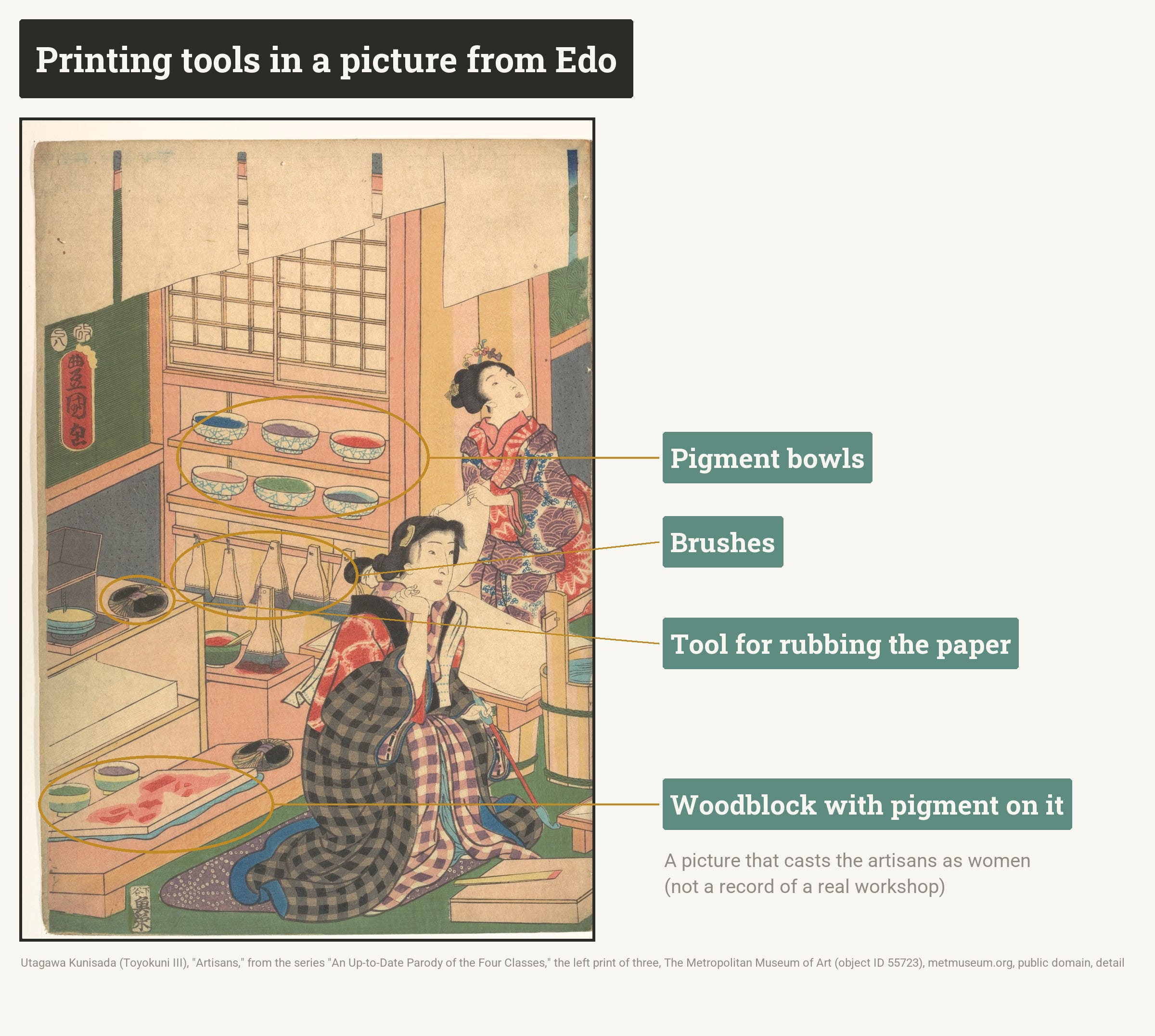
The Americans could not make sense of it. Such crude tools could not possibly produce pictures so fine. Were the Japanese, afraid of having the secrets of their craft stolen, keeping the real tools from leaving the country? Some, it is said, suspected as much.²
A damp cloth, and one corner of a brush. That is what makes the light and dark of sky and water in “Timber Yard, Fukagawa.”
In daily life today, there are not many occasions to encounter ukiyo-e, apart from seeing them in museums. But many of the techniques, worked out with the tools and skills of their own time, surprised me, and I felt there are elements in them that could still be used today.
How I researched this
The backbone of the explanation of the techniques is the chapter on the many techniques of full-color prints in Ōkubo Jun’ichi’s “Ukiyo-e, Color Edition.”¹ Over it I laid Ishii Kendō’s “Carving and Printing Full-Color Woodblock Prints,” published in 1929.² In his preface, Ishii writes that he was a collector of these prints who carved cherry woodblocks himself, tried printing, and wrote the book from several years of experiment and inquiry. The two books are far apart in years, 1929 and 2008, but on fuki-bokashi, ichimonji-bokashi, and atenashi-bokashi, their explanations agreed.
For the view from a workshop today, I drew on “Woodblock Prints” (2021), by Takezasadō, a woodblock print workshop in Kyoto.⁵ Hokusai’s letter and the story of the later impressions come from Ōkubo Jun’ichi’s “On Ukiyo-e Publishing.”⁷ Why blue can be shaded comes from the paper by Shimoyama Susumu and Matsui Hideo.⁴ This article does not go into the chemistry of the pigments.
Some books call ichimonji-bokashi “ten-bokashi,” or “sky shading.”¹⁰ One book says that fuki-bokashi in color-printed illustrated books is said to have begun with the 18th-century artist Toriyama Sekien.¹¹ Ishii Kendō lists alongside it another illustrated book, from 1767, seven years earlier than Sekien’s.² In the main text, I gave only the years of the two illustrated books.
Fine techniques like these often go unnoticed at a glance, and it is no different through the glass of a museum case. Ōkubo closes his chapter by saying that what matters is to hold the real thing in your hands and look.¹
The images of the prints are those made public by the Edo-Tokyo Museum (Tokyo Museum Collection),¹² the National Diet Library, Japan’s national library,¹³ and the Metropolitan Museum of Art in New York¹⁴ (public domain).
Notes
Japanese names in this article are written in the Japanese order, family name first (Utagawa Hiroshige, Ōkubo Jun’ichi).
“Timber Yard, Fukagawa” is one of Hiroshige’s “One Hundred Famous Views of Edo”; its English title is the one used by the Edo-Tokyo Museum.
The record of 1853 is the Fujiokaya nikki, a diary kept by an Edo bookseller, as Ōkubo Jun’ichi describes it (note 7).
The English titles below are my own translations of the Japanese titles, given for convenience. The original Japanese details follow each.
References
¹ Ukiyo-e, Color Edition (2008) — 大久保純一『カラー版 浮世絵』岩波書店・2008
² Carving and Printing Full-Color Woodblock Prints (1929) — 石井研堂『錦絵の彫と摺』芸艸堂・1929
³ A Dictionary for Enjoying Ukiyo-e (2016) — 高橋克彦『浮世絵鑑賞事典』角川ソフィア文庫・2016
⁴ A Study of the Blue Colorants Used in Ukiyo-e Prints (2006) — 下山進・松井英男「浮世絵版画に使用された青色着色料の研究」『文化財情報学研究』第 3 号・吉備国際大学文化財総合研究センター・2006
⁵ Woodblock Prints: Traditional Techniques and Their Designs (2021) — 竹中健司・米原有二『木版画 伝統技法とその意匠』誠文堂新光社・2021
⁶ An Illustrated Anatomy of Ukiyo-e (2020) — 牧野健太郎『浮世絵の解剖図鑑』エクスナレッジ・2020
⁷ On Ukiyo-e Publishing: “Art” Mass-Produced and Mass-Consumed (2013) — 大久保純一『浮世絵出版論 大量生産・消費される〈美術〉』吉川弘文館・2013
⁸ THE Hokusai: Thirty-six Views of Mount Fuji ARTBOX (2020) — すみだ北斎美術館 編・著『THE 北斎 冨嶽三十六景 ARTBOX』講談社・2020
⁹ The “Blue Revolution” in Ukiyo-e (1998) — ヘンリー・スミス「浮世絵における『ブルー革命』」樋口一貴 訳・『浮世絵芸術』128 号・1998
¹⁰ Hiroshige: One Hundred Famous Views of Edo (2017) — 太田記念美術館 監修『広重 名所江戸百景』美術出版社・2017
¹¹ A History of Ukiyo-e: The World of Prints of Beautiful Women and Actor Prints (2017) — 山口桂三郎『浮世絵の歴史 美人絵・役者絵の世界』講談社学術文庫・2017
¹² Image of “Timber Yard, Fukagawa” (the main image and the figures in the opening and in the section on the printer’s call) — Utagawa Hiroshige “One Hundred Famous Views of Edo: Timber Yard, Fukagawa” (Edo-Tokyo Museum), Source: Created by editing Tokyo Museum Collection (https://museumcollection.tokyo/works/6235079/)・資料番号 83200107(パブリックドメイン)
¹³ Image of another impression of “Timber Yard, Fukagawa” (the figure in the section on the printer’s call) — 歌川広重「名所江戸百景 深川木場」1856・国立国会図書館デジタルコレクション pid 1312342(パブリックドメイン)
¹⁴ Image of “Artisans,” from the series “An Up-to-Date Parody of the Four Classes,” by Utagawa Kunisada (the last figure) — 歌川国貞「今様見立士農工商 職人」・The Metropolitan Museum of Art, New York(object ID 55723)・public domain
Video credits
Old pictures: Timber Yard, Fukagawa, from One Hundred Famous Views of Edo, by Utagawa Hiroshige (1856) — Edo-Tokyo Museum, created by editing Tokyo Museum Collection (https://museumcollection.tokyo/works/6235079/); Sudden Shower over Shin-Ōhashi Bridge and Atake, from One Hundred Famous Views of Edo, by Utagawa Hiroshige (1857), four impressions — The Metropolitan Museum of Art (JP643, JP2522) and Art Institute of Chicago (1925.3742, 1981.1206); Night View of Saruwaka-machi, from One Hundred Famous Views of Edo, by Utagawa Hiroshige (1856) — Art Institute of Chicago; Twilight Moon at the Ryogoku Bridge, from Famous Views of the Eastern Capital, by Utagawa Hiroshige (c. 1831), two impressions (1939.1387, 1943.718) — Art Institute of Chicago; Nihon Bridge: Morning Scene, from Fifty-three Stations of the Tokaido Road, by Utagawa Hiroshige (c. 1833/34) — Art Institute of Chicago; Sudden Shower at Shōno, from Fifty-three Stations of the Tōkaidō, by Utagawa Hiroshige (1834–35) — The Metropolitan Museum of Art; View of Mount Fuji from Seven-ri Beach, Province of Sagami, from Thirty-six Views of Mount Fuji, by Utagawa Hiroshige (1858) — The Metropolitan Museum of Art; South Wind, Clear Sky (Red Fuji), Shichirigahama in Sagami Province, Tsukudajima in Musashi Province, and Kajikazawa in Kai Province (JP2986), from Thirty-six Views of Mount Fuji, by Katsushika Hokusai (ca. 1830–32) — The Metropolitan Museum of Art; Sekien gafu (石燕画譜, 1774), by Toriyama Sekien — National Diet Library, pid 2541893; Yūyō shokubutsu zusetsu (有用植物図説, plates vol. 1, 1891), by Tanaka Yoshio and others — National Diet Library, pid 832634; Honzō zufu (本草図譜, 1921 edition), by Iwasaki Kan’en — National Diet Library, pid 926381; a portrait of Katsushika Hokusai, from Katsushika Hokusai den (葛飾北斎伝, 1893), by Iijima Kyoshin — National Diet Library, pid 992198. All in the public domain. “Ushigafuchi Moat at Kudanzaka Hill,” by Katsushika Hokusai, and “Autumn and Winter Landscapes” (the winter scroll), by Sesshū Tōyō, Tokyo National Museum — Created based on the information available on ColBase (https://colbase.nich.go.jp/collection_items/tnm/A-10569-636, https://colbase.nich.go.jp/collection_items/tnm/A-1398). Pictograms: ICOOON MONO, Silhouette Illust, and Icon-pit.
Music: “Seoto” (瀬音) by Miyagi Michio (1894–1956), in the public domain, newly arranged for this video.
The Stories Behind Old Japan brings you stories of old Japan, drawn from Japanese-language books, researched by hyt, who lives in Japan, and edited and translated with help from AI.
The story of the blue pigment behind Hokusai’s prints: Hokusai’s Blue Came from Berlin


