

In a series of 46 prints of Mount Fuji, there is one print in which the mountain itself does not appear.
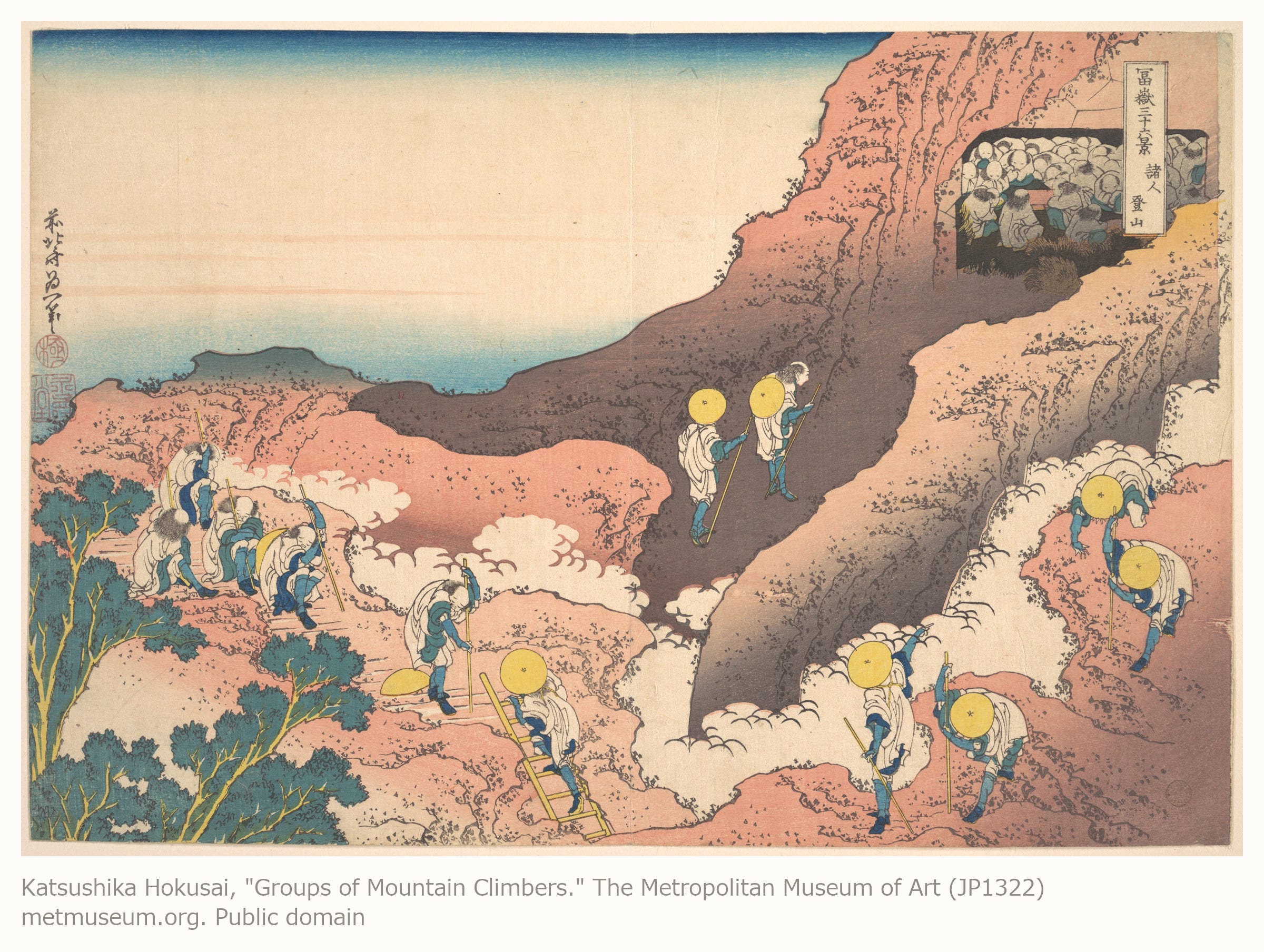
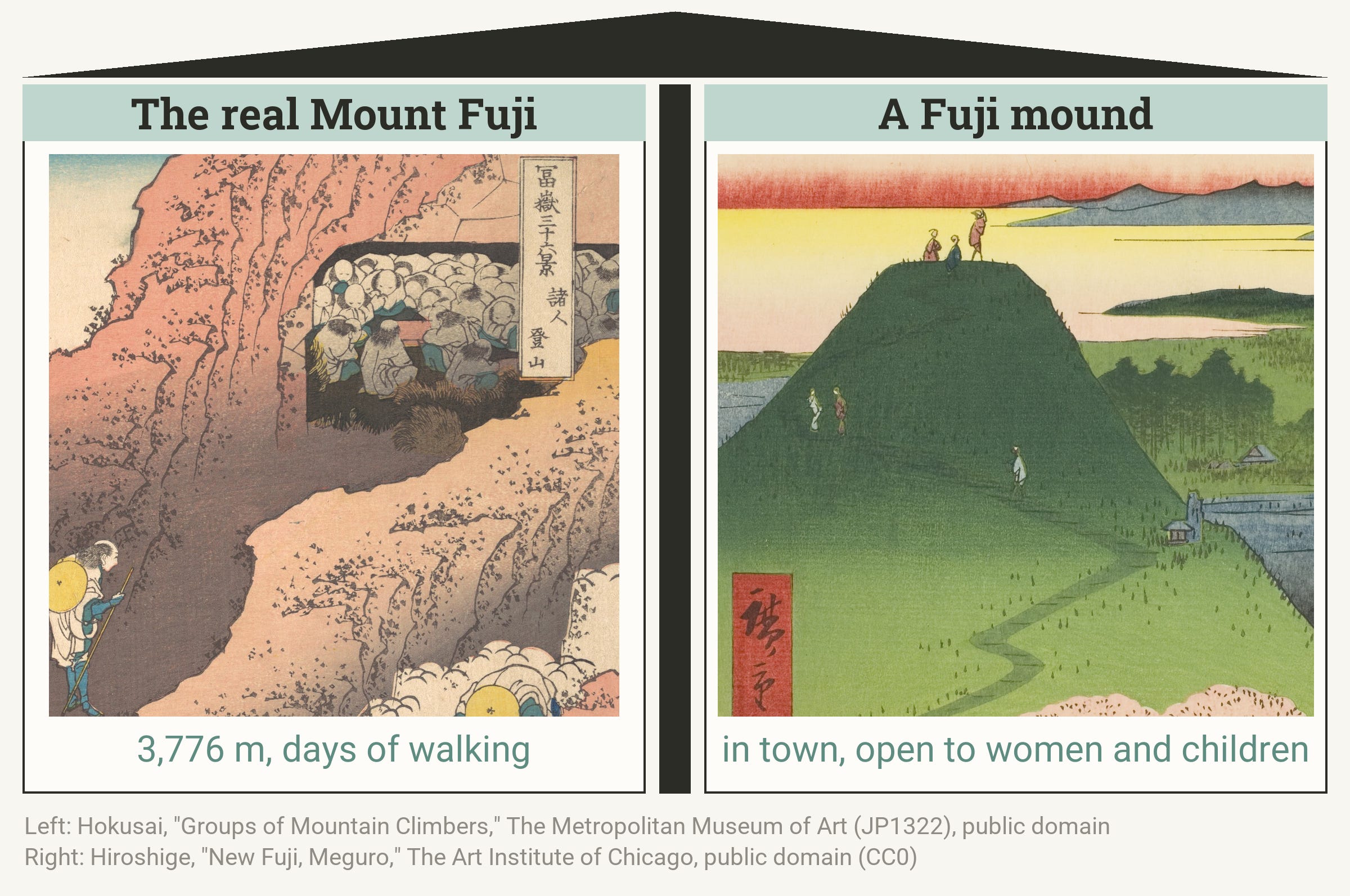
It is “Groups of Mountain Climbers” (Morobito tozan), by the artist Katsushika Hokusai. This woodblock print went on sale around 1831 in Edo, today’s Tokyo. It belongs to “Thirty-six Views of Mount Fuji,” a series of prints of the mountain. Mount Fuji, west of Tokyo, is the highest mountain in Japan.
The other 45 prints all look at Mount Fuji from somewhere. This one alone is set on the summit of the mountain itself.¹ The people are on the mountain, so the mountain cannot be seen.
People in white robes and woven sedge hats are scrambling up the rocks, leaning on their staffs. In a hollow in the rocks at upper right, people are packed tightly together.
Who are these people? Why are they all up on the mountain together? As I set the books side by side, a story comes into view: an association of townspeople in Edo, and small Mount Fujis built inside the city.
Morning on the summit
I will read the print from the bottom up.
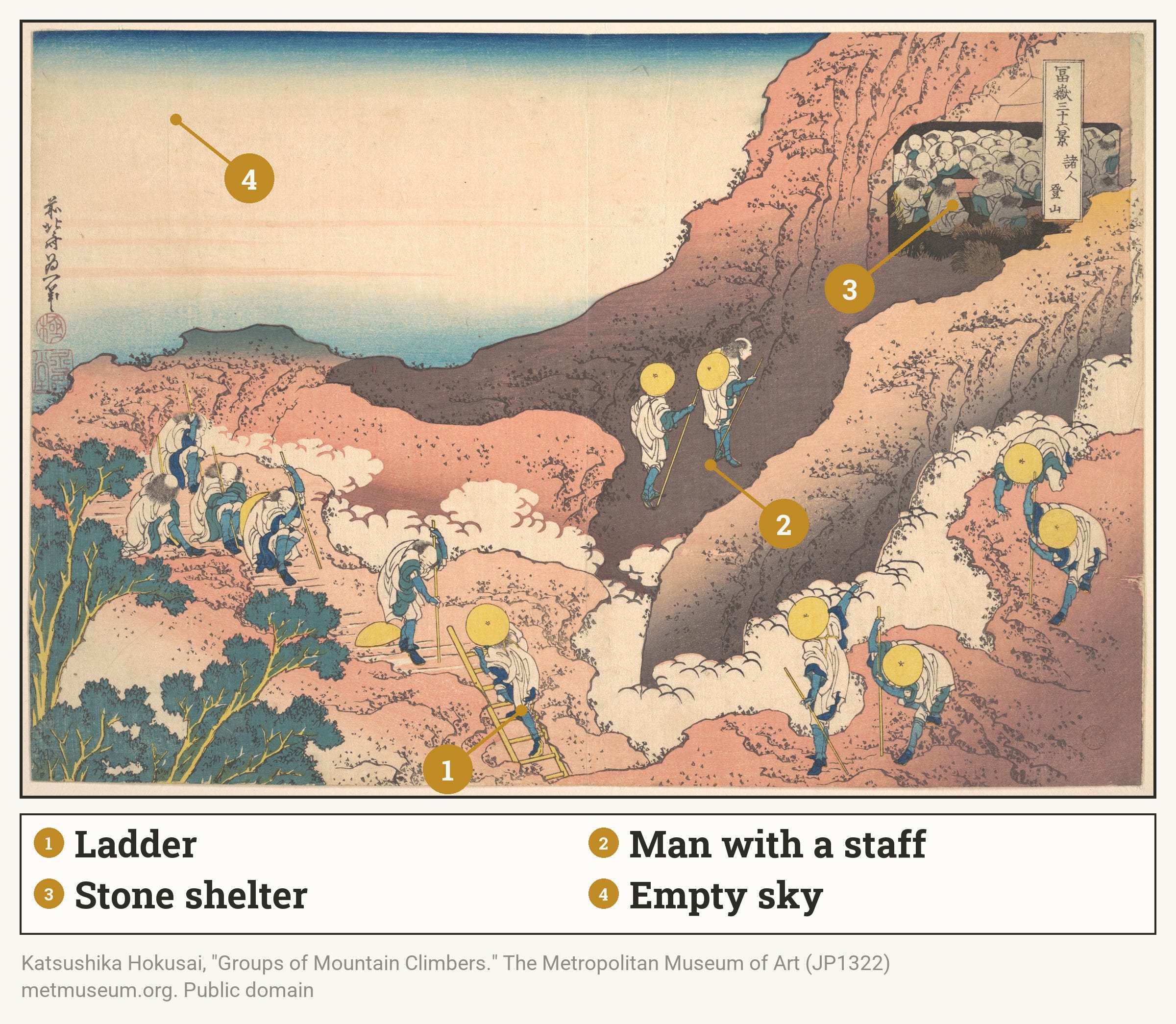
At bottom center, a little to the left, there is a ladder. A person in a sedge hat is climbing onto it. Hinohara Kenji uses this ladder as a clue to work out the location. On the summit of Mount Fuji, a long ladder did in fact lead up a peak called Komagatake. The scene is probably set somewhere around there, Hinohara writes.¹
In the middle, one person climbs, driving a staff into the rock. Others, worn out, have sat down.
The hollow at upper right is a stone shelter from the wind. The book from the Sumida Hokusai Museum describes a great many people crowded together inside.² They crouch, huddled close together.¹
The surface of the rock is shown with countless small dots.² Mist rises here and there.³
Nothing is drawn in the sky on the left. That makes the sense of being high up all the stronger.² There is a faint tinge of red in the sky. It may be early morning, just before the sun rises, Hinohara suggests.¹
The people in white
These are people who worship Mount Fuji as a god.
White robes were the dress for religious training on the mountain. They wear woven sedge hats and carry long wooden staffs.²
What they are doing on the summit is walking a full circle around the crater. There is a large crater at the top of Mount Fuji, ringed by eight peaks. Going all the way around it was the high point of the journey up the mountain.² The people in the print are partway around.¹
Those who reached the summit waited for the sunrise and prayed to it, then went around the small Shinto shrines that ring the crater.⁴ The people in the shelter are likely waiting for the sunrise. Before dawn, the summit is very cold.⁴
A group like this is called a “Fuji kō” (富士講).
The Fuji kō: climbing the mountain together
A kō is an association: people from the same town or village who join together for a single purpose. Some kō pooled money and lent it among the members, and others made pilgrimages to distant Shinto shrines and Buddhist temples.⁵
A Fuji kō is an association for climbing Mount Fuji to worship there.
The beginnings go back to the early 17th century. An ascetic who had trained in a cave at the foot of Mount Fuji is said to have founded the first one in Edo.⁵
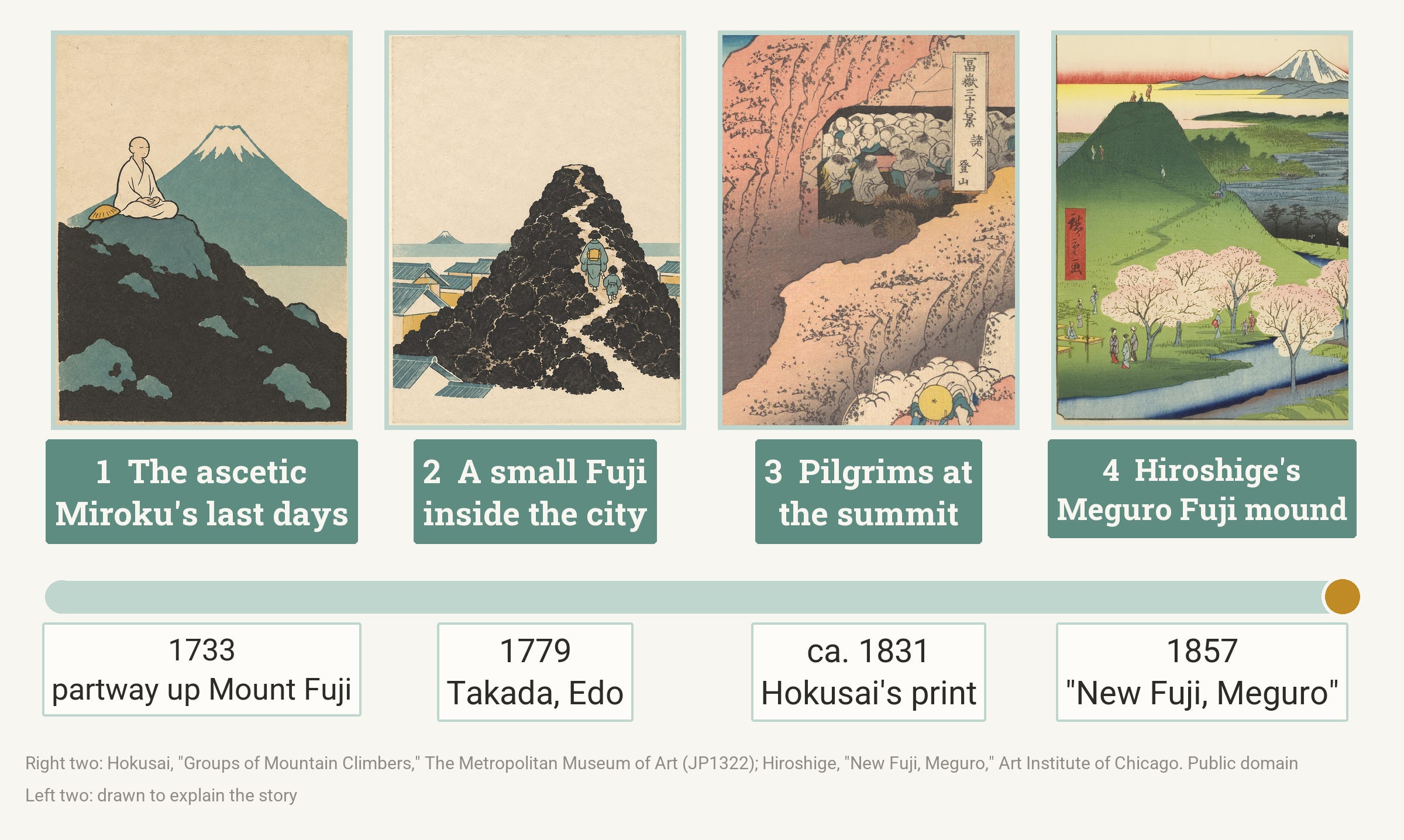
One thing that made them spread widely was the death of an ascetic. In 1733, an ascetic named Miroku gave up food and died on a rock partway up Mount Fuji. He did so praying that the world would become a better place. Harashida Minoru writes that this death made the Fuji kō spread rapidly through the city of Edo.⁶
Edo is today’s Tokyo. At the time, it was one of the largest cities in the world. In that city, the Fuji kō grew so numerous that people spoke of “the eight hundred and eight kō of Edo.” The number 808 is a set phrase meaning “a great many.” The real number is not known.⁵
When the boom happened differs from book to book. One book dates it from the first half of the 18th century.¹ Another places the explosive growth around the beginning of the 19th century.⁷ Kanzaki Noritake distinguishes between the time the kō were born and the time they spread.⁵
Monthly payments and a lottery
The way a Fuji kō worked is a little like a group tour today.
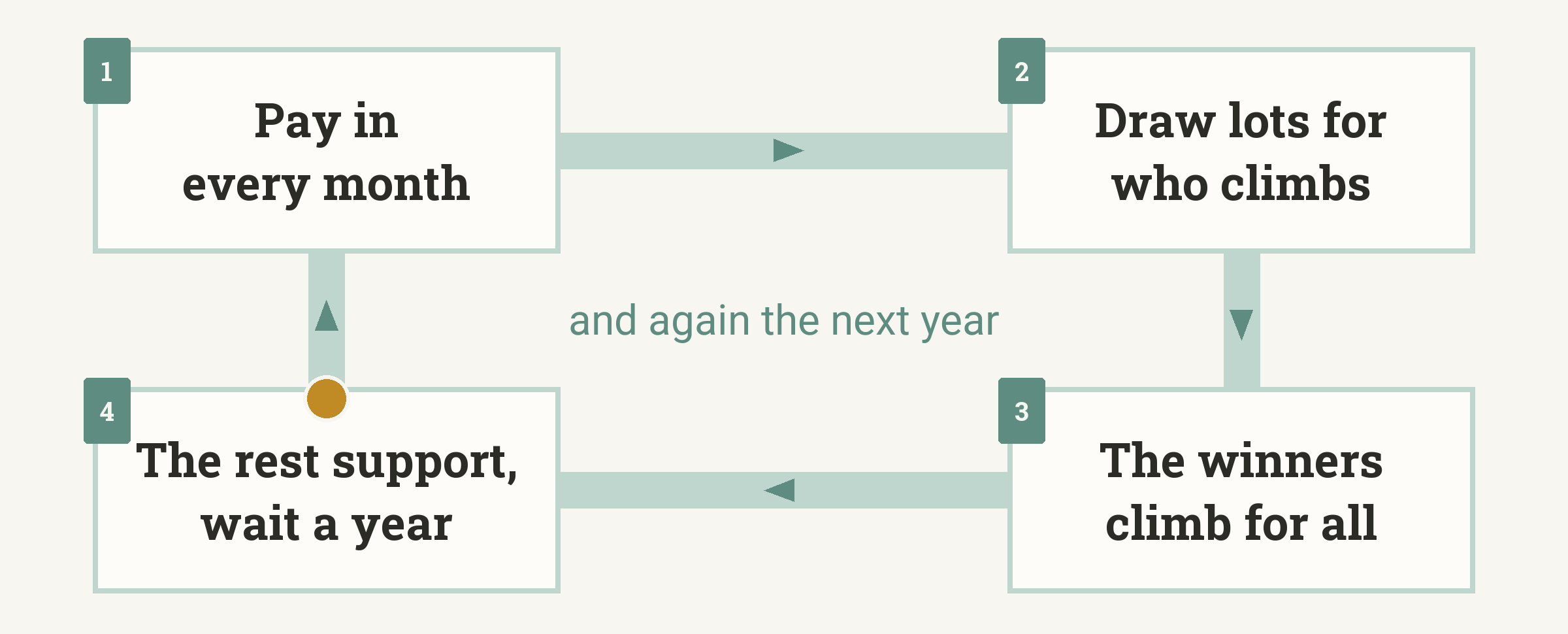
Every month, the members paid a fixed amount into a common fund. It went mainly toward the cost of climbing the mountain. The number of people who would climb was decided beforehand, and they were often chosen by lottery.⁵,⁸
Those who won the draw climbed on behalf of everyone. Those who did not kept paying in to support the others, and waited for the next year.⁴
Every kō had a sendatsu, the guide and leader of the group. He guided the climb on the mountain and led the group in matters of faith. It was not a profession. The head of a family with a trade of his own did this work out of devotion, in the time left over from his business.⁵
The office that governed the city of Edo did not look kindly on the Fuji kō. Between 1775 and 1849, it issued seven public orders banning them.⁵ Seven orders also means this: people kept gathering all the same.
In fact, even as the Fuji kō flourished, the people who actually climbed to the summit were few. Kanzaki Noritake writes that many people visited a shrine at the foot of the mountain, climbed a small hill built there, and counted that as their climb.⁵
A Fuji for those who could not climb
Women were forbidden to climb to the summit of Mount Fuji.³,⁶ The mountain itself was thought to be the body of the god.⁶ For the old, for children, and for the frail, too, Mount Fuji was too far away.
So someone built a Mount Fuji in the city.
He was Tōshirō, a gardener who raised and sold plants in Takada, in Edo, now part of Shinjuku Ward in Tokyo. He was a disciple of Miroku. The idea came to him at the Buddhist memorial service held 33 years after his teacher’s death, and after 14 years of work he finished it in 1779. It was a small Mount Fuji, built of lava carried from the real one and piled up. The thought behind it was to let women and children climb with ease.⁶
This was the first “fujizuka” (富士塚), a Fuji mound: a small Mount Fuji built in the city by the people of the Fuji kō.
Climb a Fuji mound, and you receive the same blessings as if you had climbed the real Mount Fuji. So people said, and the mounds became tremendously popular.⁹ Arisaka Yōko sees the Fuji kō as becoming widely known only after this mound was built.¹⁰ On the day Mount Fuji opened for the climbing season, around mid-July on today’s calendar, crowds climbed the Fuji mounds as well.¹¹
Fuji mounds were built all over. By the mid-19th century, there were more than 20 in Edo.¹² Ōkubo Jun’ichi writes that they were built here and there across Edo and were nothing unusual.⁷
The Fuji in town, as Hiroshige drew it
About 26 years after Hokusai’s print. Utagawa Hiroshige, another artist in Edo, made prints of Fuji mounds.
“Original Fuji, Meguro” (Meguro Motofuji) and “New Fuji, Meguro” (Meguro Shinfuji), from “One Hundred Famous Views of Edo.” Both are from 1857. Meguro is now Meguro Ward in Tokyo. At the time, it was an area on the edge of Edo, with many hills.
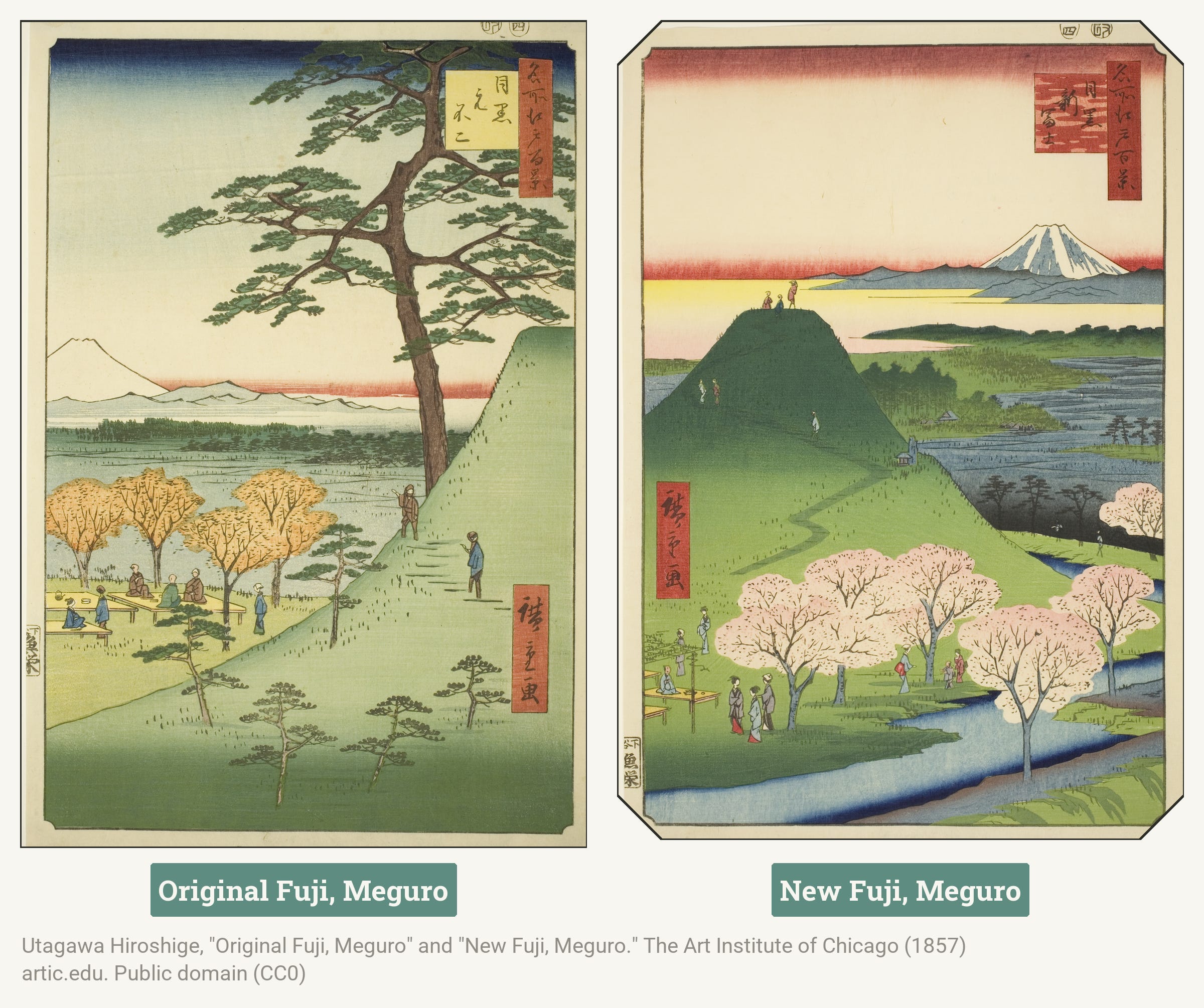
The original Fuji was built in 1812. It stood about 12 meters high. Among the Fuji mounds of Edo, it was one of the larger ones.¹¹ The new Fuji came in 1819. Kondō Jūzō, an official of the shogunate, the government run by warriors, and a man known for exploring the islands to the north, built it on the grounds of his own residence. Because the earlier one stood nearby, the two were told apart as “new” and “original”.¹³ Partway up the new Fuji stood a rock and a small shrine. The rock was a copy of the one on which Miroku had died.¹³
In both prints, Hiroshige fills the foreground with the Fuji mound and sets the real Mount Fuji small in the distance.¹¹ In the print of the original Fuji, a person climbing the mound points at the distant Fuji.¹¹
Hokusai drew people standing on the real summit. Hiroshige drew people climbing a Fuji in the middle of town. Between the two artists’ prints, the everyday life of the same people, those who worshipped Mount Fuji, comes into view.
Why did 46 prints of Fuji come out?
By its name, “Thirty-six Views of Mount Fuji” should be 36 prints. It sold so well that 10 were added, making 46. “Groups of Mountain Climbers” is one of the 10 added later.¹
Putting out dozens of large prints one after another was a costly, bold decision for the publisher, the shop that issued the prints. The Sumida Hokusai Museum’s book gives two reasons the publisher could take the plunge: Hokusai’s popularity, and the spread of the Fuji kō.²
How strongly the books tie the Fuji kō to the sales differs from one book to the next.
One factor in its good reception.³ It gave sales a push.¹⁴ The one who goes furthest is Ōkubo Jun’ichi. He writes that it has been pointed out that the people of the Fuji kō must naturally have been expected to become buyers.¹⁵ Fujisawa Murasaki writes that the prints seem to have been liked partly for a role like a protective charm, drawing on the faith in Mount Fuji.¹⁶
That said, among the books I read, none showed a record of a Fuji kō member buying this print. Nor is it known why Hokusai chose Mount Fuji in the first place.³
What is certain is this: a great many people in Edo worshipped Mount Fuji and hoped to climb it one day. And near the end of the series, Hokusai made those people the main subject of a print.
Did Hokusai climb it?
If he could draw the summit in this much detail, did Hokusai not climb it himself? It is tempting to think so.
Hinohara Kenji’s answer, written in 2019, is careful. There is no firm evidence that he climbed. It is hard to imagine that, in his 70s, he went up the mountain to research this print. Still, the possibility that he climbed when young is not zero.¹
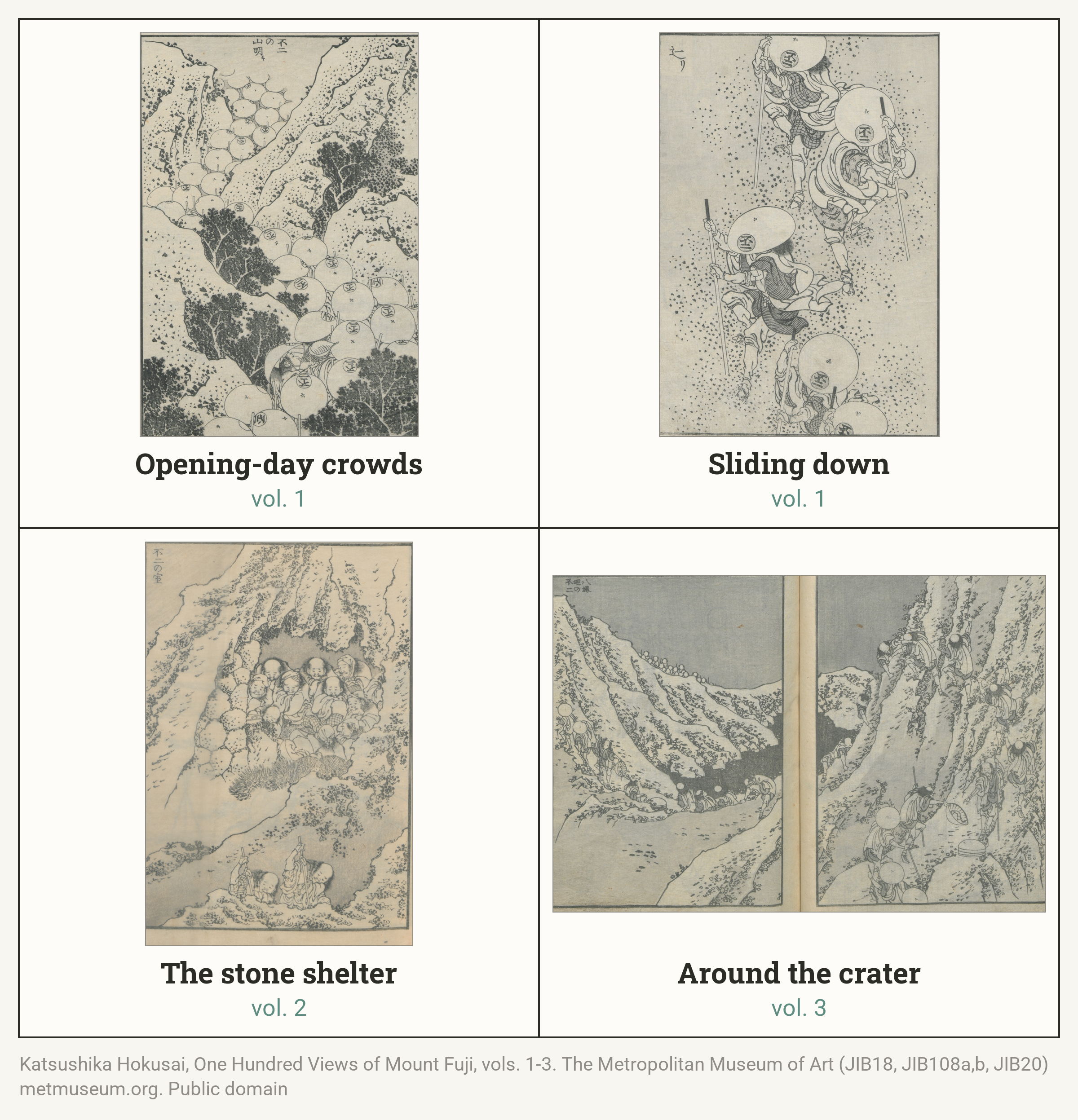
Hokusai went on drawing the Fuji kō after this. His illustrated book “One Hundred Views of Mount Fuji,” which he began issuing in 1834, has pictures of crowds climbing on the opening day of the season, of people sliding down the sandy slopes, of people resting in a stone shelter, and of people going around the crater.¹,² Hinohara writes that Hokusai’s strong interest in the Fuji kō is beyond doubt.¹
There is also one completely different reading.
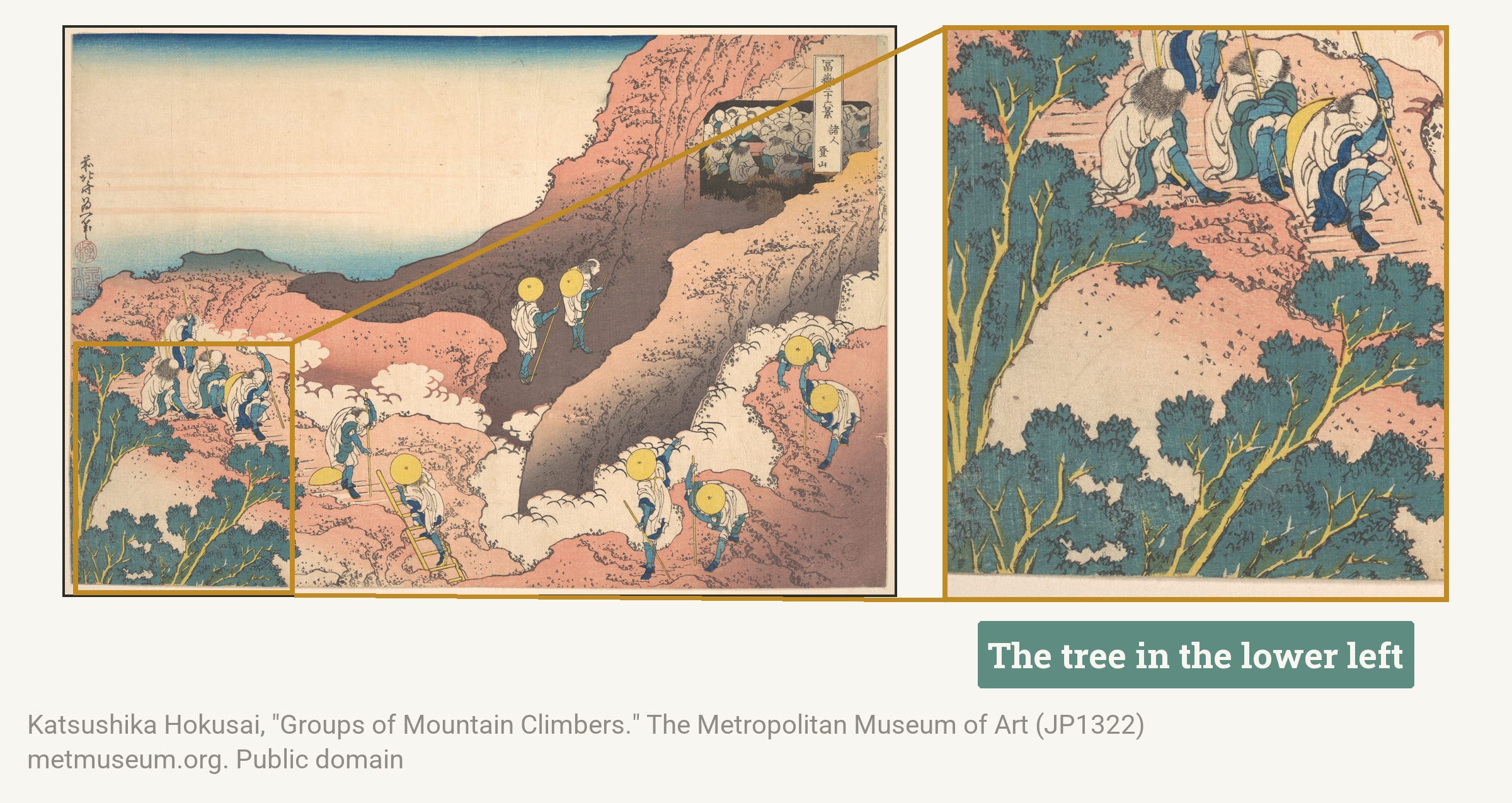
In the lower left corner of the print, a leafy tree is drawn. Ariizumi Toyoaki fixes on it. No such tree grows on a summit 3,776 meters high. So this is not the real summit but a Fuji mound in the city. And the word morobito in the title means “all sorts of people”: anyone can climb here.⁹
Looking at the same tree, Makino Kentarō wonders whether Hokusai had ever climbed Mount Fuji.⁴
The tree is certainly there. The other books do not mention it, and they read the print as a scene on the summit.
Tokyo still has Fuji mounds you can climb today.
The Fuji mound in the grounds of a shrine in Sendagaya, Shibuya Ward, is said to have been built in 1789.³ It is about six meters high. Near the top, lava from Mount Fuji has been set in place.
Makino Kentarō wrote in 2020 that Tokyo still has more than 50 Fuji mounds.⁴ If many readers say they would like to know more, I will think about writing an article on them.
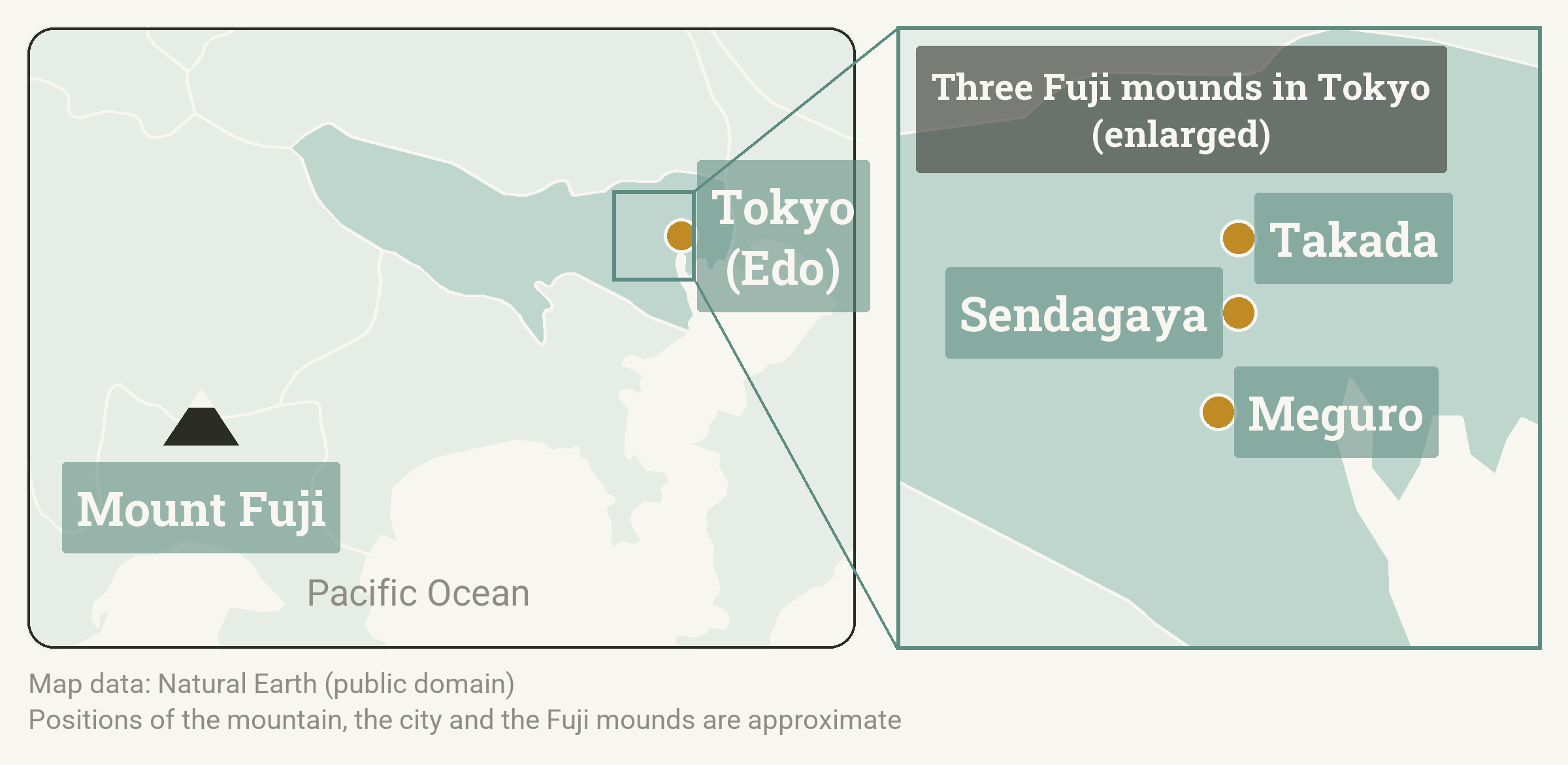
The people in Hokusai’s print walked for days and waited for morning in a stone shelter on the real summit. On a Fuji mound in town, the top is reached in hardly any time at all. On both summits, there were people worshipping the same mountain.
I have climbed Mount Fuji only once, but it felt like sightseeing, a climb done for the memory of it. This print made me feel how greatly the same experience can differ in meaning from one age to another, in matters like faith.
How I researched this
I wrote this article with 29 Japanese books as references. I read the pages that touch on “Groups of Mountain Climbers,” the Fuji kō, and the Fuji mounds.
Books on ukiyo-e, the woodblock prints of Edo, give the Fuji kō only a few lines. The book that explained how a kō worked in detail was a history of travel, Kanzaki Noritake’s The Travel Culture of Edo. That book draws on a study of the Fuji faith published in the early 20th century and on papers by researchers of the Fuji kō. The fourth chapter, on the payments and the lottery, rests on this travel book and on the study behind it, Inobe Shigeo’s The Worship of Mount Fuji. Two points rest on the travel book alone: that people counted a visit to a shrine at the foot as a climb, and the number of public orders.
Where the books were split, I left them split. When did the Fuji kō boom? How many kō and Fuji mounds were there? Did Hokusai climb? Does the print show the summit, or a Fuji mound? For none of these have I settled on a single answer.
There was one place where a book’s numbers did not add up. It gives the period of the public orders as “14 years,” but subtracting the first year from the last gives 74. In the article, I gave only the years and the count.
The image of the print is one made available by the Metropolitan Museum of Art in New York (in the public domain).¹⁷ The same museum holds two impressions of this print. The Hiroshige prints are ones made available by the Art Institute of Chicago (in the public domain).¹⁸
Why Hiroshige chose the Fuji mounds of Meguro, and the finer workings of the Fuji kō (the size of a kō, the lodgings at the foot, what the orders said), I have left outside the scope of this article.
Notes
Japanese names in this article are written in the Japanese order, family name first (Katsushika Hokusai, Hinohara Kenji).
The English titles below are my own translations of the Japanese titles, given for convenience. The original Japanese details follow each.
How the eight peaks around the summit crater are counted, and what each one is called, varies from source to source, and some of the names were changed around 2010. The peak names shown in the video follow the list of the Fuji Sabo Office of Japan’s Ministry of Land, Infrastructure, Transport and Tourism.
References
¹ Hokusai: Thirty-six Views of Mount Fuji (2019) — 日野原健司 編『北斎 富嶽三十六景』岩波文庫・2019
² THE Hokusai: Thirty-six Views of Mount Fuji ARTBOX (2020) — すみだ北斎美術館 編・著『THE 北斎 冨嶽三十六景 ARTBOX』講談社・2020
³ Learning More About Katsushika Hokusai (2019) — 永田生慈 監修『もっと知りたい 葛飾北斎 生涯と作品 改訂版』東京美術・2019
⁴ An Illustrated Anatomy of Ukiyo-e (2020) — 牧野健太郎『浮世絵の解剖図鑑』エクスナレッジ・2020
⁵ The Travel Culture of Edo (2004) — 神崎宣武『江戸の旅文化』岩波書店・2004
⁶ Solving the Riddles of Hiroshige’s “One Hundred Famous Views of Edo” (2007) — 原信田実『謎解き 広重「江戸百」』集英社新書ヴィジュアル版・2007
⁷ Hiroshige and Ukiyo-e Landscape Prints (2007) — 大久保純一『広重と浮世絵風景画』東京大学出版会・2007
⁸ The Worship of Mount Fuji (1928) — 井野邊茂雄『富士の信仰』(『富士の研究 第3』浅間神社社務所 編)古今書院・1928
⁹ Reading Katsushika Hokusai’s Thirty-six Views of Mount Fuji (2014) — 有泉豊明『葛飾北斎 冨嶽三十六景を読む』目の眼・2014
¹⁰ The Riddles of the Neighborhood Fujis (2008) — 有坂蓉子『ご近所富士山の「謎」 富士塚御利益散策ガイド』講談社・2008
¹¹ Hiroshige: One Hundred Famous Views of Edo (2017) — 太田記念美術館 監修『広重 名所江戸百景』美術出版社・2017
¹² Visiting the Sites of Hiroshige’s “One Hundred Famous Views of Edo” Today (2026) — 喜千也『広重「名所江戸百景」の今を見に行く』鉄人社・2026
¹³ Hiroshige TOKYO: One Hundred Famous Views of Edo (2017) — 小池満紀子・池田芙美『広重 TOKYO 名所江戸百景』講談社・2017
¹⁴ An Invitation to Hokusai (2017) — 内藤正人 監修『北斎への招待』朝日新聞出版・2017
¹⁵ Hokusai’s Thirty-six Views of Mount Fuji: A Thousand Variations (2005) — 大久保純一『千変万化に描く 北斎の冨嶽三十六景』小学館・2005
¹⁶ Hiroshige: One Hundred Famous Views of Edo, from the Iwasaki Collection (2007) — 浅野秀剛 監修『広重 名所江戸百景 秘蔵 岩崎コレクション』小学館・2007
¹⁷ Images of “Groups of Mountain Climbers” and of One Hundred Views of Mount Fuji — The Metropolitan Museum of Art, New York, accession numbers JP1322 (the print; the museum lists it as “Groups of Mountain Climbers (Shojin tozan)” and holds a second impression, JP2962; both checked with the museum’s API on 2026-09-23) and JIB18, JIB108a,b, JIB20 (the illustrated book, volumes 1–3); public domain
¹⁸ Images of “Original Fuji, Meguro” and “New Fuji, Meguro” — The Art Institute of Chicago, reference numbers 1939.1403 and 1939.1460 (artic.edu artwork ids 34038 and 34228; checked with the museum’s API on 2026-09-23); public domain (CC0)
Video credits
Old pictures: Groups of Mountain Climbers (Shojin tozan), by Katsushika Hokusai (ca. 1830–32, JP1322) — The Metropolitan Museum of Art; Original Fuji, Meguro and New Fuji, Meguro, by Utagawa Hiroshige (1857) — Art Institute of Chicago; a picture-book shop, from Ehon Tōto asobi (画本東都遊, 1802), by Katsushika Hokusai — National Diet Library, pid 2533327; Bunsei kaisei O-Edo ōezu (文政改正御江戸大絵図, 1833) — National Diet Library, pid 2542463; a map of the summit of Mount Fuji, from Fuji to Ashigara (富士と足柄, 1914), by Yokoi Haruno — National Diet Library, pid 1877649, with most of its writing removed and English peak names added. All in the public domain. Photo of the summit of Mount Fuji: Tomo, “De berg Fuji gezien vanuit een vliegtuig, -2 januari 2010 a,” Wikimedia Commons, CC BY 2.0 (https://creativecommons.org/licenses/by/2.0/), cropped, with a caption added. Pictograms: Phosphor, Material Symbols, and Silhouette AC. Map outlines: Natural Earth.
Music: “Seoto” (瀬音) by Miyagi Michio (1894–1956), in the public domain, newly arranged for this video.
The Stories Behind Old Japan brings you stories of old Japan, drawn from Japanese-language books, researched by hyt, who lives in Japan, and edited and translated with help from AI.
Another print from the same “Thirty-six Views of Mount Fuji,” printed in blue alone, is here: Hokusai’s Blue Came from Berlin


