

There are two prints pulled from the same woodblocks.
One is almost entirely blue. In the other, the fisherman’s clothes have a reddish color, and a band of pale pink runs across the sky.
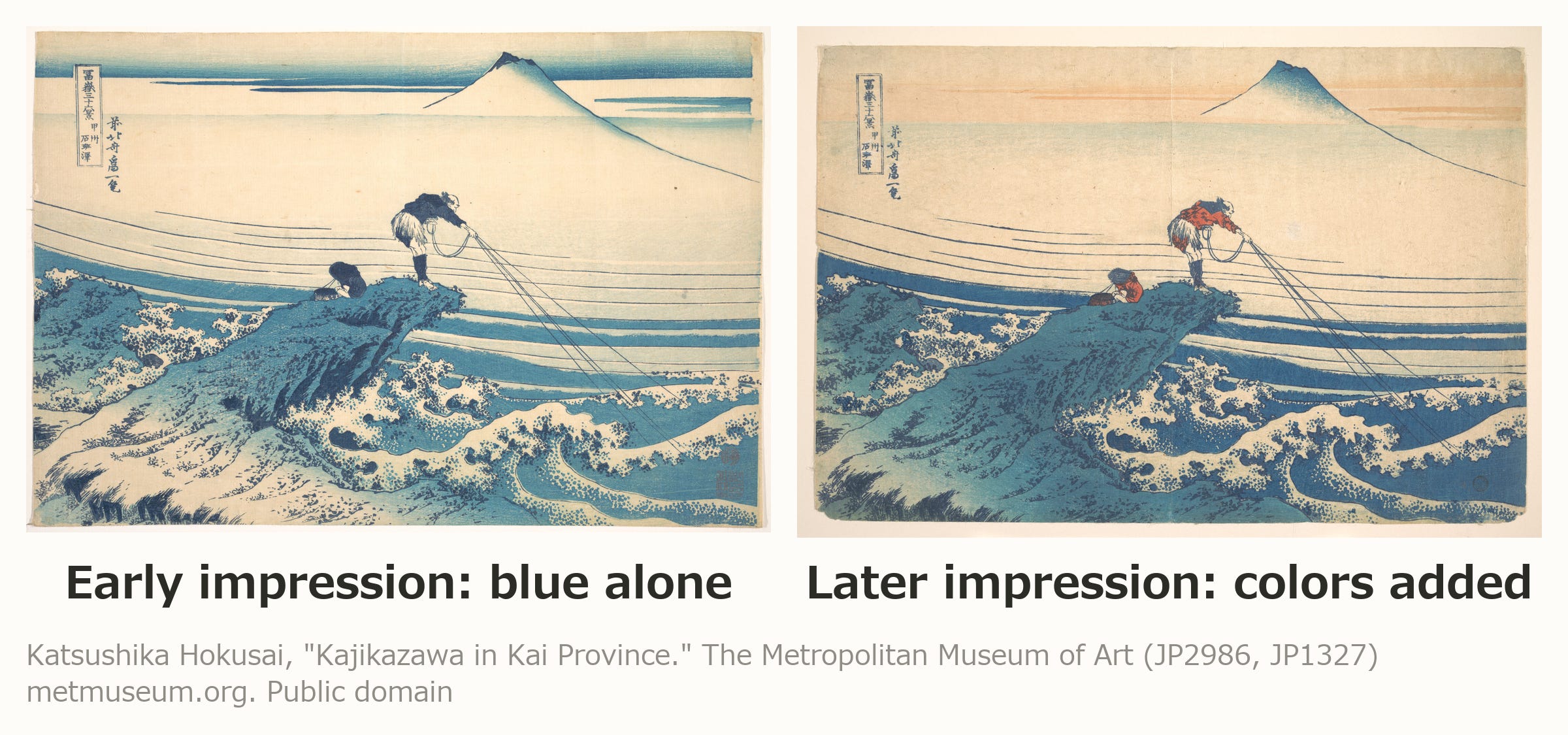
“Kajikazawa in Kai Province” (Kōshū Kajikazawa), by the artist Katsushika Hokusai. It is a woodblock print that went on sale around 1830 in Edo, today’s Tokyo. It is one of “Thirty-six Views of Mount Fuji,” a series of 46 prints of the mountain. Mount Fuji, west of Tokyo, is the highest mountain in Japan.
The blue one is thought to have come out first.¹
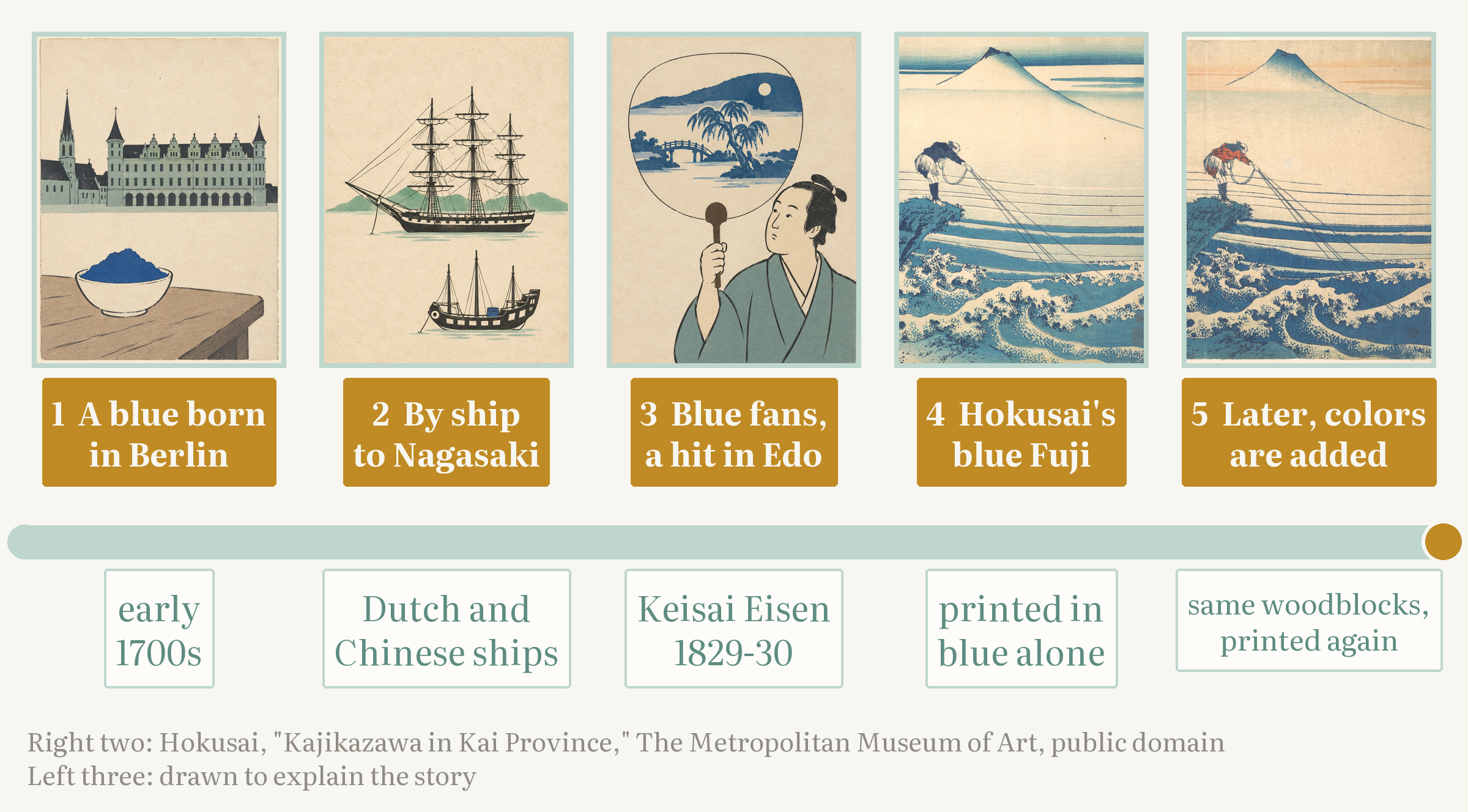
The blue that covers this print is not a Japanese blue. It is a pigment that was born in Berlin, in Europe, and reached the port of Nagasaki by ship.
How did the blue get all the way to Edo? Why was the print sold in blue alone? Set the books side by side, and both come into view: points where the books agree, and points where they say different things.
A print with nothing but blue
At the tip of a rock jutting out into a river, a fisherman pulls on lines that run down to the water. Beside him sits a child holding a fish basket. Hinohara Kenji wonders whether this is the fisherman’s child.²
Rough waves roll in toward the shore and break against the rock. The distance is wrapped in mist, and the ridgeline of Mount Fuji can only just be made out.²
Look at the colors. Apart from the small red seals at the lower right, the print uses nothing but shades of blue.³ The fisherman’s clothes, the rock, the waves, the river, Mount Fuji, the sky. At first glance it is all the same blue, but from deep blue to pale sky blue, each has a different intensity.⁴
The fisherman’s clothes, at the center, are printed especially dark. Ōkubo Jun’ichi sees this as deliberate.³
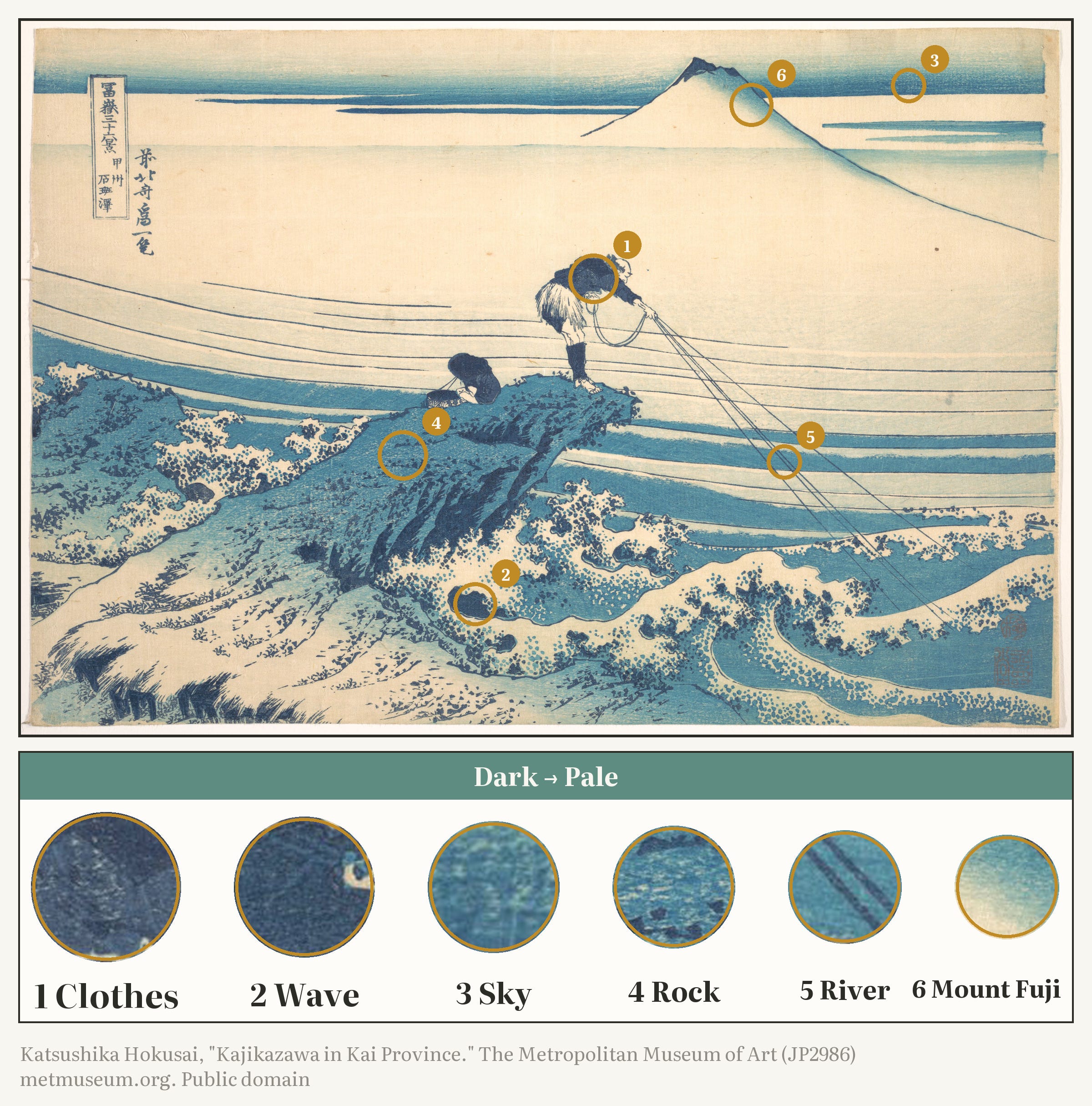
There are two red seals. One is a seal showing the print had passed the censor. The other is the seal of the publisher, the shop that issued the print.²
The place called Kajikazawa, and the riddle of the lines
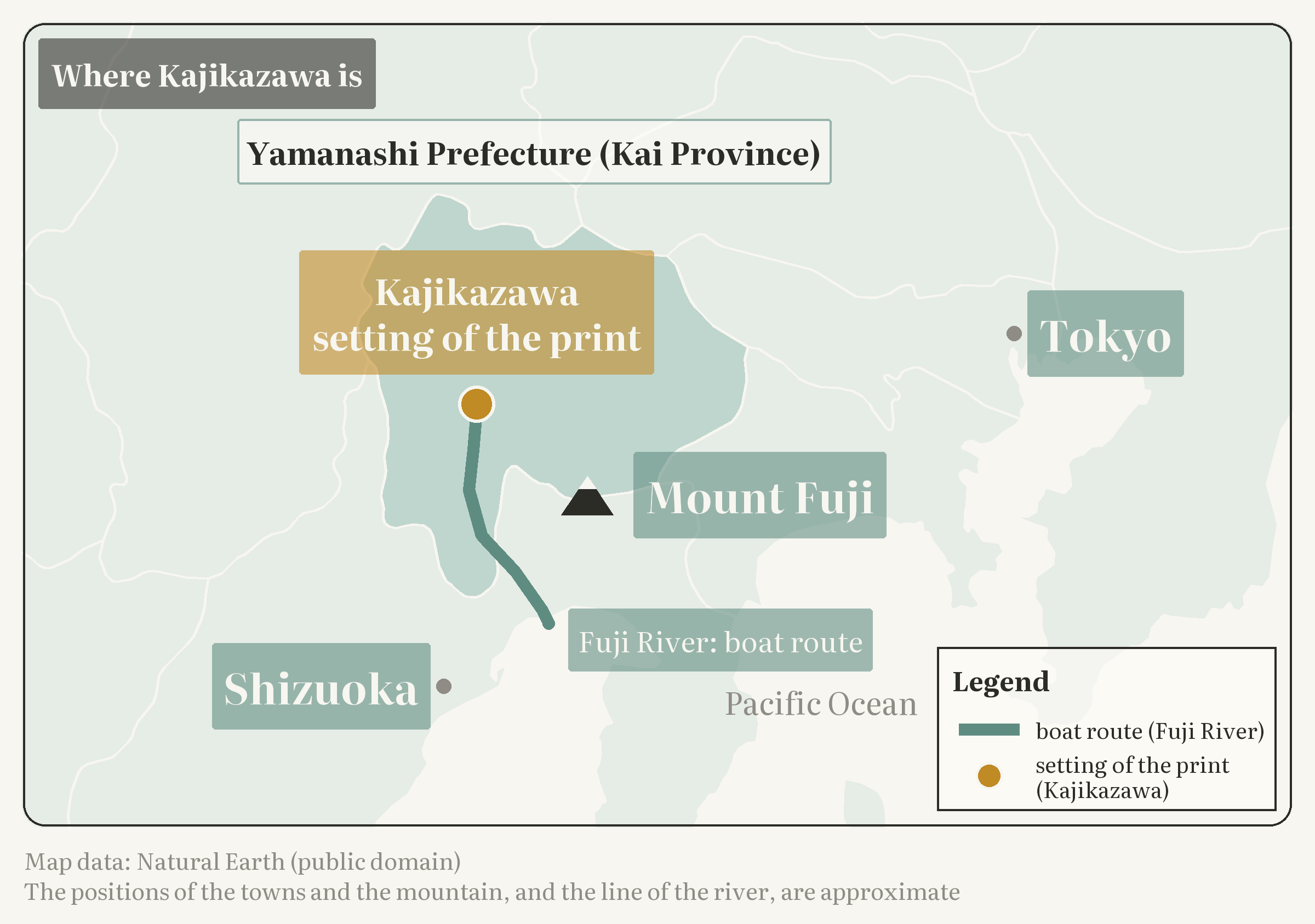
Kai Province, also called Kōshū, is today’s Yamanashi Prefecture. It is a land ringed by mountains, west of Tokyo. The 石班沢 of the title refers to a place called Kajikazawa, normally written 鰍沢. It lies where two rivers join to become the Fuji River, in what is now the town of Fujikawa in Yamanashi Prefecture.¹,²
The Fuji River was a boat route linking Yamanashi with Shizuoka, on the sea coast to the south. Kajikazawa was the key point on that route.¹
The characters in the title seem to contain a mistake. Another name for the fish called kajika is written 石斑魚. From there, the intent was probably to write 石斑沢, and 石班沢 was written by mistake, with 班 in place of 斑, Hinohara Kenji writes.²
This view does not seem to be one you can actually see. One proposed location is Unose, near where the rivers meet. Rocks are said to have once risen there as sheer as in the print. But the mountains stand close on both banks, and you cannot see the ridgeline of Mount Fuji the way the print shows it. Hinohara writes that it is probably a landscape Hokusai imagined in his head.²
The books do not agree on what the lines in the fisherman’s hands are. He is casting a net.² A cast net, or the hand lines used in cormorant fishing.¹ He is hauling in a net.⁵ He is fishing with lines.⁶ There are four readings.
Ariizumi Toyoaki goes further. The four lines cannot be explained as basket traps, a cast net, fishing lines, or cormorant fishing. Waves that rise high and break at the shore happen only on a seacoast.⁷ Other books, too, call this water “the sea”.⁸ Many books call it the Fuji River.
Two triangles, and depth from shades of blue alone
On the composition, the books agree.
With the fisherman at the apex, the rock and the lines form a triangle. The ridgeline of Mount Fuji in the distance is a triangle, too. The two triangles echo each other and give the picture stability.¹,²,⁵,⁹
The triangle is made of three things. The rock, jutting out like a boar’s nose. The fisherman’s body, bent sharply at the waist. And the lines.¹ Hokusai liked to use repeating geometric shapes.¹
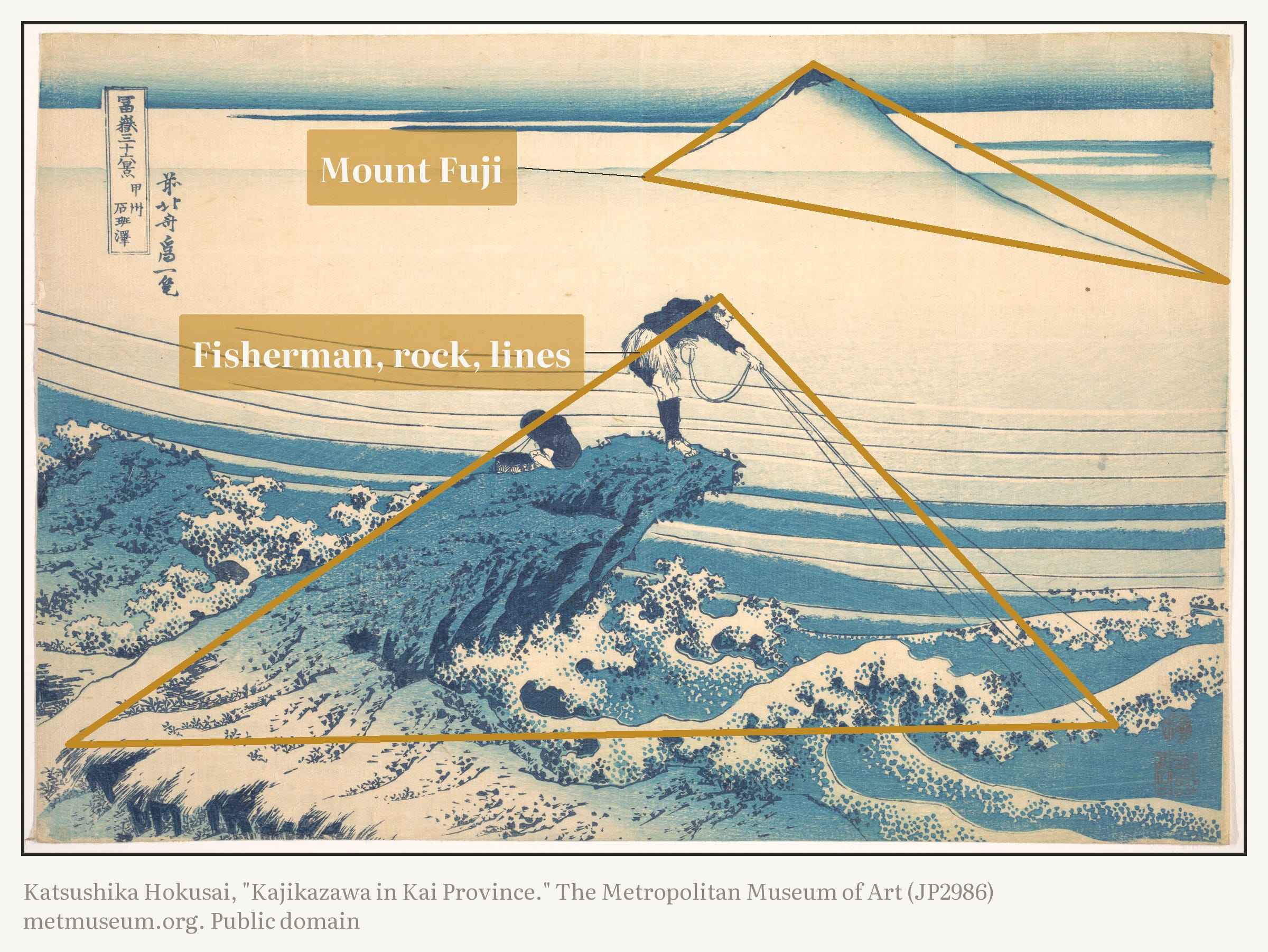
The way depth is created is a little unusual. Western linear perspective, in which lines converge on a single point in the distance, is not used in this print. It is a simple arrangement: the fisherman in front and Mount Fuji at the back, set facing each other. Between them, the lines of water and wind grow paler from the deep blue in front toward the back, and become one with the very faint blue of Mount Fuji. Ōkubo Jun’ichi writes that the depth comes from the shades of blue.⁹
These shades were possible because of the new pigment that came from Berlin.
The trouble with blue until then
The blue in ukiyo-e, the woodblock prints sold in the city of Edo, had long come from plants. The flowers of the dayflower, and the leaves of the indigo plant.
Dayflower blue bleeds easily and is sensitive to light. In old ukiyo-e that survive today, rivers look gray and skies look yellowed because the dayflower blue has faded.⁶,¹⁰ A newer study sees moisture, not light, as the main cause of the color change.¹¹
Indigo blue does not fade. But it does not dissolve in water and has to be rubbed into the fibers of the paper, so it is hard to print. It does not spread on a dampened woodblock, so it is not suited to “bokashi,” a smooth shading from dark to light. The color is also dull, with no transparency.¹⁰
Sky, sea, and rivers could only be shown in a somber blue. So Hinohara Kenji writes.²
Then came the blue from Europe. A man-made blue pigment, born by accident in Berlin, Germany, in the early 1700s. Berlin was then in a country called Prussia. This is the pigment known in English as Prussian blue.²,³ In Japan at the time, it was called “bero” or “berorin,” local pronunciations of Berlin.³,⁶ In Japanese today it is usually written “bero-ai” (ベロ藍), that is, “bero” joined to “ai,” the Japanese word for indigo. But this name is not found in documents from the Edo period, the 17th to the 19th century, and seems to have been coined later.⁶ In this article, I call it Prussian blue.
Prussian blue is vivid and transparent. Though it is a pigment made of particles, it mixes well with water and produces beautiful shading.² It can give anything from pale blue to deep navy, and it does not fade.¹⁰
From Berlin to Edo
Japan at the time kept tight limits on contact with other countries, and Dutch and Chinese ships could enter only the port of Nagasaki, at the western edge of the country. Prussian blue came in through Nagasaki.⁶
One book gives 1747 as the year it first arrived.² Another says the early 19th century.⁵ At first it was expensive, not a pigment just anyone could use.²
Things change in the late 1820s. Chinese ships began to bring it in large amounts, and the price fell.⁶ One book says the price seems to have fallen because the pigment had come to be made in China.² Smith wrote in 1998 that no document had yet been found that directly confirms it was made in China.⁶
So when did it begin to be used in ukiyo-e? Here there are three accounts.
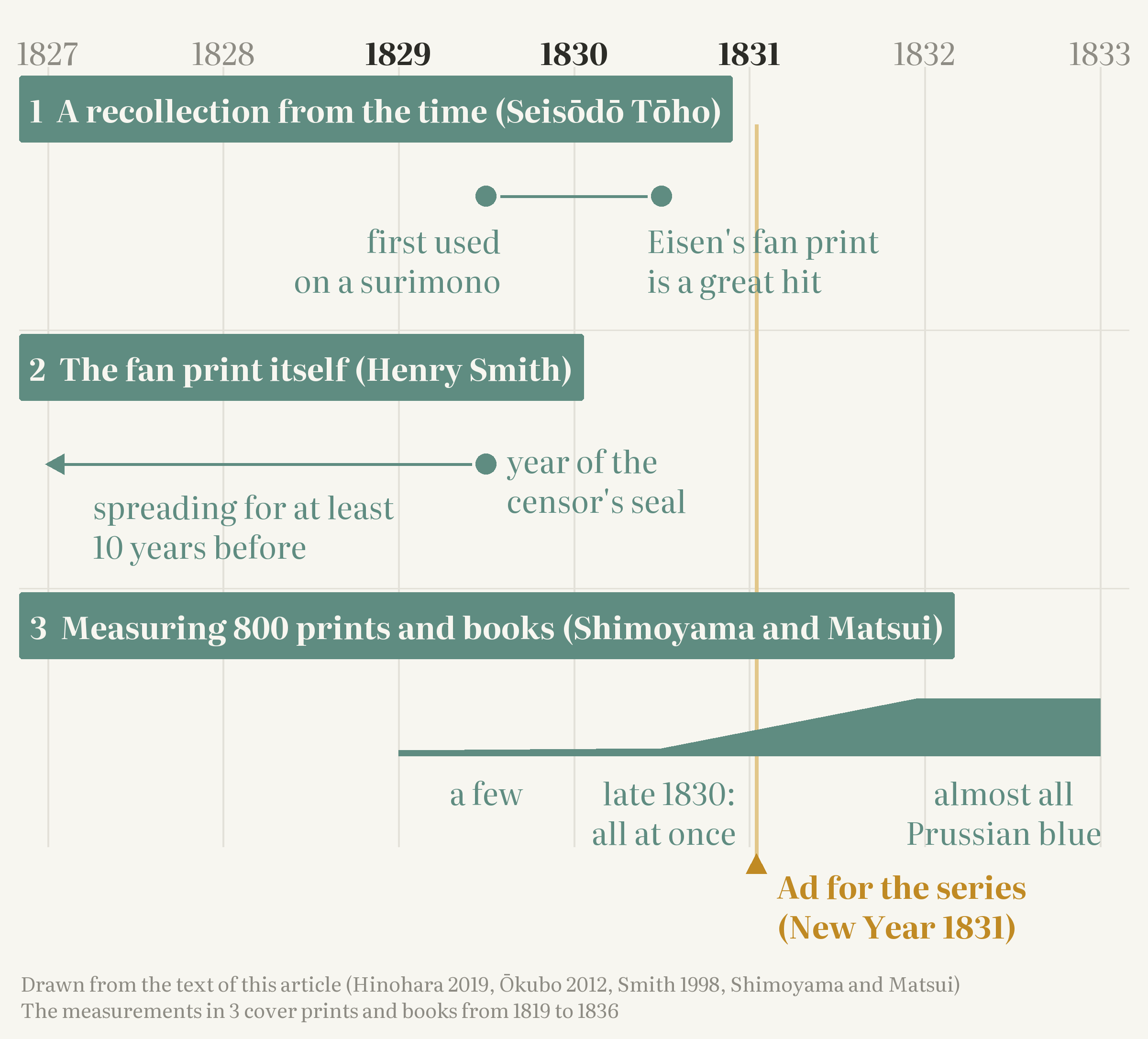
The first is the recollection of a man who knew those days. Seisōdō Tōho, born into a bookseller’s family in Edo, set it down in his book of recollections, Masaki no Katsura. In 1829, he himself used it for the first time, on a surimono, a privately commissioned print, in this case a sheet of haikai verse. The next year, the artist Keisai Eisen brought out a round-fan print, with a Chinese-style landscape on the front and the Sumida River in Edo on the back, printed in light and dark shades of this one blue, and it was a great hit. Other fan shops copied it, he says.²,⁹
The second is that fan print itself. Smith found Eisen’s fan print of a Chinese-style landscape at the Brooklyn Museum in New York. The museum’s analysis confirmed the pigment to be pure Prussian blue. And the year of the censor’s seal on the print was 1829. That is one year earlier than Tōho’s “next year.” Smith thinks Tōho may have misremembered. He goes further, and takes Tōho’s claim that 1829 was the first time to be wrong in itself. He argues that the pigment had been spreading little by little in surimono and ukiyo-e for at least 10 years before that.⁶
The third is measurement. Shimoyama Susumu and Matsui Hideo examined the blues in 800 prints and books from 1819 to 1836, using light, without damaging them. In Edo, Prussian blue begins to be used in 1829, in a few exceptional cases. From the second half of 1830 it spreads all at once, and by the end of 1831 almost all the blue is Prussian blue. In actor prints from Osaka, they say, it was in use more than 10 years earlier than in Edo.¹⁰
Around 1830, the blue of Edo’s ukiyo-e was changing over to Prussian blue. On that, all three agree. On when the very first print was made, and by whom, they do not.
“Aizuri ichimai”: blue was the selling point
“Thirty-six Views of Mount Fuji” is a series on Mount Fuji issued by the Edo publisher Eijudō. The title says thirty-six, but the series sold well, so 10 more were added, making 46 in all. The popular ukiyo-e of the time were actor prints and prints of beautiful women. Prints of famous places were a minor field.²,⁹
An advertisement for the series appears at the back of a novel that came out at the New Year of 1831. It says “aizuri ichimai,” that is, single-sheet prints in blue. It also says they would come out “a little at a time, one view to a sheet”.²,⁹ Being aizuri, printed in blue alone, was the “big selling point” of the series.²
After its account of Eisen’s fan print, Tōho’s book of recollections continues as follows. Eijudō printed Hokusai’s Fuji in this blue and issued it. “This too was a great hit, twice that of the fans”.²
Of the 46 prints, 10 were printed in blue alone or in colors close to it. These 10 share the same form of signature, and “Kajikazawa in Kai Province” is one of them.²,³
Smith divided these 10 into two groups of five. Five in blue alone, and five with a little pale pink and green added. Smith proposes that the five in blue alone were already out in the late autumn of 1830, when the woodblock for the advertisement was cut. All five show places to do with water: sea, river mouth, lake, river. “Kajikazawa in Kai Province” is among those five.⁶
But on whether these 10 were the first of the series to come out, the books are split. One view holds that the 10 blue prints came first. Another holds that the group with the famous print of the great wave and the print of the red Fuji came first, and the 10 blue prints came second. Hinohara Kenji wrote in 2019 that no clear conclusion had been reached yet.²
There is one more thing that only measurement revealed. The blue in this series was long thought to be all Prussian blue. When Shimoyama and Matsui measured 36 of the prints, the outlines were the old indigo, and the rest of the blue was Prussian blue.²,¹⁰ The old blue for the lines, the new blue for the colored areas. The printers were using the two blues for different jobs.
In later impressions, color is added
Back to the two prints at the beginning.
When ukiyo-e sold well, they were printed again and again from the same woodblocks. In later impressions, the colors sometimes change.
In later impressions of “Kajikazawa in Kai Province,” the rock turned green, the clothes of the fisherman and the child changed to another color, and pale pink was added to the sky. It was the publisher who added the colors.⁵ The name given to the color of the clothes differs from book to book. Brown.² Orange.¹ Red.⁵
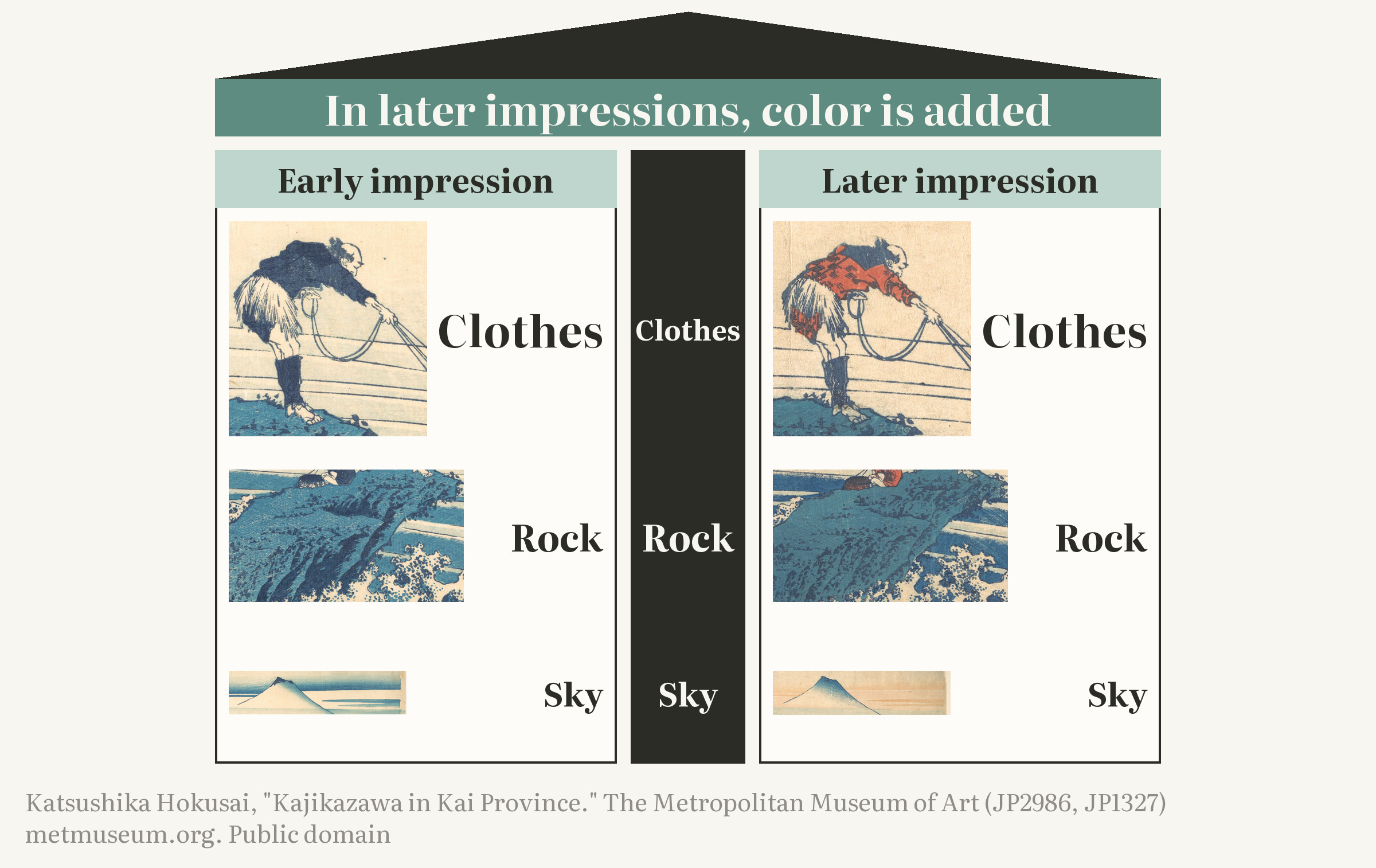
Other prints in the blue group also change color in later impressions.²
Why were colors added? Of the books I read, only one gives a reason. Blue alone was “too refined, and cold.” There was a problem in making it a product that would sell, writes An Invitation to Hokusai.⁵ The other books say only that the colors changed, and give no reason.
Ōkubo Jun’ichi writes that the fashion for printing in blue alone was short-lived. Even so, he adds, Hokusai understood how this blue works in a landscape and deliberately went on depicting waterside scenes.⁹
Ōkubo also gives a warning. If you talk about the effect of color without separating early impressions from later ones, you risk misreading what the artist was originally aiming for.¹² The print in blue alone, and the print with color. Which one you are looking at changes how you read the picture.
After Hokusai: the age of sky and water
The effect of blue that Hokusai had shown was soon put to use by other artists. In the early 1830s, Utagawa Kuniyoshi and Utagawa Hiroshige, in their prints of famous places in Edo, printed sky and water in deep shades of this blue. In both, many of the views are along the sea or along rivers. Ōkubo Jun’ichi sees this as probably a choice made to bring out the effect of the blue.⁹
Print the sky and water in this blue, and you get the distance of the sky and the depth of the water. Shimoyama and Matsui write that Prussian blue was the material foundation that let landscape prints stand as a field of their own.¹⁰
There was a time when Hiroshige’s blue was called “Hiroshige blue” overseas.¹³ I plan to cover that in another article.
Hokusai drew this fisherman once more.
He appears in volume 13 of the drawing manual Hokusai Manga, which came out around 1849, about 20 years after “Kajikazawa in Kai Province.” On a rock at Kajikazawa called Inohana, “the boar’s nose,” a fisherman is hauling in a net. The composition is “Kajikazawa in Kai Province” flipped exactly left to right.¹
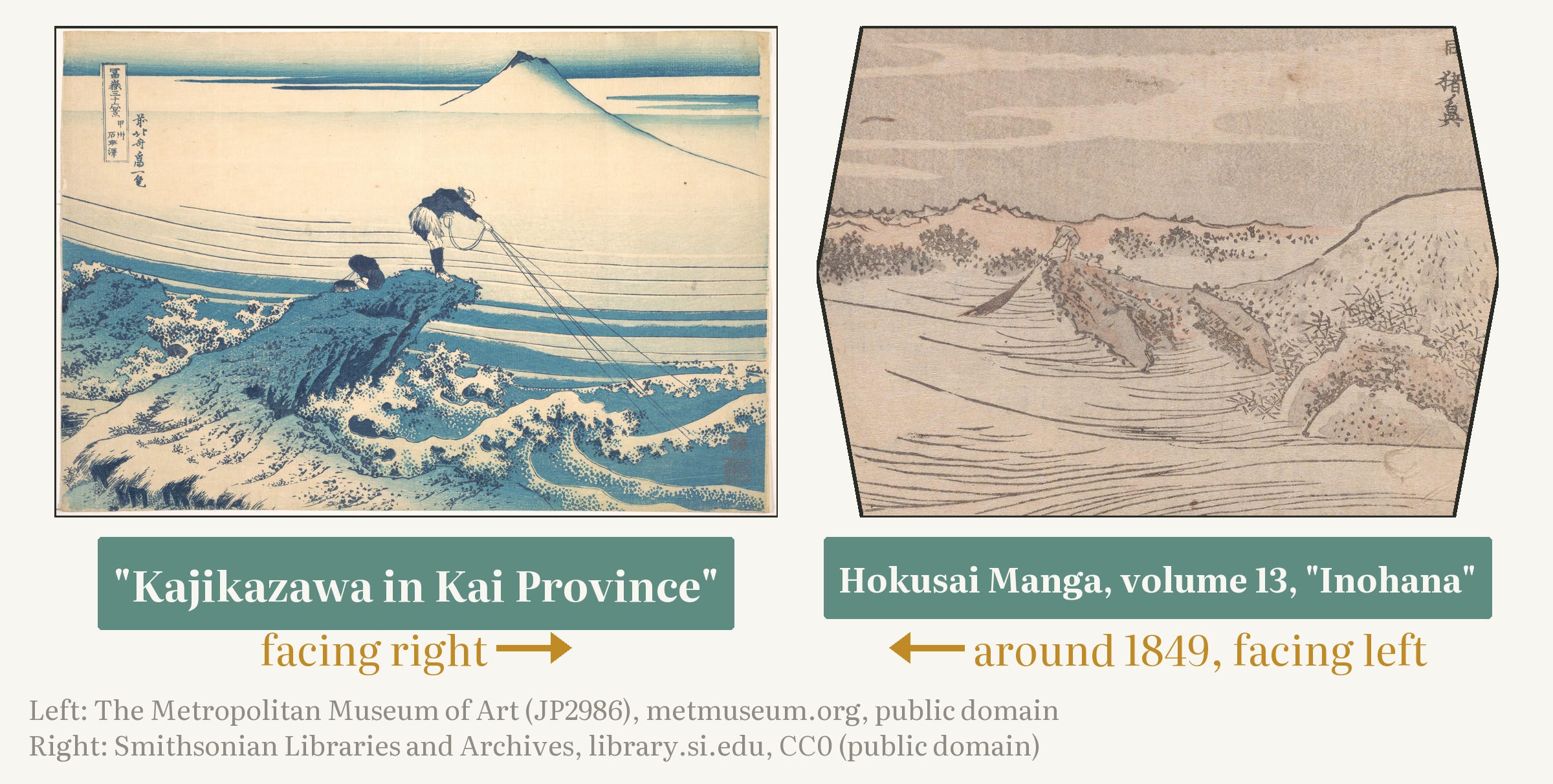
Hokusai had also drawn Kajikazawa in volume 7 of Hokusai Manga, in 1817. That one shows a single boat going down the Fuji River.² Whether Hokusai ever visited Kajikazawa is not known. Hinohara Kenji writes that a fisherman hauling in a net was probably a subject Hokusai was fond of.²
Hokusai Manga is a drawing manual made mainly of lines in black ink. The blue water is not there.
I have seen this blue-only print by Hokusai before, though I do not clearly remember whether it was in a textbook or on TV. It shows that even in an age when the windows for trade were so limited, a wave of technological innovation was arriving from overseas, and I found that interesting.
How I researched this
I wrote this article by setting 23 Japanese-language books and three papers side by side. I read every page that touches on the pigment or on “Kajikazawa in Kai Province.”
The two who write in most detail are Ōkubo Jun’ichi and Hinohara Kenji. In some places two books agreed, but both were by the same author. In the text, I wrote “the books agree” where books by different authors agreed, and where only one person says something, I gave that person’s name.
Where the books were split, I left them split and set them side by side. The first year it was used in ukiyo-e. Whether the 10 blue prints came out first. What the fisherman’s lines are. Why colors were added. I have not reduced any of these to a single answer.
What a book says also changes with how new it is. Smith’s 1998 paper says that the outlines in this series are also Prussian blue. Later measurement showed that the lines are the old indigo. Hinohara’s 2019 book follows the findings of those measurements.
The images of the print are made available by the Metropolitan Museum of Art in New York (in the public domain).¹⁴ The same museum had two impressions in blue alone and one with colors added. The Hokusai Manga image at the end is made available by Smithsonian Libraries and Archives (in the public domain).¹⁵
I also looked for an actual example of a print in which the dayflower blue has changed. There were candidates, but I am not a specialist and could not judge which part of the picture had changed, so I have not included a figure.
The story of the “Thirty-six Views of Mount Fuji” series itself, and the techniques of printing and shading, I have left outside the scope of this article.
Notes
Japanese names in this article are written in the Japanese order, family name first (Katsushika Hokusai, Hinohara Kenji).
The English titles below are my own translations of the Japanese titles, given for convenience. The original Japanese details follow each.
References
¹ THE Hokusai: Thirty-six Views of Mount Fuji ARTBOX (2020) — すみだ北斎美術館 編・著『THE 北斎 冨嶽三十六景 ARTBOX』講談社・2020
² Hokusai: Thirty-six Views of Mount Fuji (2019) — 日野原健司 編『北斎 富嶽三十六景』岩波文庫・2019
³ Ukiyo-e, Color Edition (2008) — 大久保純一『カラー版 浮世絵』岩波書店・2008
⁴ Reading Ukiyo-e Through Motifs (2025) — 日野原健司『モチーフで読む浮世絵』筑摩書房・2025
⁵ An Invitation to Hokusai (2017) — 内藤正人 監修『北斎への招待』朝日新聞出版・2017
⁶ The “Blue Revolution” in Ukiyo-e (1998) — ヘンリー・スミス「浮世絵における『ブルー革命』」樋口一貴 訳・『浮世絵芸術』128 号・1998
⁷ Reading Katsushika Hokusai’s Thirty-six Views of Mount Fuji (2014) — 有泉豊明『葛飾北斎 冨嶽三十六景を読む』目の眼・2014
⁸ Katsushika Hokusai: The Man Mad About Painting Who Charmed the World from Edo (2017) — 美術手帖 編『葛飾北斎 江戸から世界を魅了した画狂』美術出版社・2017
⁹ Hokusai, Color Edition (2012) — 大久保純一『カラー版 北斎』岩波書店・2012
¹⁰ A Study of the Blue Colorants Used in Ukiyo-e Prints — 下山進・松井英男「浮世絵版画に使用された青色着色料の研究」『文化財情報学研究』第3号(刊行年は PDF に記載なし)
¹¹ Julia Poirier, “Dayflower Blue: A characteristic Japanese woodblock print colour” (2021) — Chester Beatty, Dublin, conservation blog, May 27, 2021 (web)
¹² Hiroshige and Ukiyo-e Landscape Prints (2007) — 大久保純一『広重と浮世絵風景画』東京大学出版会・2007
¹³ Solving the Riddles of Hiroshige’s “One Hundred Famous Views of Edo” (2007) — 原信田実『謎解き 広重「江戸百」』集英社新書ヴィジュアル版・2007
¹⁴ Images of “Kajikazawa in Kai Province” — The Metropolitan Museum of Art, New York, accession numbers JP2986 (blue alone), JP2581 (blue alone), and JP1327 (with colors added); public domain
¹⁵ Image from Hokusai Manga, volume 13 — Smithsonian Libraries and Archives, digital library; CC0
Video credits
Old pictures: Kajikazawa in Kai Province, by Katsushika Hokusai, two impressions (JP2986, JP1327) — The Metropolitan Museum of Art; South Wind, Clear Sky (Red Fuji), by Katsushika Hokusai (ca. 1830–32) — The Metropolitan Museum of Art; Under the Wave off Kanagawa (The Great Wave), by Katsushika Hokusai (1830/33) — Art Institute of Chicago; The Actor Ichikawa Ebizo IV as Takemura Sadanoshin, by Tōshūsai Sharaku (1794) — Art Institute of Chicago; Takashima Ohisa, by Kitagawa Utamaro (ca. 1793) — Art Institute of Chicago; Tsukuda Island, from Famous Places in the Eastern Capital, by Utagawa Kuniyoshi (ca. 1832/33) — Art Institute of Chicago; Descending Geese at Shinobazu Pond, from Eight Views of the Eastern Capital, by Utagawa Hiroshige (1836/37) — Art Institute of Chicago; Hokusai Manga, volume 13 — Smithsonian Libraries and Archives; Honzō zufu (本草図譜, 1921 edition), by Iwasaki Kan’en — National Diet Library, pid 926379 and 926381. All in the public domain. Map outlines: Natural Earth.
Music: “Seoto” (瀬音) by Miyagi Michio (1894–1956), in the public domain, newly arranged for this video.
The Stories Behind Old Japan brings you stories of old Japan, drawn from Japanese-language books, researched by hyt, who lives in Japan, and edited and translated with help from AI.


