

In Japan there are more than ten thousand Shinto shrines that enshrine one man as a god. His name is Sugawara no Michizane. He was a scholar in Kyoto, the capital of Japan in the 9th and 10th centuries, who rose all the way to minister. Many of those shrines display a plum crest.
The shape, though, is not always the same. At Kitano in Kyoto, five round stars. At Dazaifu in Kyushu, in southwestern Japan, a plum blossom with petals. And at Kanazawa on the Sea of Japan coast, swords point out from between the circles.
Why did the plum of one and the same god change its shape from place to place? And how did it become the crest of one of the greatest daimyo families in Japan, the lords who ruled the domains? This article looks at how the crest passed from the shrine to the family.
One plum, two lines
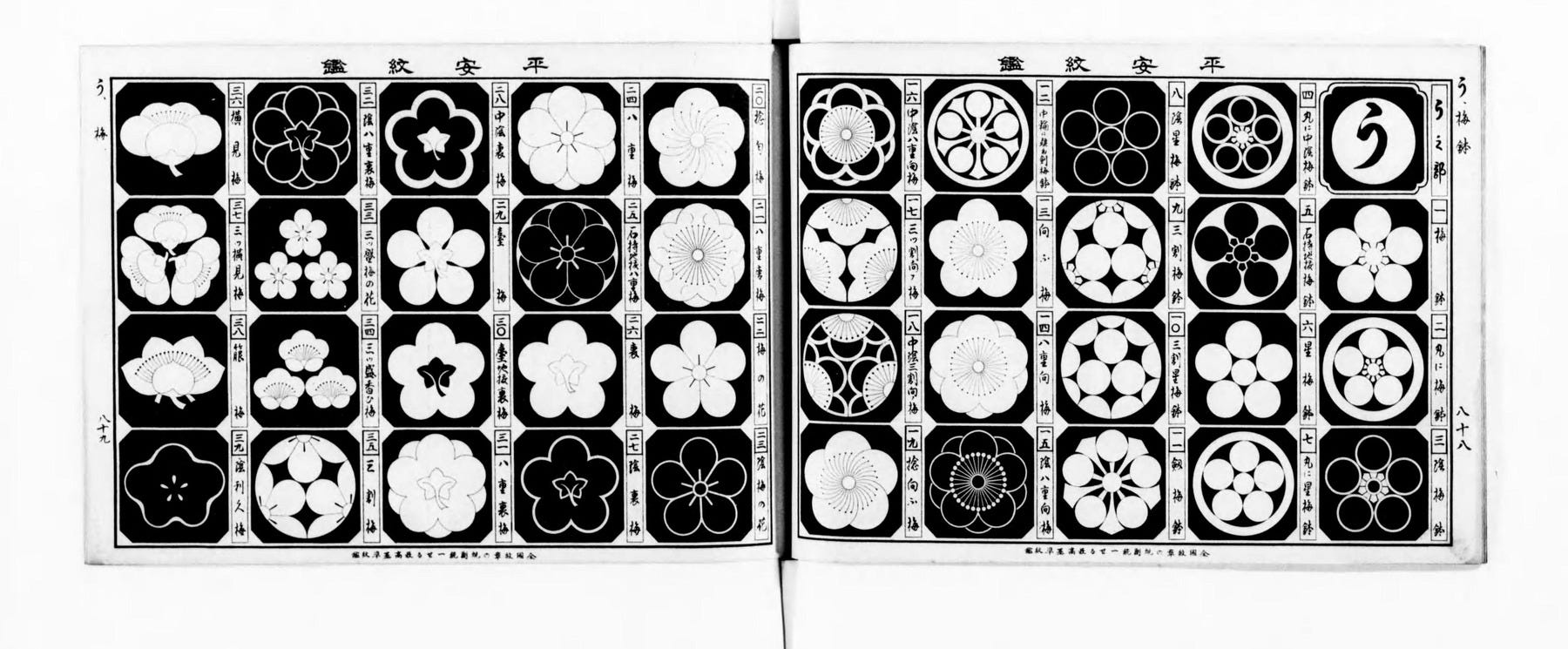
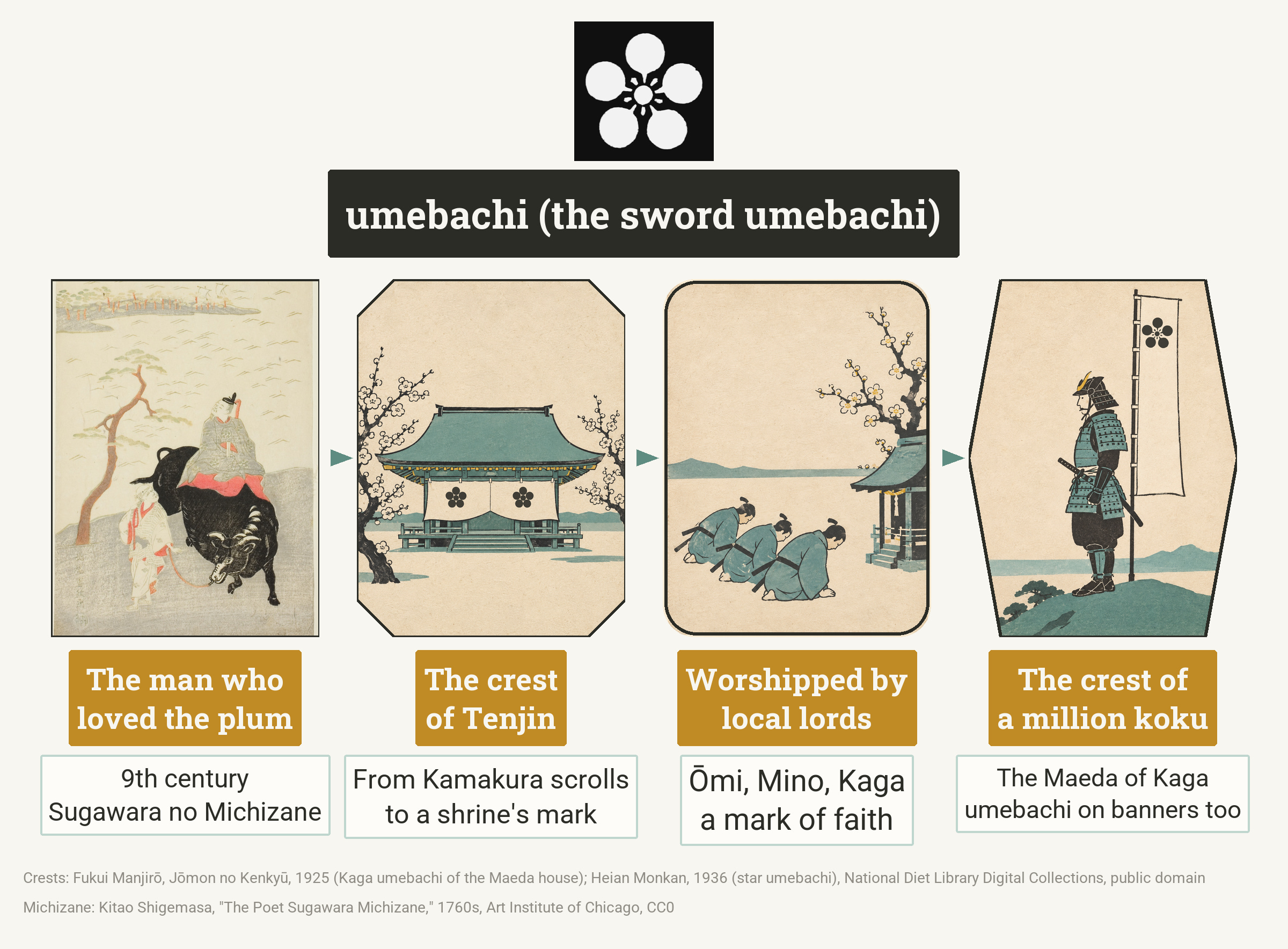
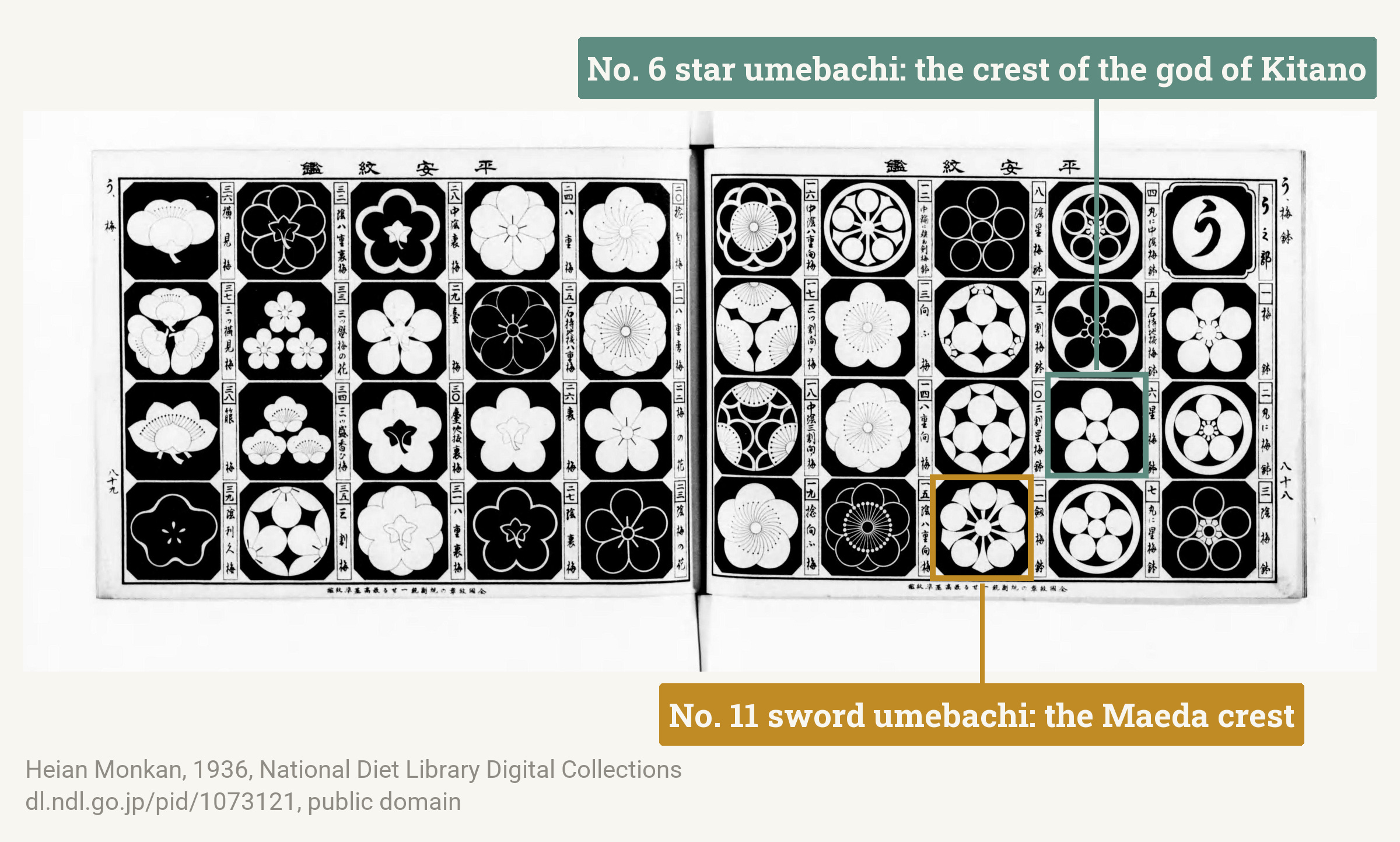
Across two facing pages of Heian Monkan, a printed catalog of crests from 1936, 39 plum crests are lined up. The right page begins with the “umebachi” (梅鉢) group, five circles set in a ring. The left page is the “plum blossom” group, drawn with petals.
Books on family crests, or kamon, keep these two apart. The shape that copies the flower is the plum blossom crest; the shape built from circles is the umebachi crest.¹,² In numbers, the umebachi wins by a wide margin.³ It was already so in the Edo period, from the 17th to the 19th century.⁴ Within the umebachi group, two shapes alone, the plain umebachi and the umebachi in a circle, make up about eight in ten.²
The plum crest has about 300 variations in all. The cherry blossom has about 200.⁵
Where does the name umebachi come from? Here the books disagree. The name umebachi ends in bachi: the sticks used to beat a taiko drum. One explanation says the shape is these drumsticks laid out like a plum blossom. Some books say the bachi in question are those of stringed instruments like the shamisen and biwa, which are plectrums. Another explanation: it looks like umebachisō, a small wild plant found at Arima. Another: it is a worn-down form of umewa-no-uchi, “plum inside a ring.”¹,⁴ Numata Yorisuke, the scholar of crests, accepts neither the bachi nor the plant. The shape began as a plum blossom, he argues; it drifted away from the real flower, turned geometric, and only happened to end up looking like bachi.¹ I plan to cover the story of the name in a separate article.
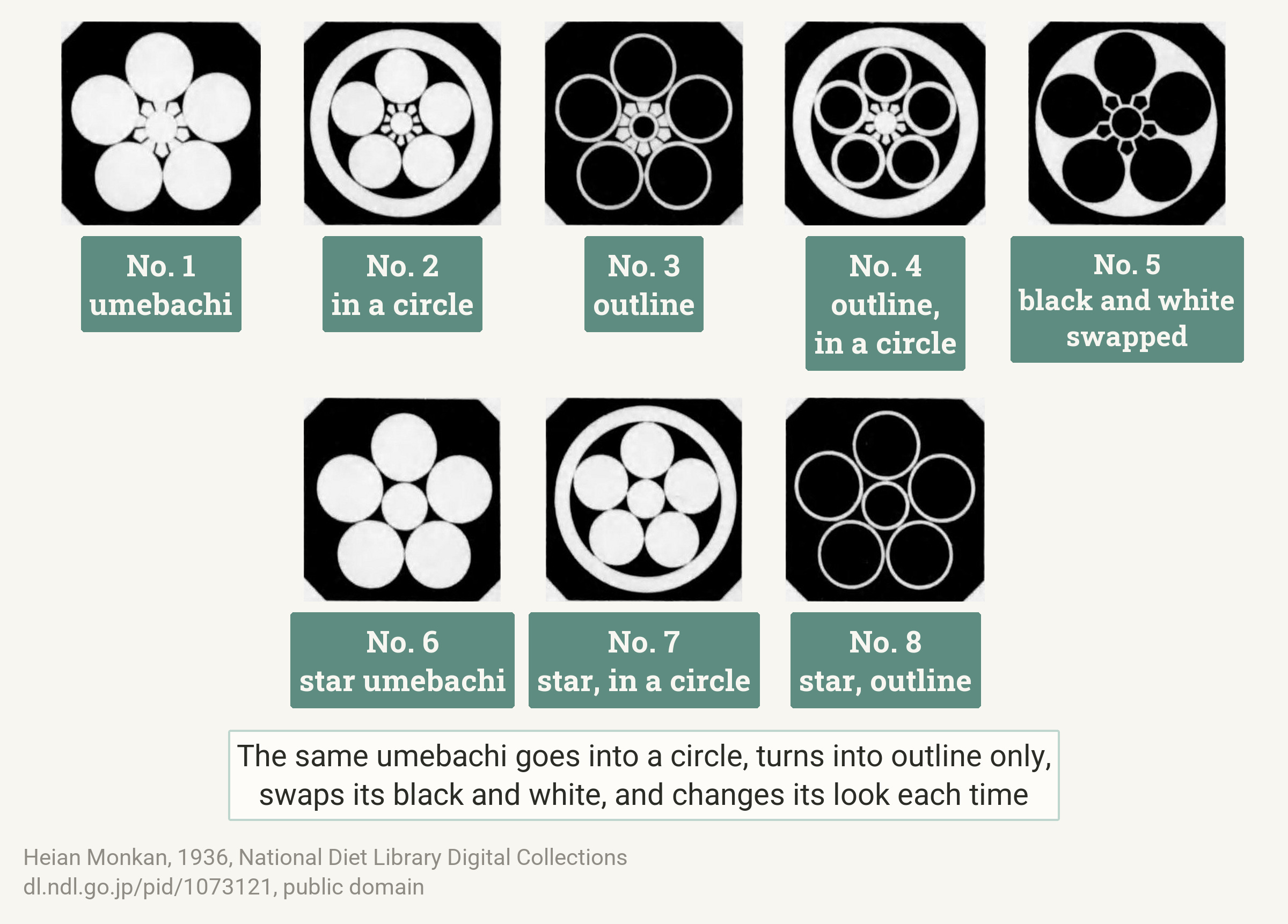
Look at Nos. 1 to 8 on the right page. The same umebachi goes into a circle, turns into outline only, swaps its black and white, and changes its look each time. What this article follows is not the shape but the people who used it. Who put that plum on, and why?
Michizane, the man who loved the plum
Sugawara no Michizane was a scholar in 9th-century Kyoto. Favored by Emperor Uda, he proposed in 894 that the missions to Tang China be stopped, and he rose to Minister of the Right.⁶ In 901 he was driven from the capital and exiled to the government outpost at Dazaifu in Kyushu. That is in today’s Fukuoka Prefecture. Two years later he died there, at 59.⁶
There are many stories about Michizane and the plum. A poem he addressed to the plum tree in his garden, as he left the capital, has come down to us.
Kochi fukaba / nioi okoseyo / ume no hana
aruji nashi tote / haru na wasure so
When the east wind blows, send your scent all the way to me, plum blossoms; though your master is gone, do not forget the spring. The last line comes in two forms in the books, “haru na wasure so” and “haru o wasuru na.”³,⁶ In a poem he wrote in Classical Chinese at the age of 11, he likened moonlight to snow under a clear sky and plum blossoms to stars.³ There is also the legend of the “flying plum”: a plum tree so devoted to the exiled Michizane that it flew through the sky to Dazaifu.³,⁷
Not everyone takes this story at face value. Takasawa Hitoshi writes that in China, those sent to the frontier had a custom of putting their homesickness into poems about the plum, and that people going down to Dazaifu followed it. The tale that Michizane had a special love for the plum may be a later invention, he says, and should not be swallowed whole.³ Still, more books say that Michizane loved the plum dearly.
After Michizane’s death, the capital was struck by one misfortune after another. Fujiwara no Tokihira, the Minister of the Left who had brought him down, died at 39, and in 930 lightning struck the imperial palace and killed the court noble Fujiwara no Kiyotsura.³,⁶ People feared it was the work of Michizane’s vengeful spirit. In 942 a woman named Tajihi no Ayako received an oracle, and five years later, in 947, a shrine to Michizane was built at Kitano in Kyoto.⁷,⁸ In 959 the court noble Fujiwara no Morosuke built its halls, and in 987 Michizane was granted the divine title “Kitano Tenman Daijizai Tenjin.”⁸ The vengeful spirit had become Tenjin, the deified Michizane. Shrines that enshrine this Tenjin are called Tenmangū.
Tenjin was, to begin with, a god of thunder. Thunder brings rain, so he was also a god of farming.⁹ Niwa Motoji sees the tragedy of Michizane as having become intertwined with a sky god who was already worshipped as the guardian of villages.¹⁰ As for the face everyone knows today, the god of learning, there is another explanation. Takasawa Hitoshi speculates that a man named Sugawara no Tamenaga (1158 to 1246) may have created the stories in order to turn the vengeful spirit into a god of learning.³
At Kitano, the Plum Blossom Festival is still held on February 25, the day of Michizane’s death.⁹,¹¹
Picture scrolls and written oaths: when the crest still belonged to the god
There is no trace of Michizane himself using the plum as a family crest. He seems to have used it as a pattern on clothing and furniture, writes Ōkuma Miyoshi.¹² Some books say Michizane’s family crest was the umebachi.¹³,¹⁴
The first sure sign comes from a picture scroll of the Kamakura period, in the 13th century. In the scroll that tells the origins of Kitano Tenmangū Shrine, patterns of plum blossoms and plum branches appear more often than any other. The ox-drawn carriages of the court nobles would normally carry kuyō, a crest of nine stars; here they carry the umebachi. Numata Yorisuke reads this as a sign that the painter had the link between Michizane and the plum in mind.¹ The umebachi was in use as a shrine crest by the Kamakura period, Numata writes. Its meaning was not beauty, but “remembrance” or “faith.”¹
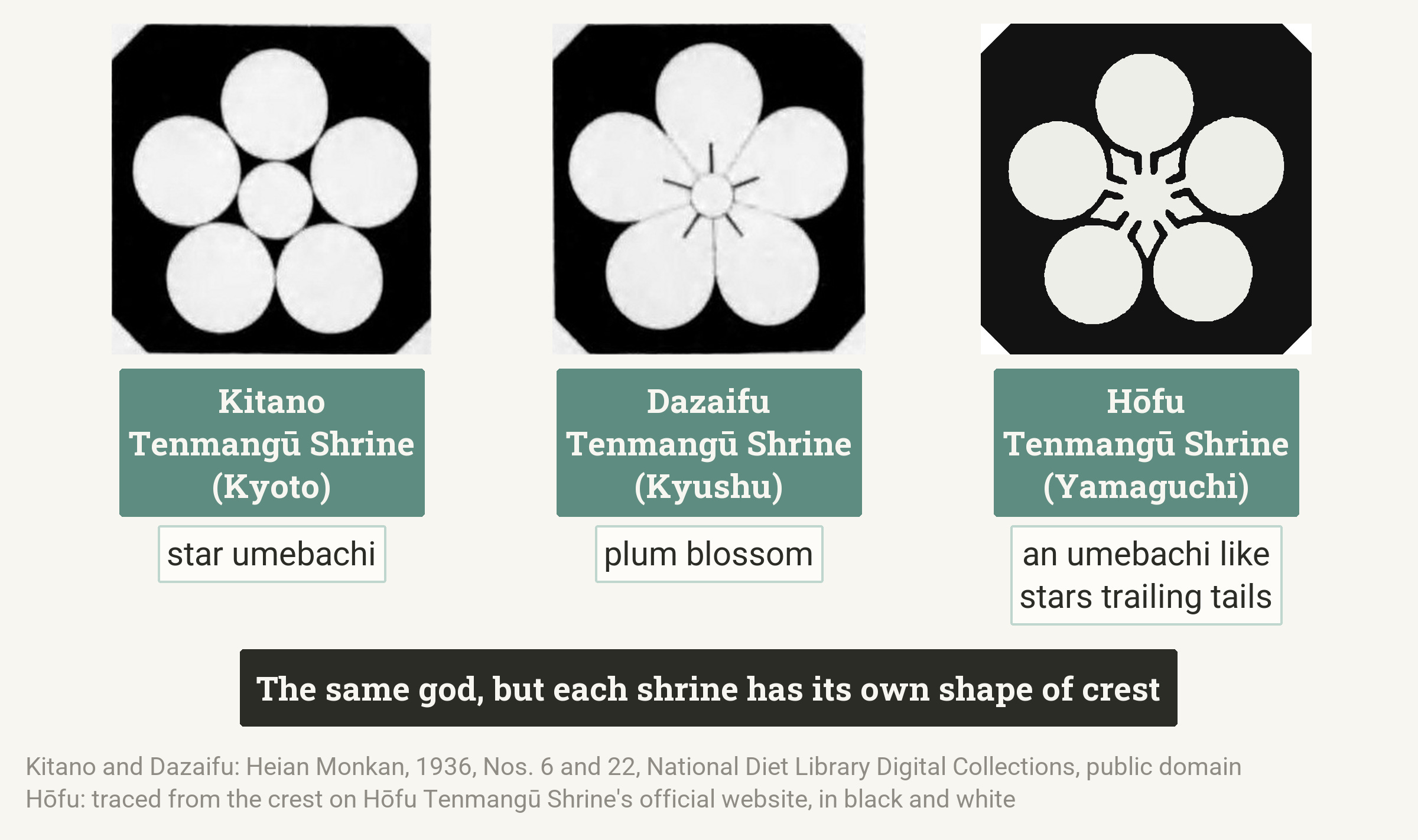
Yet the shape differs from shrine to shrine. Kitano uses the Hoshi-umebachi, or star umebachi, its five circles seen as stars. Dazaifu in Kyushu uses a lifelike plum blossom with petals. The shrine at Hōfu, at the western end of Honshu, Japan’s main island, in Yamaguchi Prefecture, was built in 904, the year after Michizane’s death; it is the oldest Tenmangū shrine in Japan, and its umebachi looks like stars trailing tails.⁸ The Tenmangū shrines of Osaka mostly use the plain umebachi.¹³ The same god is enshrined, but the crest takes a different shape depending on which shrine a share of the god was brought from.
Niwa Motoji once asked at the office of Kitano Tenmangū Shrine where its crest came from. The priest’s answer: “Hmm, I’m not sure.” When Niwa mentioned that Dazaifu’s crest is a plum blossom, he was told they had never noticed.⁷
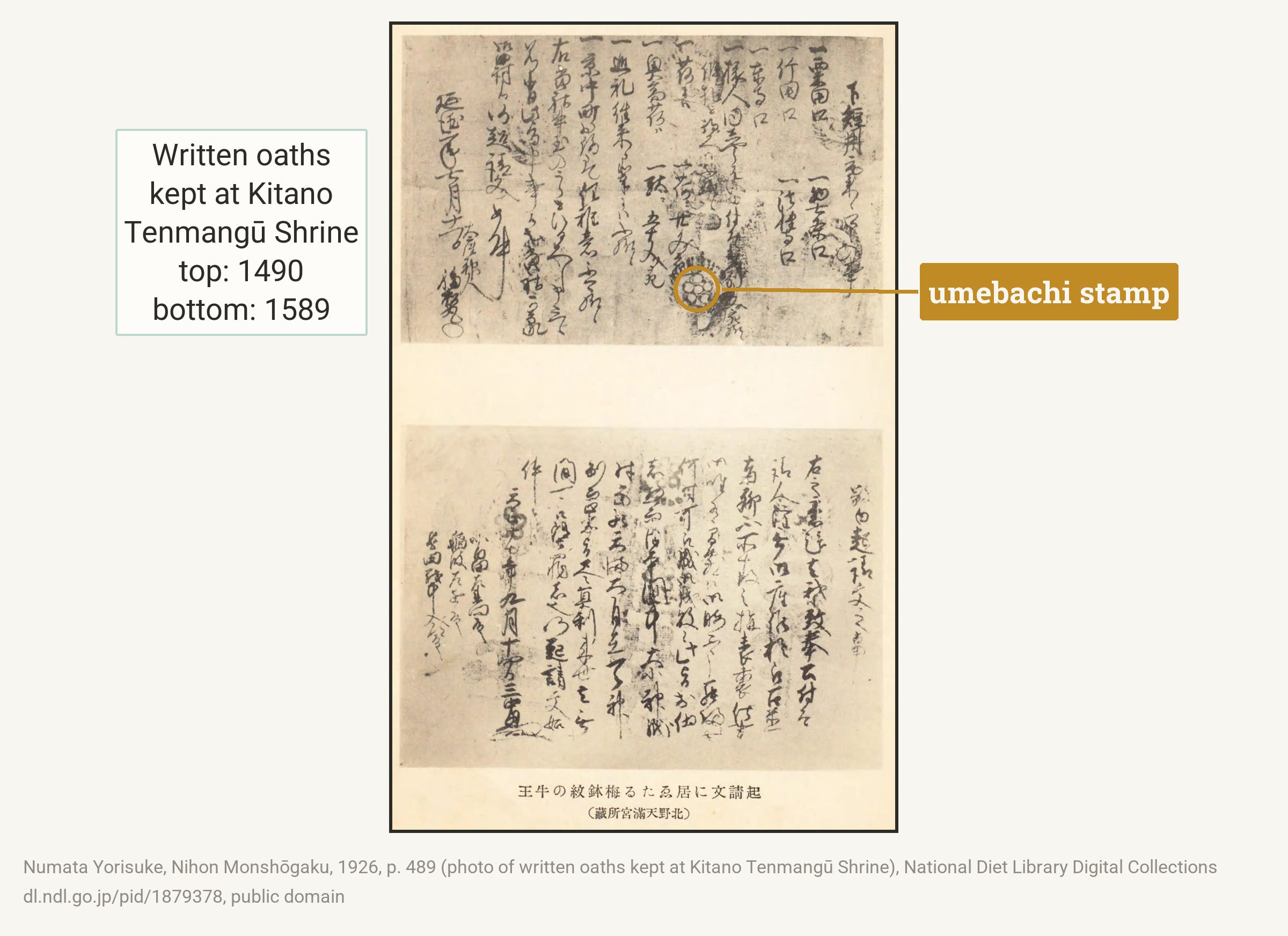
From the 14th to the 16th century, the umebachi appears on paper as well. When warriors, Japan’s military class, swore an oath to the gods, they wrote it on a document stamped with a shrine’s seal. These are called kishōmon, written oaths. Just like the paper charms called goō from the shrines of Kumano, the oaths of 1490 and 1589 kept at Kitano Tenmangū Shrine carry the stamp of the umebachi.¹ The goō were paper charms handed out by the shrines of Kumano; it was said that if you broke a promise written on them, crows of Kumano would die and you would fall into hell.³ On those oaths, the umebachi was stamped as the seal of the god.
The local lords who worshipped at Tenmangū
There were two roads by which a god’s crest became a family’s crest.
The first is the road of descent. Michizane’s descendants took the crest of their deified ancestor as their family crest. Among the court nobles of Kyoto, six families descend from Michizane: the Takatsuji, Higashibōjō, Karahashi, Gojō, Kiyooka, and Kuwahara. Five of them, all but the Gojō, used the plum crest.¹ Among warriors, there were the Hisamatsu of Owari, the western part of today’s Aichi Prefecture. The family later became daimyo of Matsuyama in Iyo and of Kuwana, and its crest is the umebachi.¹,³ In western Japan, a band of warriors in Mimasaka, the northern part of today’s Okayama Prefecture, known as the Kanke-tō, traced its line to a descendant of Michizane, and it used the umebachi too.¹,³
The second is the road of faith. A family with no blood tie to Michizane, but with faith in Tenmangū, takes the shrine’s crest as its own. This road spread to far more families.¹
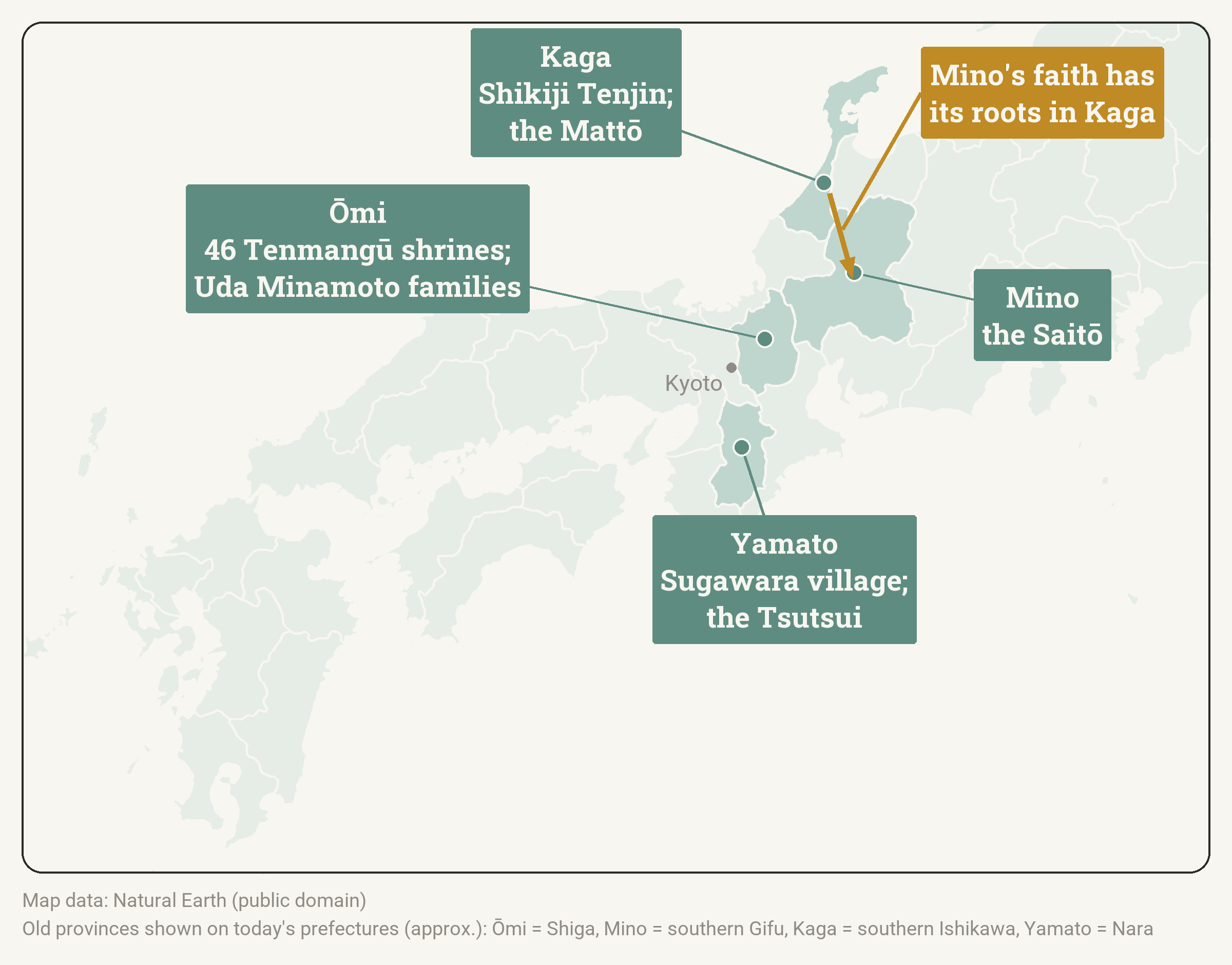
The warrior families of the Kamakura period were not yet using the plum. It does not appear in the records of their battles.¹ Faith in Tenmangū spread among warriors in the Muromachi period, from the 14th to the 16th century.¹,⁶ Kenmon Shokamon, a record of family crests from the second half of the 15th century, shows crests of the plum family for three houses. They are the Mattō of Kaga, the province around Kanazawa; the Tsutsui of Yamato, today’s Nara Prefecture; and the Taira.¹,² The Mattō took the Shikiji Tenjin shrine in Kaga as the guardian shrine of their clan, and the Tsutsui were based in Sugawara village in Yamato, where the Sugawara clan was born and a great Tenmangū shrine stood.¹ Whether those three crests are umebachi, though, is where the books part ways. Numata and Chikano read them as umebachi; Niwa Motoji reads them as plum star, plum blossom, and reverse plum, the blossom seen from behind, and says the umebachi was not yet in fashion.⁷
In the Warring States period, the 16th century, the heaviest users of the umebachi were the powerful local warrior families of Ōmi and Mino. Ōmi, today’s Shiga Prefecture just east of Kyoto, had 46 Tenmangū shrines.¹ The Sasaki and other families descended from Emperor Uda, the Kawashima, Tsuchihashi, Oka, Matsui, Nakajima, and Nomura, used the umebachi. A portrait of Gamō Ujisato, a warrior lord born in Ōmi, kept at Kōtokuji Buddhist temple in Aizu in today’s Fukushima Prefecture, shows the umebachi as well.¹ In Mino, today’s Gifu Prefecture just east of Ōmi, the Saitō family brought a share of the god from a Tenmangū shrine and enshrined it in every place they lived. The Saitō’s original crest was nadeshiko, a pink flower. That they used the umebachi anyway came from faith, Numata holds.¹ Saitō Dōsan brought a share of the god from a Tenmangū shrine and enshrined it, and made the plum his secondary crest.⁶ The Shikiji Tenjin shrines in Kaga and in Echizen were the guardian shrines of the Saitō, the Hayashi, and the Inokuchi. The Shikiji Tenjin shrines were not originally shrines to Michizane at all. Because of the name “Tenjin shrine,” people later came to take them for Tenmangū shrines.¹ Numata traces the roots of the faith in Mino back to Kaga.¹
The crest first, the clan name later
Normally a family has its lineage first, and the crest follows. For many umebachi families, it went the other way around. They took the umebachi out of faith, and then, in the Edo period, began to say they were of the Sugawara clan.
Examples are the Maeda, the Hori, the Kanamori, the Takenokoshi, and the Fukao.¹ The Fukao were originally of the Minamoto line descended from Emperor Uda; they moved to Mino in the 15th century and later changed their clan name to Sugawara. The Takenokoshi, too, used the umebachi while still of the Uda Minamoto line, and then changed to Sugawara.¹ An old record from Mino notes that calling the Saitō a Sugawara family just because they wear the umebachi is probably a mistake.¹ A senryū, a comic verse of the Edo period, put it this way.
Descendants of the thunder god: even their crest shines.
The “thunder god” is Michizane.⁷ The descendants are the Maeda of Kaga, and the crest is the umebachi.
The biggest example of all is the Maeda family of Kaga.
The Maeda claimed descent from Michizane. The domain’s own history says that a descendant of Michizane took the family name Maeda in Kyushu and moved to Arako in Owari, and that the sixth generation was Toshiie, who later became the daimyo of Kaga.¹ Kansei Chōshū Shokafu, a collection of warrior family genealogies compiled by the shogunate, the government run by warriors, also records that Michizane had two sons in Kyushu: the elder became the ancestor of the Maeda, and the younger of the Harada.⁷
The scholars read it differently. Numata sees the Maeda as a branch of the Saitō of Mino. The umebachi came from faith in Tenmangū, he writes; its meaning was “purely one of faith.”¹ Niwa Motoji, too, writes that the branch-of-the-Saitō theory is a reasonable one.⁷ Takasawa Hitoshi likewise records that the family is in fact held to be a branch of the Saitō.³ Much about the origins of the Maeda is said to be unclear. There is also a theory that in Noto, north of Kaga, Kitano Tenmangū Shrine held many estates, and that the Maeda played up their descent from the Sugawara to make the land easier to govern.¹⁵
The family’s story, and the scholars’ reading. I plan to cover the question of where the Maeda came from in a separate article.
The bachi of a million koku
Maeda Toshiie is held to have been born in 1538, and he died in 1599.¹⁵ He was the warrior lord who became the great daimyo of Kaga under Toyotomi Hideyoshi, the man who brought Japan under one rule at the end of the 16th century. From Hideyoshi he received the clan name Toyotomi, the family name Hashiba, and two crests: the paulownia with five and seven blossoms, and the chrysanthemum. He hardly used them, and stuck to the umebachi.¹⁵,¹⁶ On a folding screen showing the battle of Shizugatake in 1583, you can see banners with a black umebachi on a white ground.¹⁶
A koku is a unit of rice, and it measured the size of a daimyo’s lands. In the Edo period, the main house of the Maeda, the Kanazawa domain, held a little over 1.02 million koku. The branch houses, the Toyama and Daishōji domains, held 100,000 koku each.² There was one more Maeda branch, at Nanokaichi in Kōzuke, today’s Gunma Prefecture.
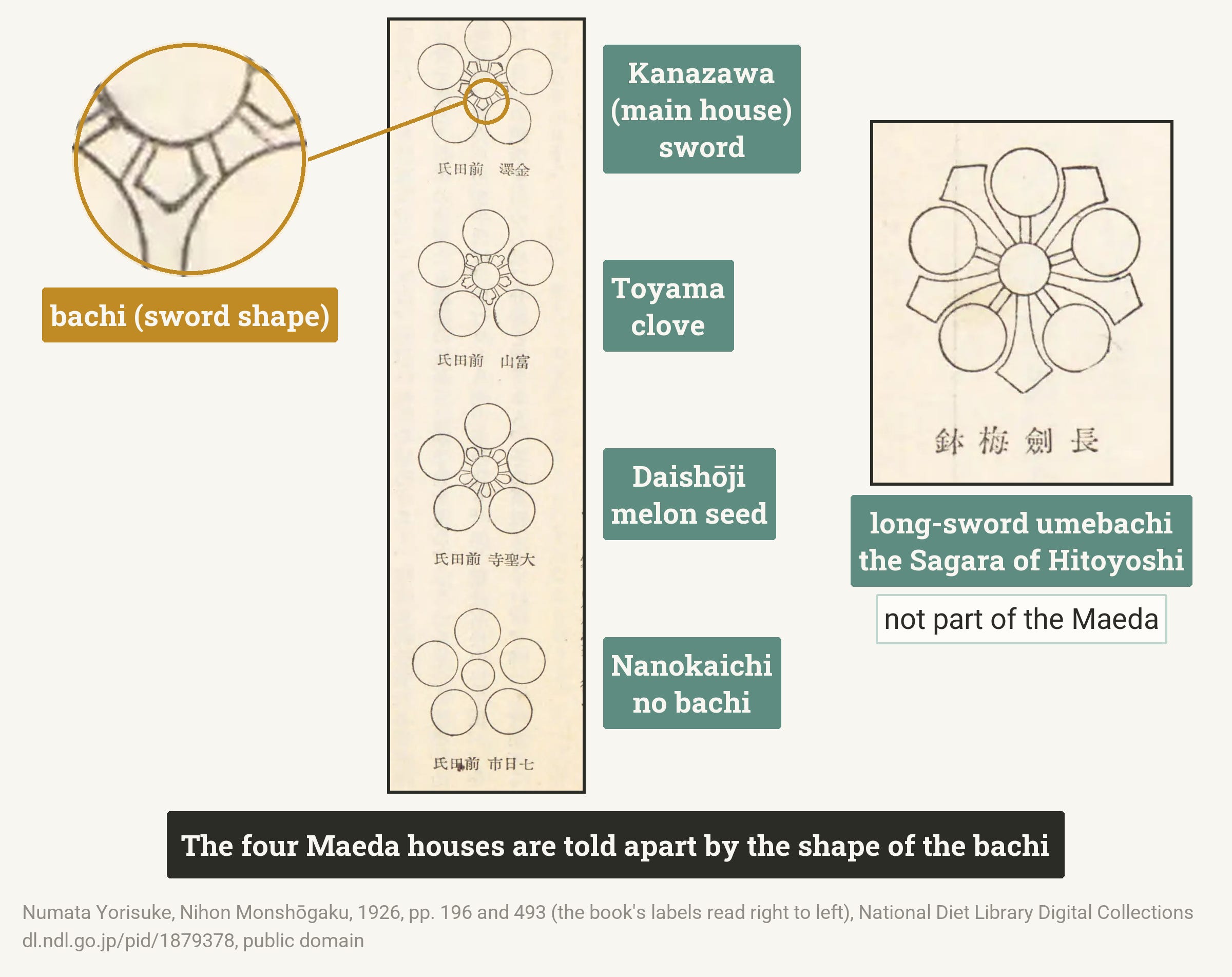
The four Maeda houses are told apart by the shape of the umebachi’s “bachi.” From the center of the umebachi, short bars reach out between the circles. These short bars are the bachi. The main house in Kanazawa uses the Ken-umebachi, or sword umebachi, with each bachi ending in a sword point. Because the sword has not yet grown long, it is also called the “young sword.”¹ Toyama’s bachi end in the swollen shape of a clove. Daishōji’s end in the shape of a melon seed. Nanokaichi in Kōzuke uses an umebachi with no bachi at all.¹,²,¹⁵ The Sagara of Hitoyoshi in Kyushu use the long-sword umebachi, with longer swords. They are not part of the Maeda family.¹
Main house and branch houses, told apart by a part of the crest. It is the same device the Mōri of Chōshū, today’s Yamaguchi Prefecture, used with the omodaka, arrowhead, a water plant, and the single bar over three stars.¹
The sword umebachi of the Kanazawa domain is also called the Kaga umebachi.¹⁰ At the start of the Edo period, in the 17th century, Kaga minted koban, oval gold coins, stamped with the umebachi, and the crest became widely known.⁶ It made its way into a senryū as well.
The scent of plum: in the directory of lords, a great income, plain to see.
The directory is the bukan, the register of the daimyo lords. The scent of plum, meaning the umebachi crest, stands out in the register alongside a very large income in koku, the verse says.¹⁰
Where the umebachi is today
The daimyo of the Edo period who used a plum crest were the Maeda and their branches; the Hisamatsu Matsudaira houses, which came out of the Hisamatsu of Owari; the Hori of Iida; the Sagara of Hitoyoshi; the Koide of Izushi; and others.³,⁶ Count the warrior families that served the shogun, Japan’s military ruler, directly, and the number changes from book to book. More than 250,³ over a hundred,⁶ over 110.²
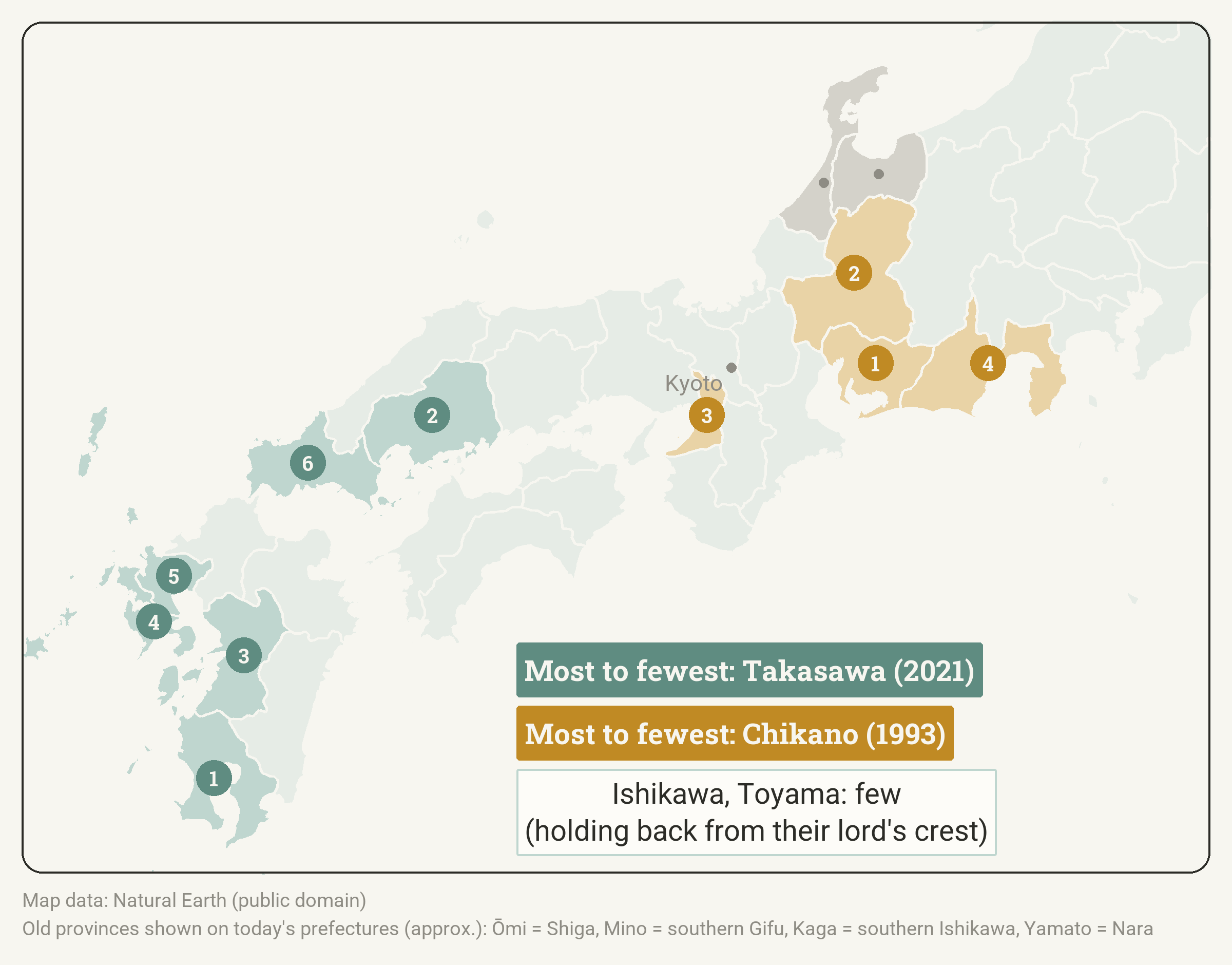
Today’s distribution, too, depends on how you count. Takasawa Hitoshi, writing in 2021, puts Kagoshima first, followed by Hiroshima, Kumamoto, Nagasaki, Saga, and Yamaguchi.³ Those are prefectures in Kyushu and western Honshu. By Chikano Shigeru’s count, published in 1993, the order is Aichi, Gifu, Osaka, and Shizuoka.² Those are prefectures in central Honshu. It is not that one is right and the other wrong; they counted different things in different ways.
What is clear is where the crest is scarce. Ishikawa and Toyama. In the Maeda’s own home ground, very few families use the umebachi. Chikano suggests they held back from using their lord’s crest.²
At the same time, Ishikawa Prefecture has more shrines with a plum as their crest than any other in Japan.¹⁰ Because the Maeda crest was the umebachi, the shrines connected with the family came to use the umebachi as their shrine crest too.⁸ Oyama Shrine in Kanazawa is not a shrine to Michizane. The ones enshrined there are Maeda Toshiie and his wife, Matsu. Even so, the brick fence around the main hall of this shrine, which moved to its present site in 1873, carries the sword umebachi.⁸,¹⁰
Families hold back; shrines display it. That is still the place of the umebachi of a million koku.
In the town of Kanazawa, the umebachi is still everywhere. There is Kanazawa Shrine, built in 1794 by the lord Maeda Harunaga. And among them is a shrine called Tsubakihara Tenmangū Shrine.⁸
In 1297, a Kaga warrior named Togashi Yoshichika brought a share of the god here and enshrined it.⁸ That was near the end of the Kamakura period, at the close of the 13th century.
The Maeda umebachi came from the Tenmangū faith of Mino, as Numata Yorisuke sees it. And the roots of that faith in Mino lay in Kaga. That the Maeda became the daimyo of Kaga at the end of the Warring States period was a matter of chance. Numata calls the crest’s return to this land “a strange twist of fate.”¹
On the right page of the two facing pages, the sword umebachi at No. 11 is that family’s crest. This book draws its swords long; on the crest of the main house at Kanazawa, they are much shorter. On the same page, the star umebachi at No. 6 is the crest of the god of Kitano.
When I hear “plum,” what comes to mind is the umeboshi, the pickled plum, inside a rice ball. It made me feel that something people still enjoy today, in one form or another, has been loved in all sorts of forms since long ago.
How I researched this
The books give different numbers for “more than ten thousand.” About 12,000 shrines,⁸,¹³ about 10,500,¹⁰ and 10,300.¹⁷ All of them pass ten thousand, so that is what I wrote.
Did Michizane love the plum? Are the three crests in Kenmon Shokamon umebachi? Are the Maeda descended from Michizane? None of the three questions could be settled by a single book. This article sets the books side by side and does not force them into one answer.
The books also differ on which form of plum each of the six families descended from Michizane used. In Numata Yorisuke’s Japanese Heraldry, the labels on the family tree and the summary table disagree with each other within the same book. In this article I gave only the family names and did not go into the shapes.
The same book also disagrees with itself on one family of Ōmi. The chapter on the plum writes the name Nakajima (中島), and the chapter on the distribution of crests writes it with a different second character (中内). In this article I followed the chapter on the plum.
Japanese Heraldry is a book from 1926. The machine-read text is garbled in places, so for the pages used in this article I read the scanned page images at the National Diet Library, Japan’s national library. The number of daimyo in the Edo period and the counts by prefecture today change with who counted and how, so I gave the source for each.
The crest images come mainly from two facing pages of Heian Monkan, a printed catalog of crests from 1936.¹⁸ I also used crests from A Study of Family Crests (1925)¹⁹ and Japanese Heraldry¹ (all three National Diet Library, public domain).
Notes
Japanese names in this article are written in the Japanese order, family name first (Sugawara no Michizane, Maeda Toshiie).
The English titles below are my own translations of the Japanese titles, given for convenience. The original Japanese details follow each.
References
¹ Japanese Heraldry (1926) — 沼田頼輔『日本紋章学』明治書院・1926(植物門 梅 印刷 p.484〜510)
² A Complete Catalog of Japanese Family Crests (1993) — 千鹿野茂『日本家紋総鑑』角川書店・1993
³ The Great Dictionary of Family Crests (2021) — 髙澤等『家紋大事典』東京堂出版・2021
⁴ A Dictionary of Family Crest Origins (1999) — 丹羽基二『家紋起源事典』青春文庫(刊行年=奥付に記載なし・著作権表示 1999)
⁵ Stories of Family Crests (1997) — 泡坂妻夫『家紋の話』1997
⁶ A Cultural History of Family Crests (1999) — 大枝史郎『家紋の文化史』講談社・1999
⁷ A Hundred Tales of Family Crests (1996) — 丹羽基二『家紋百話』上・河出書房新社・1996
⁸ An Illustrated Guide to Gods and Shrines Through Their Crests (2023) — クリエイティブ・スイート著・高澤等監修『神紋でたどる神様と神社のお詣り図鑑』二見書房・2023
⁹ A Seasonal Almanac of Family Crests (2011) — 高澤等『家紋歳時記』洋泉社・2011
¹⁰ A Survey of Shrine Crests (1974) — 丹羽基二『神紋総覧』講談社学術文庫・2016(原本 1974・秋田書店)
¹¹ The Complete Book of Family Crests (2012) — 高澤等監修『見て楽しい読んで学べる 家紋のすべてがわかる本』PHP 研究所・2012
¹² A Dictionary of Japanese Family Crests (2015) — 大隈三好『日本の家紋事典―由来と解説』金園社・2015
¹³ An Illustrated Book of Family Crests (2025) — 森本勇矢監修『思わず語りたくなる家紋の図鑑』三才ブックス・2025
¹⁴ A Dictionary of Crests (2020) — 波戸場承龍・波戸場耀次『紋の辞典』雷鳥社・2020
¹⁵ Reading the Warring States Period Through Family Crests (2026) — 小和田哲男監修『家紋で読み解く戦国時代』宝島社・2026
¹⁶ One Hundred Warlords: Their Crests, Banners, and Standards (2016) — 大野信長『【新装版】戦国武将100 家紋・旗・馬印FILE』学研プラス・2016
¹⁷ What to Know About Surnames and Family Crests (2010) — 武光誠『知っておきたい名字と家紋』河出文庫・2010
¹⁸ Heian Monkan, a printed catalog of crests (1936) — 『平安紋鑑』1936・国立国会図書館デジタルコレクション pid 1073121 コマ60(p.88〜89・パブリックドメイン)
¹⁹ A Study of Family Crests (1925) — 福井万次郎『定紋の研究』2 版・織要社・1925・国立国会図書館デジタルコレクション pid 909592 コマ114(下編 p.48・パブリックドメイン)
Video credits
Old pictures: Heian Monkan (平安紋鑑, 1936) — National Diet Library, pid 1073121; Japanese Heraldry (日本紋章学, 1926) — National Diet Library, pid 1879378; A Study of Family Crests (定紋の研究, 1925) — National Diet Library, pid 909592; The Poet Sugawara Michizane, by Kitao Shigemasa (1760s) — Art Institute of Chicago; Sugawara no Michizane, from Zenken kojitsu (前賢故実, 1868), by Kikuchi Yōsai — National Diet Library, pid 778219; a fragment of the Illustrated Legends of the Kitano Tenjin Shrine (ca. 1300) — The Metropolitan Museum of Art; Kitano Tenmangū Shrine, from Famous Places of the Capital, by Sadanobu — National Diet Library, pid 1305975; Geijutsu shiryō (芸術資料, 1937) — National Diet Library, pid 1906516; Hisui hyakkafu (非水百花譜, 1920), by Sugiura Hisui — National Diet Library, pid 13706432; Bugaku no zu (舞楽之図) — National Diet Library, pid 2574288; The Goddess Benten Holding a Biwa and a Young Man Holding a Hand Drum, by Katsukawa Shunshō (late 1780s) — Art Institute of Chicago; Turning a Shamisen, by Kitagawa Utamaro (ca. 1804/06) — Art Institute of Chicago; Maeda Toshiie kō (前田利家公, 1899) — National Diet Library, pid 781996; Kansei chōshū shokafu (寛政重脩諸家譜, 1922 edition) — National Diet Library, pid 1082717; a portrait of Gamō Ujisato — Wikimedia Commons. All in the public domain. Illustrated Legends of the Kitano Tenjin Shrine, the Kōan and Kenji versions (北野天神縁起絵巻), Tokyo National Museum, partly cropped — Created based on the information available on ColBase (https://colbase.nich.go.jp/collection_items/tnm/A-227, https://colbase.nich.go.jp/collection_items/tnm/A-12362). Photo of Kanazawa Shrine: Daderot, CC0, Wikimedia Commons. Pictograms: ICOOON MONO, Silhouette Illust, Icon-pit, and Phosphor. Map outlines: Natural Earth.
Music: “Seoto” (瀬音) by Miyagi Michio (1894–1956), in the public domain, newly arranged for this video.
The Stories Behind Old Japan brings you stories of old Japan, drawn from Japanese-language books, researched by hyt, who lives in Japan, and edited and translated with help from AI.
Another road by which a shrine’s crest became a family crest: the story of Hachiman’s tomoe is here: From Shrine Roofs to Family Crests


