

About three in ten of Japan’s major Shinto shrines display the same crest. That is what Niwa Motoji found when he surveyed shrine crests across the country.¹
Three comma-like shapes, each with a round head and a thin tail, set as if turning inside a circle. It is called tomoe (巴).
How did this crest become the crest of shrines, and then the crest of warrior families? Follow its trail, and you begin to see how one thing led to another.
The crest you see most at Japan’s shrines
From Hokkaido in the north to Okinawa in the south, the tomoe has reached shrines in almost every part of Japan.¹
You find it on roof tiles, on the metal fittings that cover nail heads, on stone lanterns, on ceilings, and on the cloth curtains hung across the front of a shrine. It is all over the buildings.¹
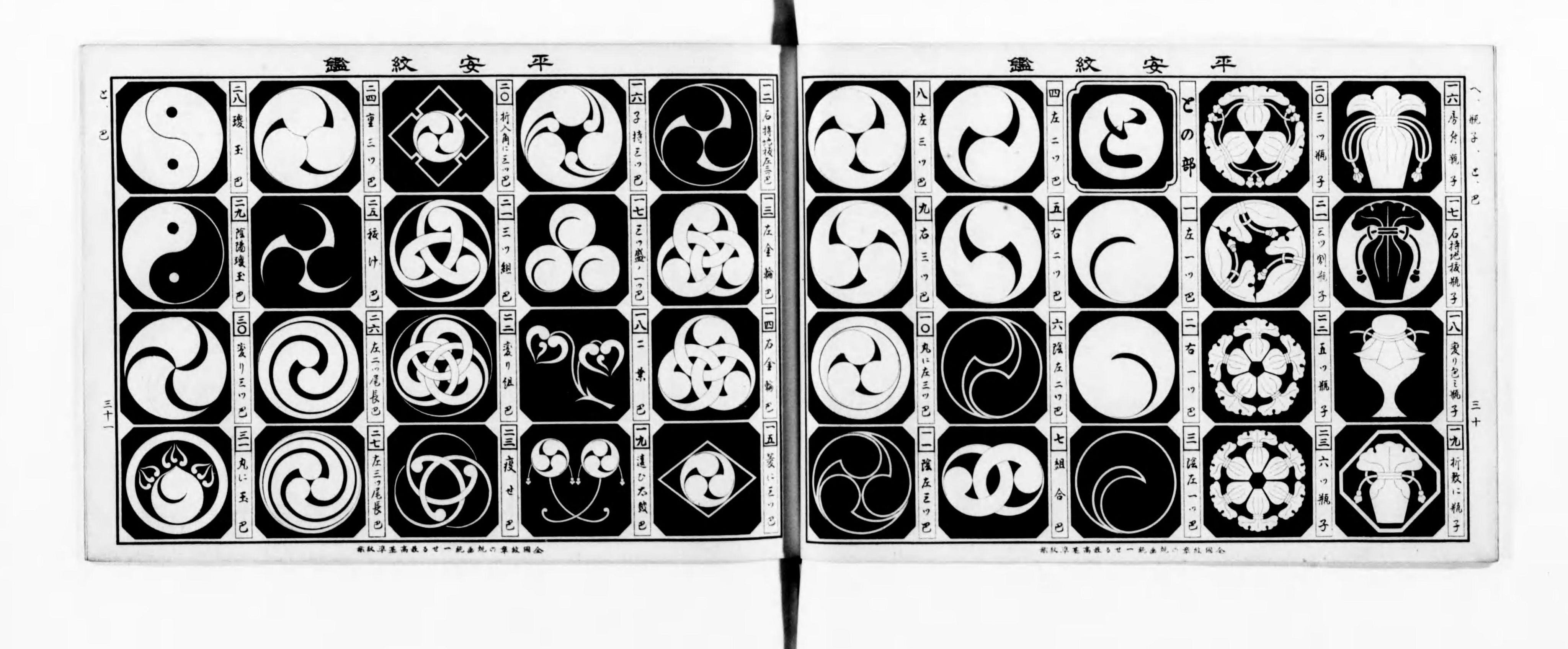
It comes in many shapes. Heian Monkan, a printed catalog of crests from 1936, lines up 31 shapes of tomoe alone. Some have one head, some two, some three.
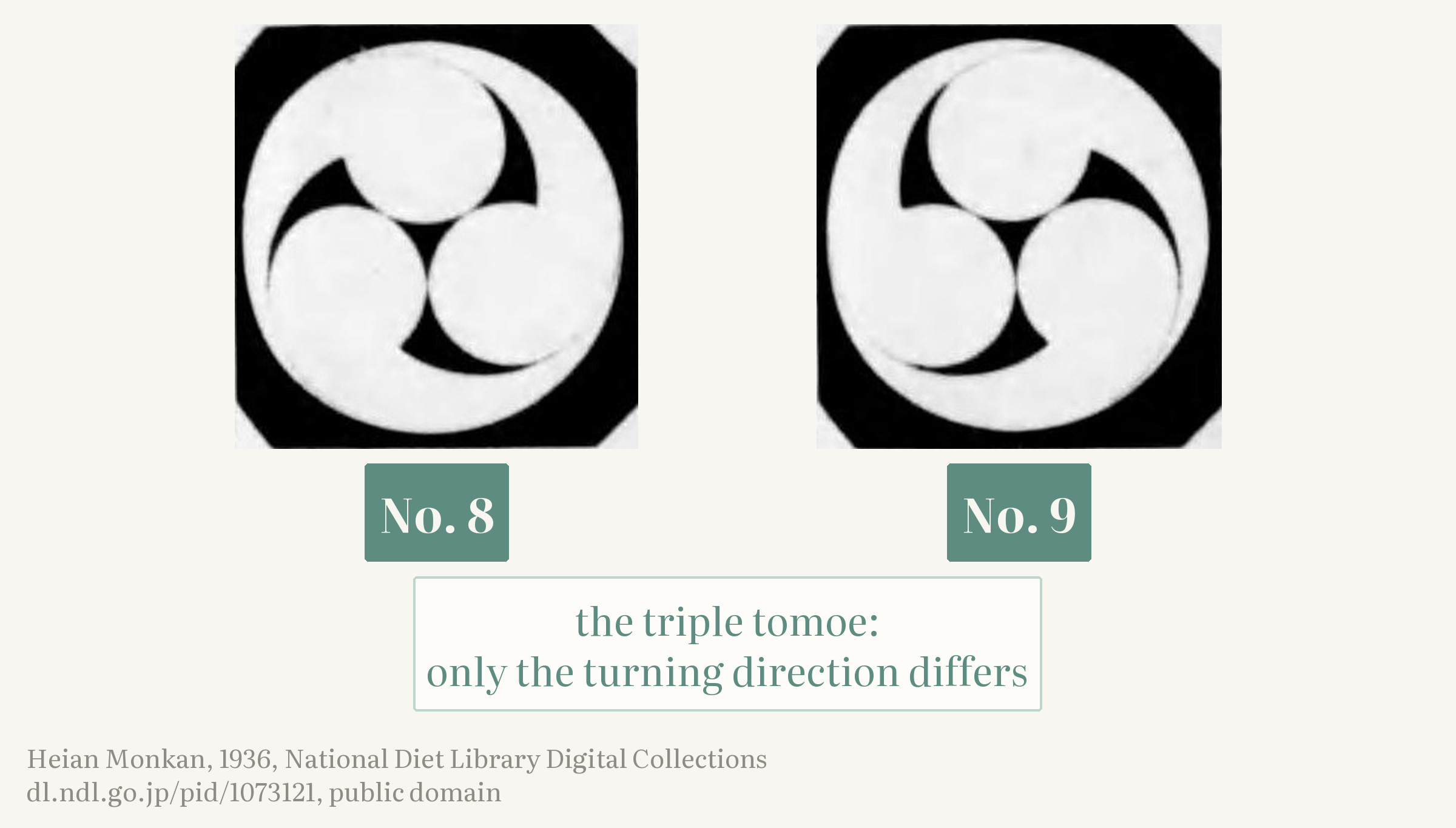
The most common is the one with three heads, the “triple tomoe.”² Most tomoe at shrines take this shape, too.¹
No. 8 and No. 9 on the two facing pages are that triple tomoe. The two differ only in the direction they turn.
A tomoe is called either “left” or “right.” But which turning direction counts as left depends on the book, and some books say the opposite. This article follows the labels in the 1936 catalog and does not go into the question of direction.
It began as a fashionable decorative pattern
The tomoe was not a shrine crest from the start.
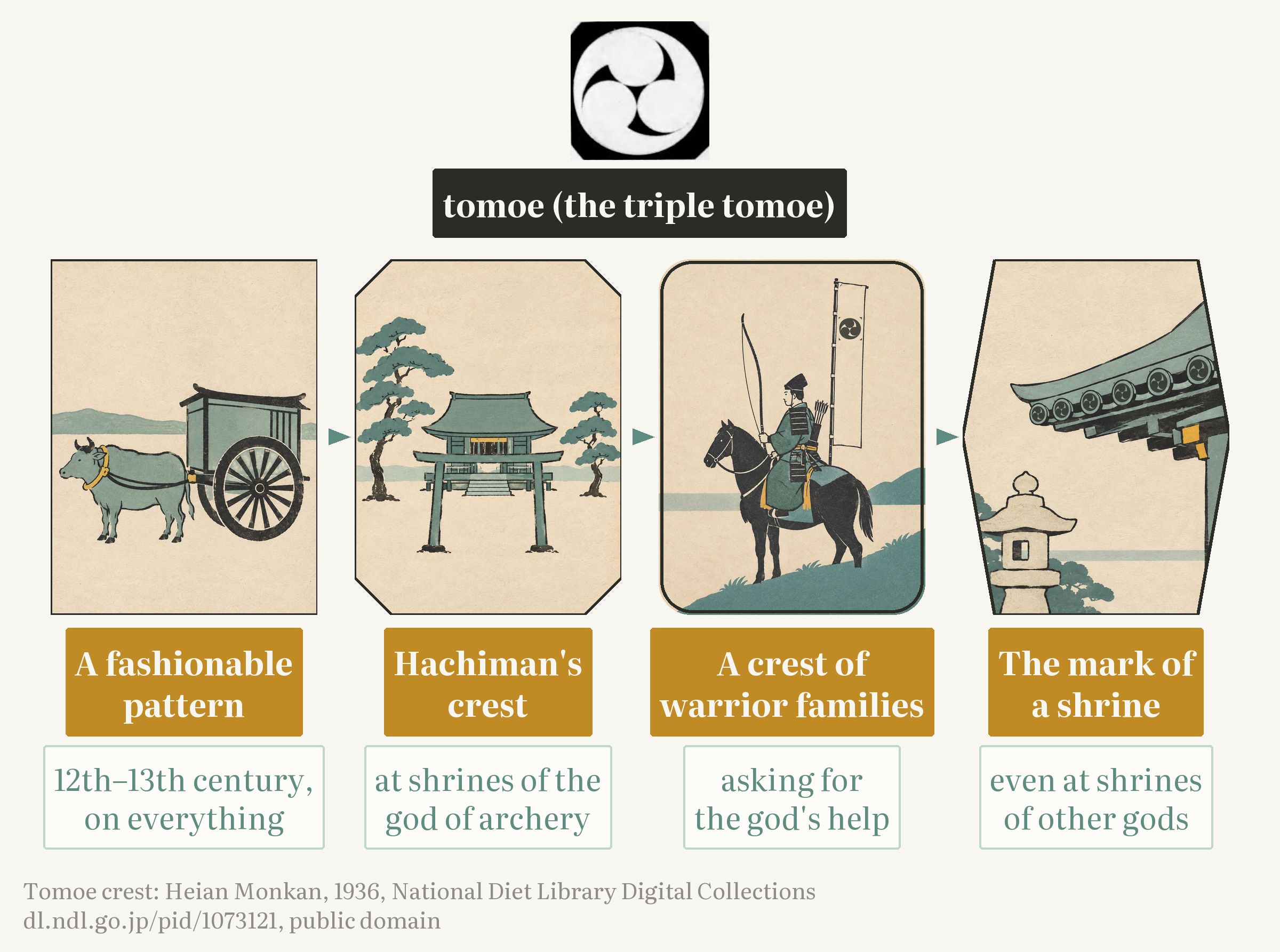
From the end of the Heian period into the Kamakura period, in the Japan of the 12th and 13th centuries, the tomoe was a hugely fashionable decorative pattern. Weapons, clothing, furniture, the ox-drawn carriages of the court nobles, the shafts of writing brushes, the sides of boats, bridge railings. It went on everything.³ Every picture scroll of the time has the tomoe drawn in it.²
Numata Yorisuke sees this as fashion. Even its frequent use on weapons was “simply following the fashion,” he writes, with no special meaning behind it.²
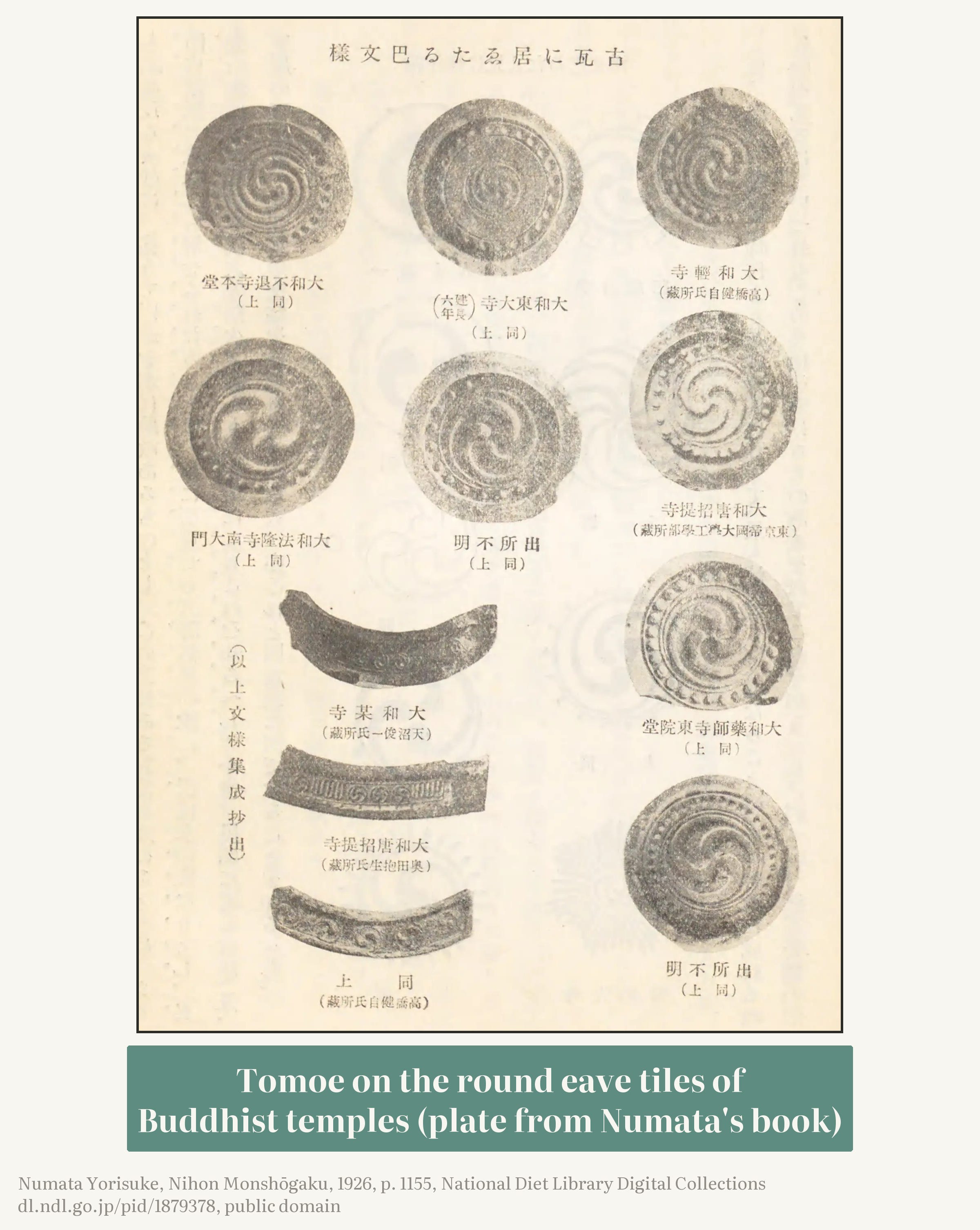
Roof tiles were part of this fashion, too. The round tiles at the eaves of Buddhist temples had carried a lotus flower pattern until then. From the second half of the Heian period, the tomoe took its place. The tiles themselves came to be called “tomoe tiles.”²
The tomoe on a tile does carry a meaning. People of the time saw the tomoe as a whirlpool. Water puts out fire. The tomoe at the eaves is a charm against fire.²
What the tomoe originally depicts is not settled. A whirlpool, thunder, an archer’s tool. Takasawa Hitoshi lists seven leading theories.⁴ I plan to cover this in a separate article.
It becomes the crest of Hachiman
Hachiman is the god of archery. The gods enshrined are the ancient Emperor Ōjin and his mother, Empress Jingū.¹,⁵ He is also called “Hachiman of the bow and arrow.” The Minamoto clan, a family of warriors, Japan’s military class, made it their custom to pray to Hachiman before going into battle.¹
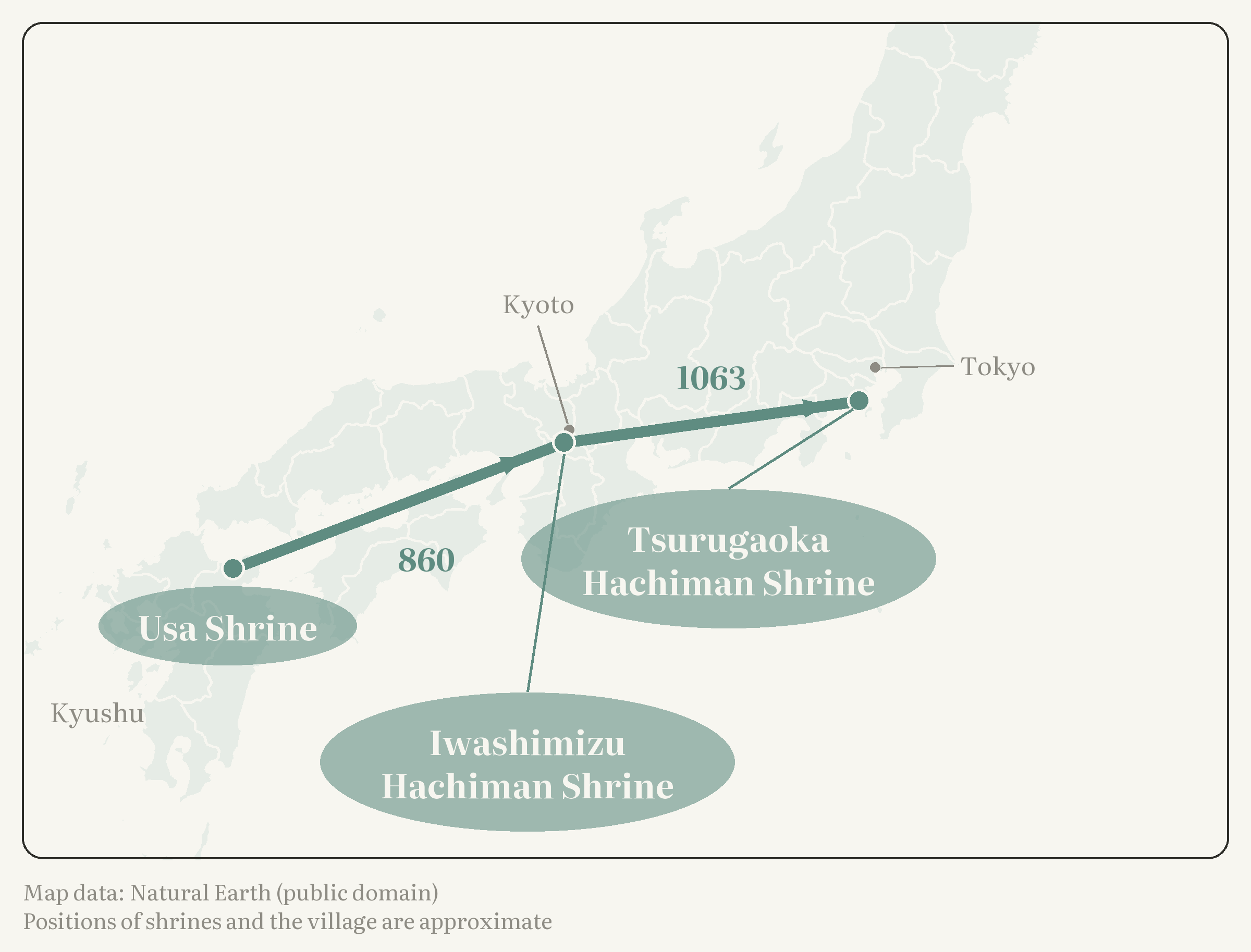
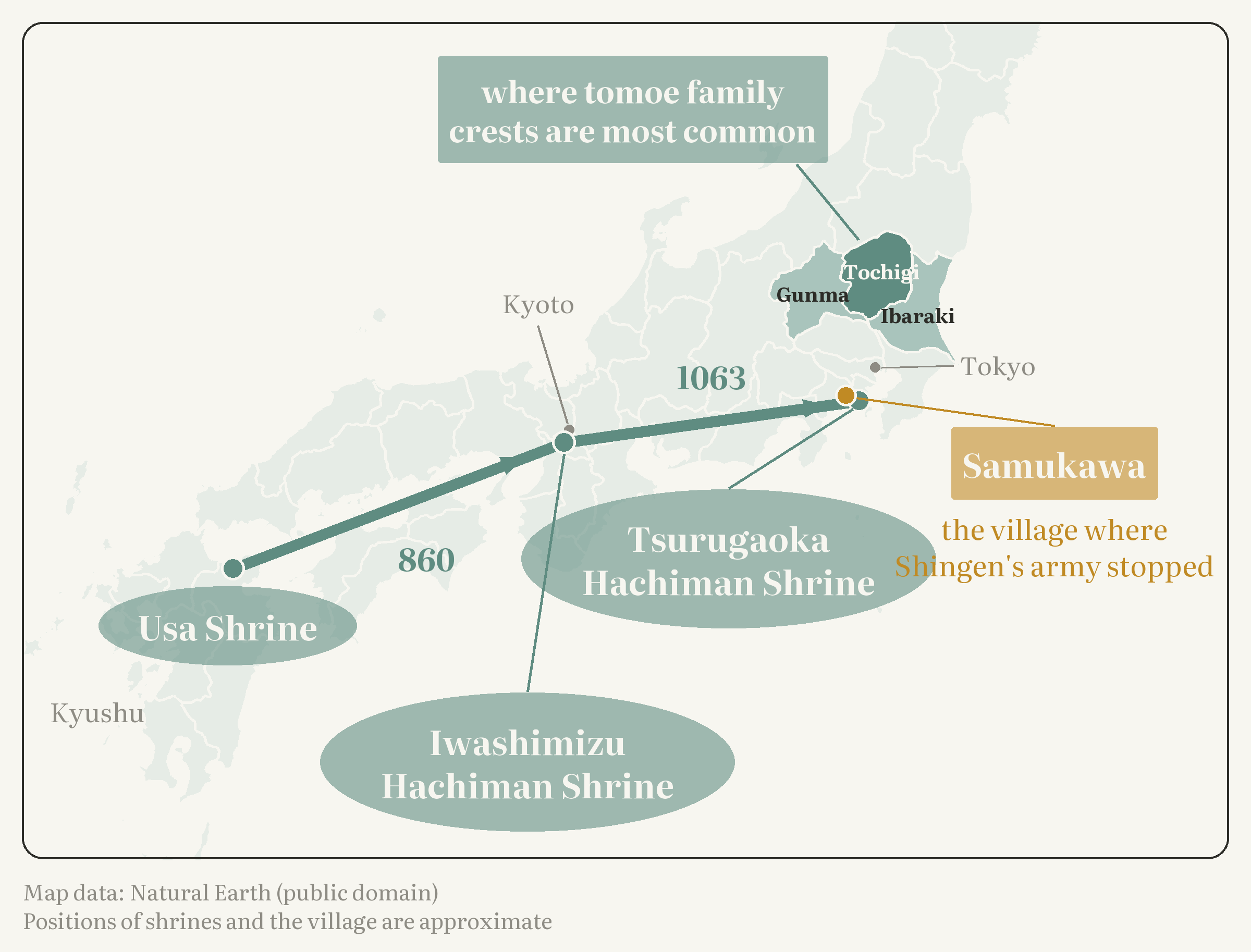
The original shrine is Usa Shrine in Kyushu, in southwestern Japan. In 860, Hachiman was also enshrined near Kyoto, which was then the capital. This is Iwashimizu Hachiman Shrine.
In 1063, Minamoto no Yoriyoshi of the Minamoto clan enshrined Hachiman once more, as a branch of Iwashimizu, in Kamakura to the east, southwest of today’s Tokyo. This became Tsurugaoka Hachiman Shrine.¹
At the end of the 12th century, Minamoto no Yoritomo of the Minamoto clan set up a government run by warriors in Kamakura. Hachiman was the guardian god of the Minamoto. Warriors enshrined Hachiman on their own lands as well. At the time of Niwa’s survey there were 25,000 Hachiman shrines across the country, and almost all of them had branched off from these three.¹
And those Hachiman shrines all bore the tomoe.
Why the tomoe for Hachiman? The books explain it in two ways
Here, the explanation depends on the book.
The first is the fashion explanation. Hachiman shrines were being built across the country just when the tomoe was in high fashion. A fashionable pattern gets used to decorate buildings. In time the decoration became a charm against evil and a charm against fire, and in a later age it was taken to be the god’s crest.¹,⁵
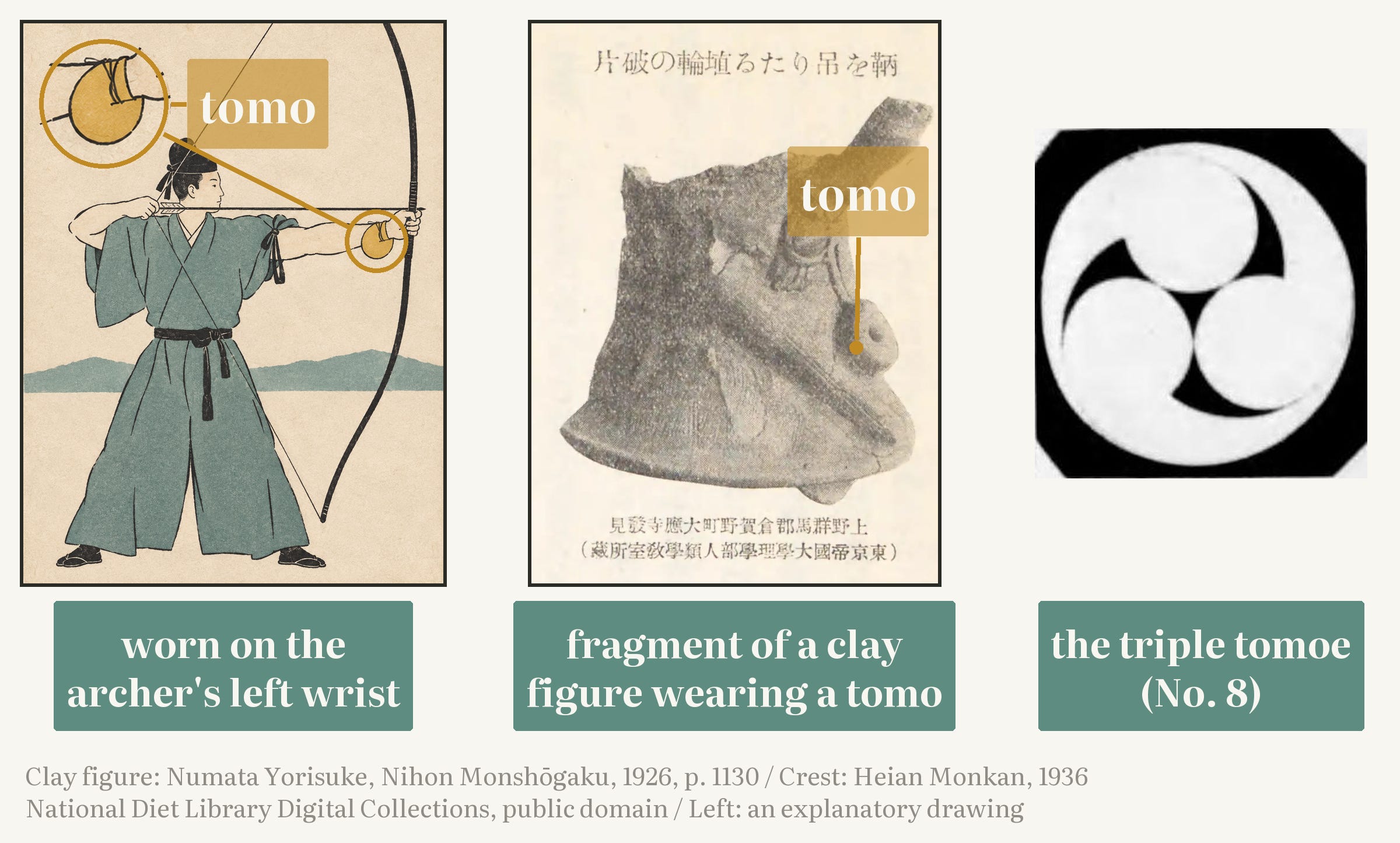
The second is the archer’s-tool explanation. The name tomoe comes from “tomo-e,” a picture of a tomo. A tomo is a leather guard that an archer wears on the left wrist when drawing the bow. It keeps the bowstring from striking the wrist.²
Up to this point, the books agree. Takasawa Hitoshi takes it from here to Hachiman.
Hachiman is the god of archery. The Nihon Shoki tells that Emperor Ōjin, the enshrined god, was born with an arm as thick as if a tomo were wrapped around it. The Nihon Shoki is a history compiled in the 8th century.
That is why the tomoe, which recalls the tomo, became Hachiman’s crest, Takasawa writes.⁴ Warriors, too, took the tomoe to be “a picture of a tomo” and prayed to Hachiman for skill with the bow.⁵
There is also a theory that the tomoe shows Emperor Ōjin as he lay in his mother’s womb.¹
Which one is right is not settled. Numata Yorisuke sums it up this way: the tomoe crest carries both meanings, beauty and faith.²
Takemitsu Makoto puts the two in order. First it went onto shrines as a fashionable decoration, and later warriors took it to be a picture of an archer’s tool.⁵
The shape of a fashion became the shape of a prayer.
Warriors who believed in Hachiman make it their family crest
The first to use the tomoe as a family’s mark were not warriors. In the 11th century the Saionji, a family of court nobles in Kyoto, used it as the mark on their ox-drawn carriages.²,³ I plan to cover this in a separate article.
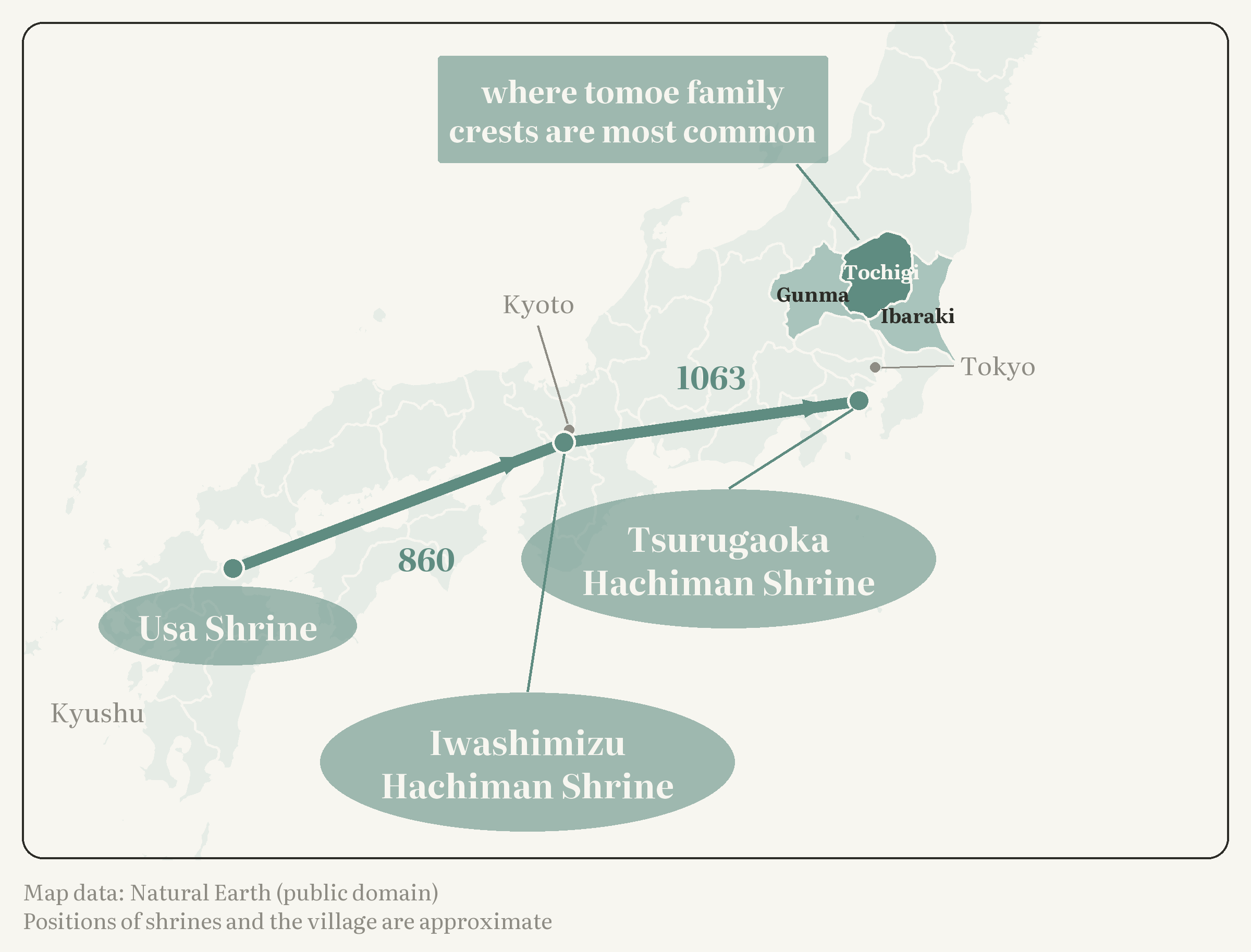
Most warrior family crests date from the Kamakura period, which began at the end of the 12th century. Numata names three warrior families that made the tomoe their family crest: the Utsunomiya, the Oyama, and the Yūki.² All three were families of the northern Kanto Plain, which spreads out north of Tokyo, in what are now Tochigi Prefecture and the western part of Ibaraki Prefecture.
Numata writes as follows. The tomoe was regarded as the crest of Hachiman, the god of archery. So warriors who revered Hachiman made it their family crest and asked for the god’s help.² Ōkuma Miyoshi also writes that many warriors hoping for the god’s help “asked for it and made it their family crest.”³
The three families kept their roots in this land for hundreds of years. The families that branched off from them used the tomoe, and so did the families that followed them. As a result, Numata wrote in 1926, the tomoe is most common in what is now Tochigi Prefecture, and it spreads into neighboring Gunma and Ibaraki Prefectures.² In a 1993 book, Chikano Shigeru writes that this pattern has changed little.⁶
In the Edo period, from the 17th to the 19th century, 340 to 350 of the warrior families that served the shogun, Japan’s military ruler, used the tomoe. The number comes from counting in Kansei Chōshū Shokafu, a collection of warrior family genealogies compiled by the shogunate, the government run by warriors.²,⁴
It spreads to shrines that are not Hachiman’s
The tomoe did not stay at Hachiman shrines alone.
“Even shrines that were not Hachiman shrines commonly used the tomoe crest as the symbol of a shrine.” These are the words of Niwa Motoji.¹ Hoping to share in Hachiman’s power, other shrines put the tomoe on their buildings as well.
Yasaka Shrine in Kyoto, Katori Shrine in Chiba Prefecture, just east of Tokyo, and Kanda Shrine in Tokyo. None of them enshrines Hachiman. Their crest is the tomoe.¹,⁷
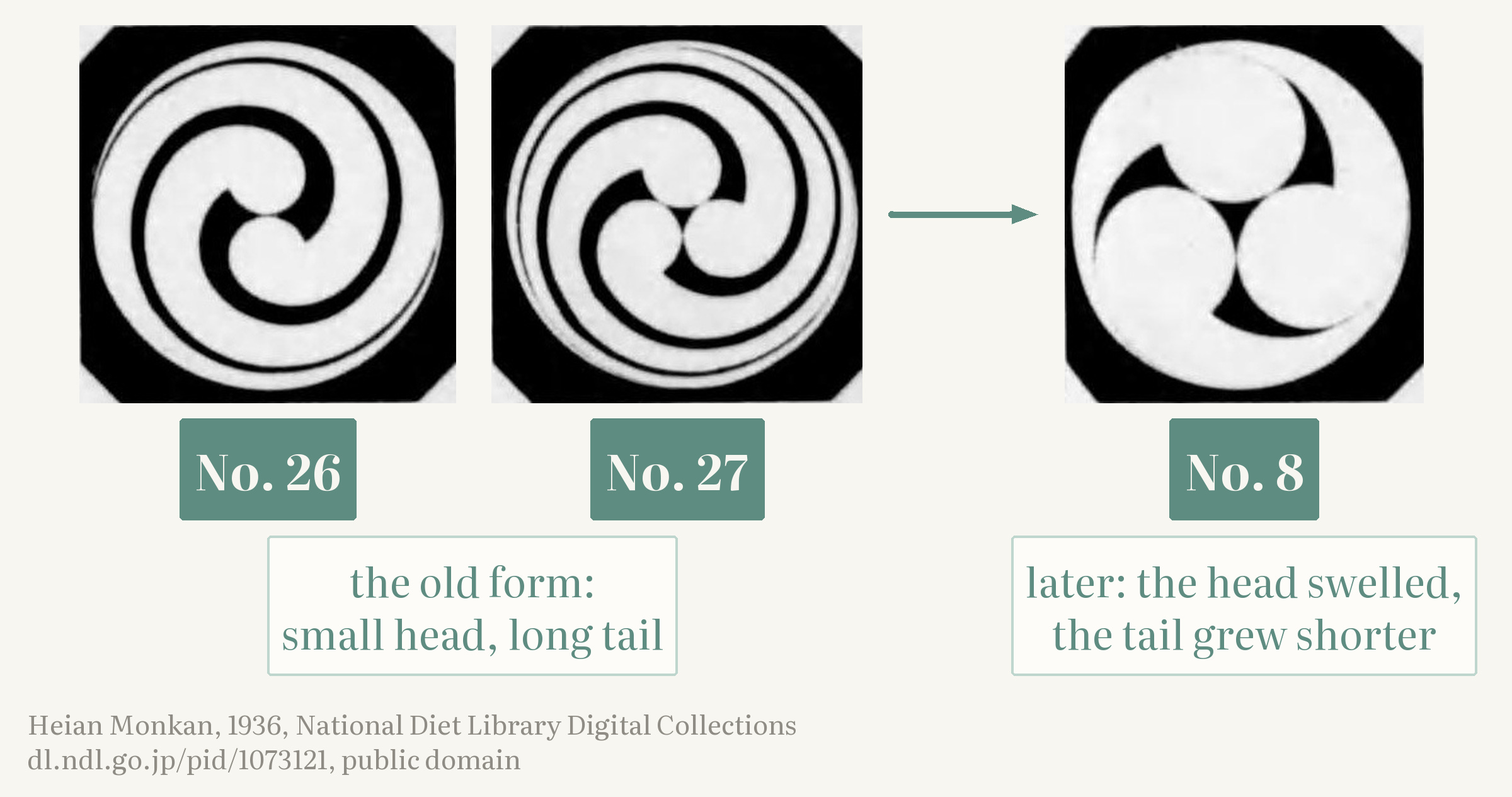
The tomoe of older times has a slightly different shape. The head is small and the tail is long. As time went on, the head swelled and the tail grew shorter.¹ No. 26 and No. 27 on the two facing pages are tomoe that keep the old long-tailed form.
In this way the tomoe went from being Hachiman’s crest to being the mark of the shrine itself. The “about three in ten” at the start of this article is the result.
This is a story from the Warring States period, the 16th century.
Takeda Shingen, a warrior lord who ruled a mountain province in central Japan, led a great army into what is now Kanagawa Prefecture, southwest of Tokyo. When they reached a village called Samukawa, the whole army stopped. Deep in a pine grove, banners with the triple tomoe were flying. It was a Hachiman shrine.
Shingen ordered the advance. A senior retainer took hold of his horse’s reins and stopped him. Hachiman is the guardian god of warriors. Attack, he said, and the god would punish him.
Shingen grudgingly paid his respects to the shrine, offered his helmet to it, and turned back, the story goes.¹
This shrine is today’s Samukawa Shrine. It was not originally a Hachiman shrine. In an age of constant fighting, it had called itself a Hachiman shrine to protect itself from the soldiers of other provinces.¹
The tomoe was a crest on which warriors placed their prayers. At the same time, it was a crest that stopped warriors.
What flew on those banners was the triple tomoe. It is the shape of No. 8 and No. 9 on the two facing pages.
I had heard the word tomoe, and I had seen the basic tomoe family crests. But I knew nothing at all of the history behind it, or of the fact that it is spread so widely across shrines all over Japan. Even about familiar things in the country where I was born and raised, there is a lot I do not know.
How I researched this
“About three in ten” is a figure from Niwa Motoji’s survey. In his 1974 book, Niwa gathered the crests of the major shrines across Japan, 3,285 shrine entries in all. These were shrines that held a certain rank or higher under the system in place before World War II.
Of these, the tomoe accounted for “about 30 percent or more.” Count the small shrines too, Niwa writes, and the share rises further. It is a figure from 50 years ago, limited to the major shrines.
No single book answered the question “Why the tomoe for Hachiman?”
Takemitsu Makoto (2010) explains it from fashion.⁵ Takasawa Hitoshi (2021) explains it from Emperor Ōjin and the tomo.⁴ Niwa Motoji (1974) touches on both and also gives the theory of the child in the womb.¹ Numata Yorisuke (1926) sums it up as both beauty and faith.²
For this article, I set the four books side by side. I have not made them into one answer.
There is a reason I did not go into the “left” and “right” names of the tomoe. While looking into this, I found that within one and the same book, the tomoe of Usa Shrine is “right” in the main text and “left” in the table. The author, Niwa himself, notes that he wrote them down just as the shrines reported them.
There are two schools that name the directions in opposite ways. I plan to cover this in a separate article.
The crest images are from the two facing pages of Heian Monkan, 1936 (National Diet Library, Japan’s national library; public domain).⁸ The ox-drawn carriages of the nobles, the banners of warriors, the tomoe of the royal house of Ryukyu, in what is now Okinawa. I have left the family side of the story outside the scope of this article.
Notes
Japanese names in this article are written in the Japanese order, family name first (Niwa Motoji, Takeda Shingen).
The English titles below are my own translations of the Japanese titles, given for convenience. The original Japanese details follow each.
References
¹ A Survey of Shrine Crests (1974) — 丹羽基二『神紋総覧』講談社学術文庫・2016(原本1974・秋田書店)
² Japanese Heraldry (1926) — 沼田頼輔『日本紋章学』明治書院・1926(文様門 第一章 巴 p.1129〜1191)
³ A Dictionary of Japanese Family Crests (2015) — 大隈三好『日本の家紋事典―由来と解説』金園社・2015
⁴ The Great Dictionary of Family Crests (2021) — 髙澤等『家紋大事典』東京堂出版・2021
⁵ What to Know About Surnames and Family Crests (2010) — 武光誠『知っておきたい名字と家紋』河出文庫・2010
⁶ A Complete Catalog of Japanese Family Crests (1993) — 千鹿野茂『日本家紋総鑑』角川書店・1993
⁷ A Cultural History of Family Crests (1999) — 大枝史郎『家紋の文化史』講談社・1999
⁸ Heian Monkan, a printed catalog of crests (1936) — 『平安紋鑑』1936・国立国会図書館デジタルコレクション pid 1073121 コマ31(p.30〜31・パブリックドメイン)
Video credits
Old pictures: Nihon monshōgaku (日本紋章学, 1926) — National Diet Library, pid 1879378; Kansei chōshū shokafu (寛政重脩諸家譜, 1922 edition) — National Diet Library, pid 1082717; Mōko shūrai kassen emaki (蒙古襲来合戦絵巻, a later copy) — National Diet Library, pid 2591514; Empress Jingū and Her Minister Takenouchi no Sukune, by Katsukawa Shun’ei (late 1780s) — Art Institute of Chicago; The Fourth Battle at Kawanakajima, by Utagawa Yoshitsuna (ca. 1847–52) — The Metropolitan Museum of Art. All in the public domain. Pictograms: ICOOON MONO, Silhouette Illust, Icon-pit, and Phosphor. Map outlines: Natural Earth.
Music: “Seoto” (瀬音) by Miyagi Michio (1894–1956), in the public domain, newly arranged for this video.
The Stories Behind Old Japan brings you stories of old Japan, drawn from Japanese-language books, researched by hyt, who lives in Japan, and edited and translated with help from AI.
I plan to cover the tomoe as a family crest (ox-drawn carriages, warrior banners, the royal house of Ryukyu) in a separate article.


