About The Stories Behind Old Japan
About this personal magazine
In The Stories Behind Old Japan, I explore the stories behind old Japanese pictures and designs, one at a time. I write about what they mean, how they came about, the books they appear in, and where you can see the originals.
Toward the end of the Edo period (from the 17th to the 19th century), terakoya, small schools where children learned to read and write, had spread beyond Japan’s towns to farming, mountain, and fishing villages. Many books were published for ordinary people to enjoy: light reading, illustrated books, and ukiyo-e woodblock prints. One record shows that around 1808, Edo, today’s Tokyo, had 656 book lenders, people who rented out books to readers.
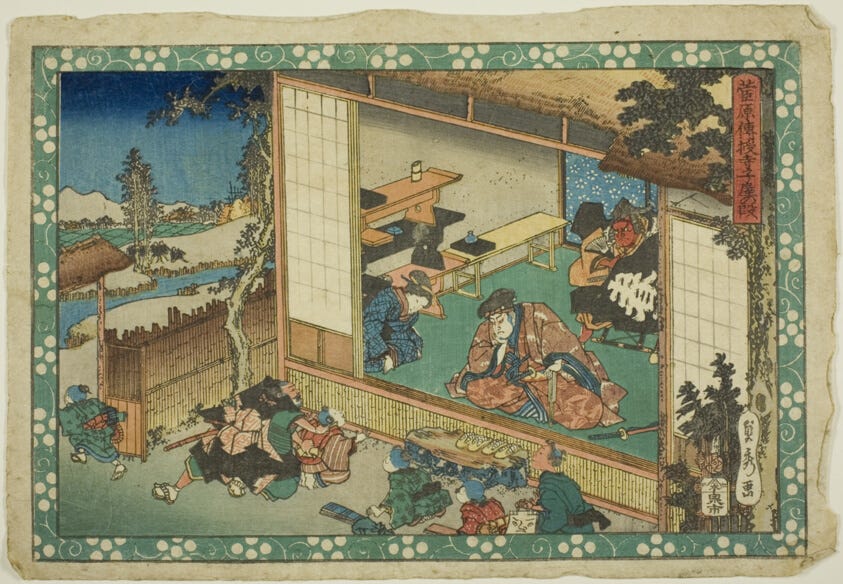
The Village School Scene (Terakoya), a scene from the play Sugawara’s Secrets. Utagawa Sadahide, c. 1830/44. Art Institute of Chicago (public domain).
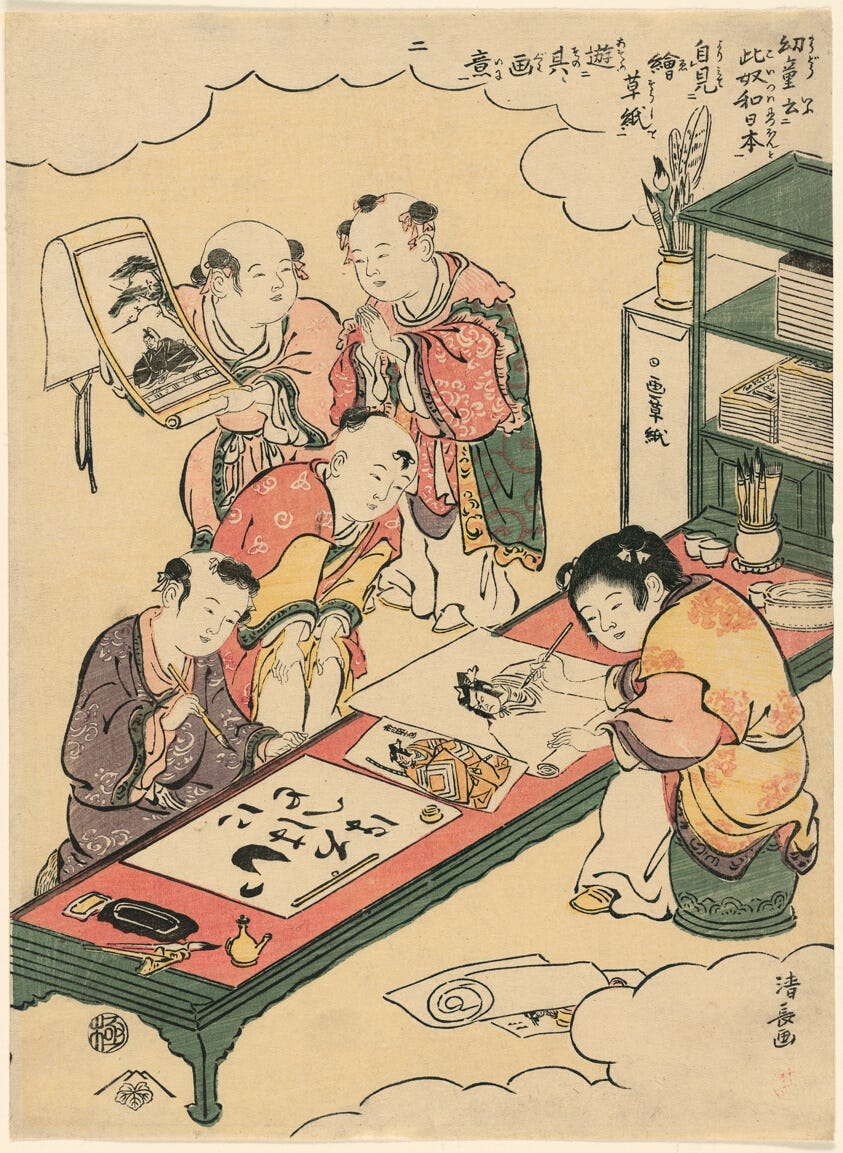
Chinese boys copying paintings and writing Japanese, from the series “Children Say ‘This is Japan!’ and Imitate the Games They See in Picturebooks.” Torii Kiyonaga, c. 1791. Art Institute of Chicago (public domain).
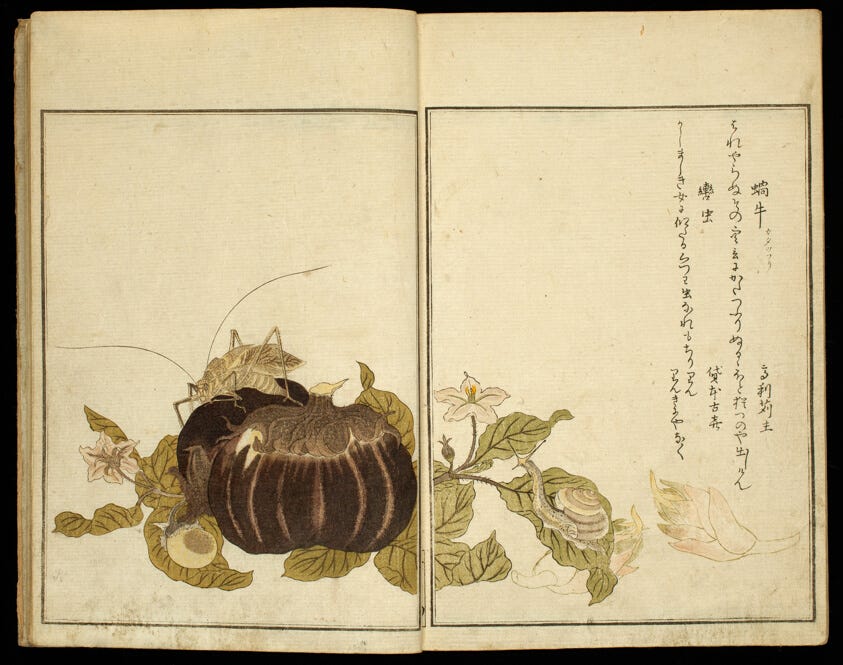
Picture Book: Selected Insects (Ehon mushi erabi). Kitagawa Utamaro, 1788. Art Institute of Chicago (public domain).
However, my own sense is that after Japan began taking in Western culture at the end of the Edo period, the people who could use English were concentrated in an elite of scholars and government officials, and translations from Japanese into English were mostly limited to academic books and some literary works. A 2026 report from Japan’s Agency for Cultural Affairs also says that because Japanese books have long worked as a business within a large home market, there are not enough people or systems to take them abroad, and not enough skilled literary translators whose quality can be relied on.
Haruki Murakami’s books have been translated into English for decades, but many other Japanese novels, by writers such as Mieko Kawakami and Sayaka Murata, have been translated only recently. Manga, too, is now translated and read around the world. Crafts such as Nambu ironware (cast-iron kettles and pots) and craft techniques such as kintsugi, the art of mending broken pottery with lacquer and gold, also seem to be drawing more attention.
Beyond these few kinds of cultural information and expensive crafts, I personally think the everyday side of Japanese culture, the part that connects to the past, holds a great deal that is interesting. In The Stories Behind Old Japan, I take what I have looked into and enjoyed on my own, translate it into English, and pass along a little of it to you.
I began with articles about family crests, or kamon. Next, I plan to write in genres such as ukiyo-e, Shinto shrines and Buddhist temples, daily life in Edo, folklore studies, and castles and their stone walls. Each genre has its own section, and you can choose one from the “Reference” tab at the top.
The subtitle, a little give and play, means a little flex and a little room to move. The more I look into Japanese culture, the more often I find that a little give and play matters, whether in how people care for nature or in things they have made. I am fond of this quality, so I made it the subtitle.
About me
I am hyt, one Japanese person living in Japan.
What I do is something like the work of a curator of old Japanese culture. I love reading and old Japanese culture, and I have enjoyed learning English since I was a child.
I have also spent time living abroad. Still, what truly made sense to me, deep down, was often tied to the past of the culture I grew up in. Reading the stories of old Japan is a way of tracing that past.
As a personal life project, I have set one broad direction: to learn from the wisdom of the past in the culture I grew up in, and to reshape it for life today with new technology.
Much of the old wisdom tucked away in Japanese culture is fascinating. I thought that if I re-edited what I have gathered from nearly 20 years of reading, along with notes I have organized and edited for myself, and translated it into English, people around the world who are interested in Japanese culture might enjoy it too. AI is the technology that makes this possible.
I am not a scholar. I write for general readers, and I edit these articles from general-interest books written in Japanese.
How I make the articles
Even with AI making the work faster, editing still takes time.
My main sources are general-interest books, and when needed I also draw on academic papers and explanations published by public institutions. All of these sources are written in Japanese. In other words, I build each article on books, papers, and public explanations published in Japanese, and I take care not to lean on my own guesses.
I write each article in Japanese and check its content and wording. Then I translate it into English and check the content and wording again, in English. I go through these steps for every article.
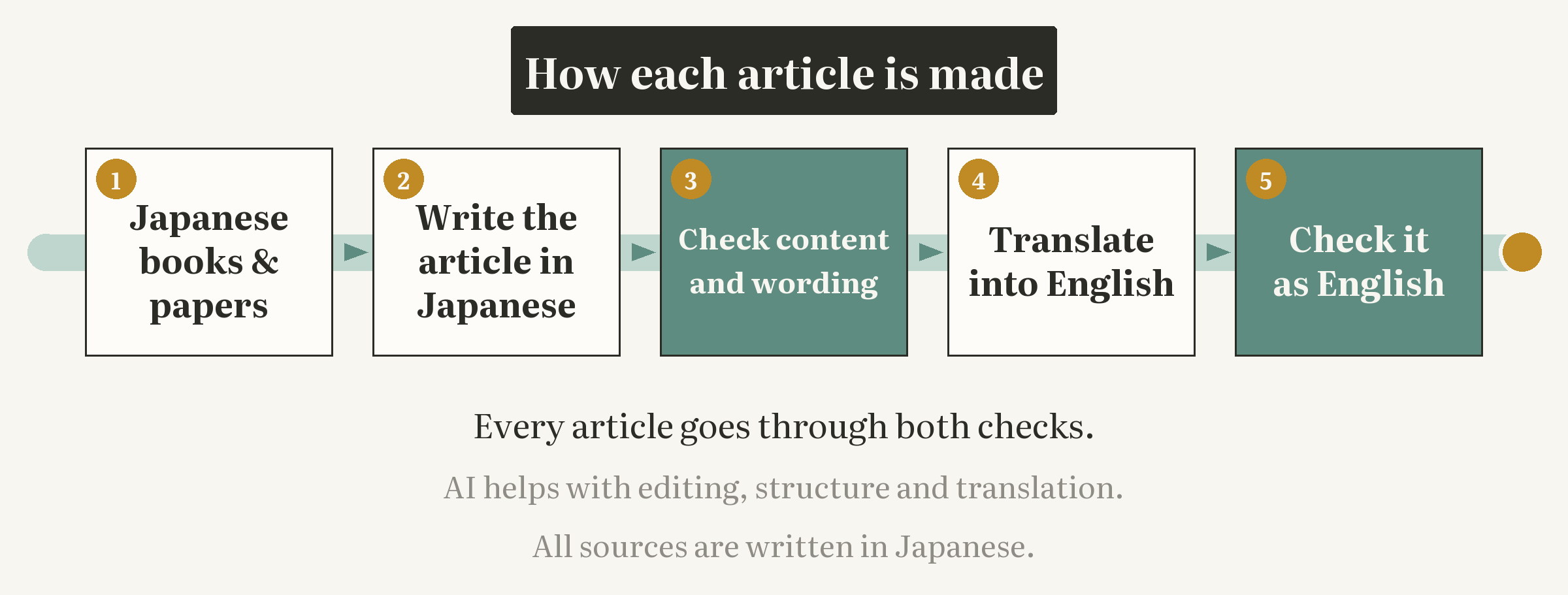
I get help from AI with editing, structure, and translation, but I do not use information from the internet whose source is unclear. The old pictures and figures in the articles are chosen from works in the public domain, and I always list the sources at the end of each article. Some of the other pictures and figures are made with AI. All of these images are there to make the articles easier to understand.
Free to read, and what comes next
All articles are free to read. I plan to keep each new article free for a while after publication, and later move it into a paid archive that only paid subscribers can read. When that is decided, I will let you know.
I will not ask for large payments, so support from readers who enjoy this magazine would let me give back to you with more content. The more people enjoy it and support it, the better the chance that I can keep going and keep adding more. There is a huge amount of material that could become articles.
About my English
I am not a native English speaker, and I have no specialized training in English. I try to use simple words and expressions as much as I can, but some of my wording may be hard to follow. If you notice anything, please let me know.
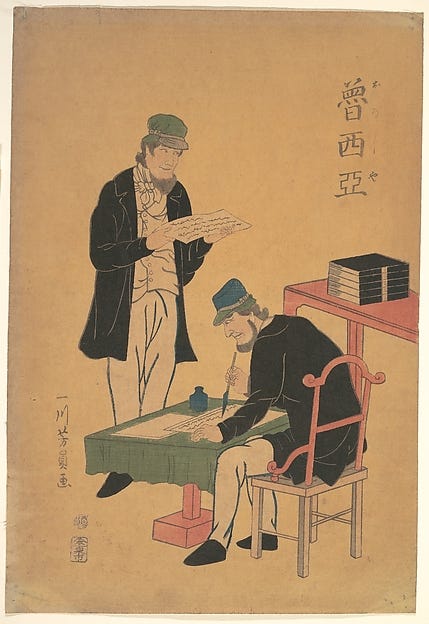
Russians Reading and Writing. Utagawa Yoshikazu, 1861. The Metropolitan Museum of Art (public domain).
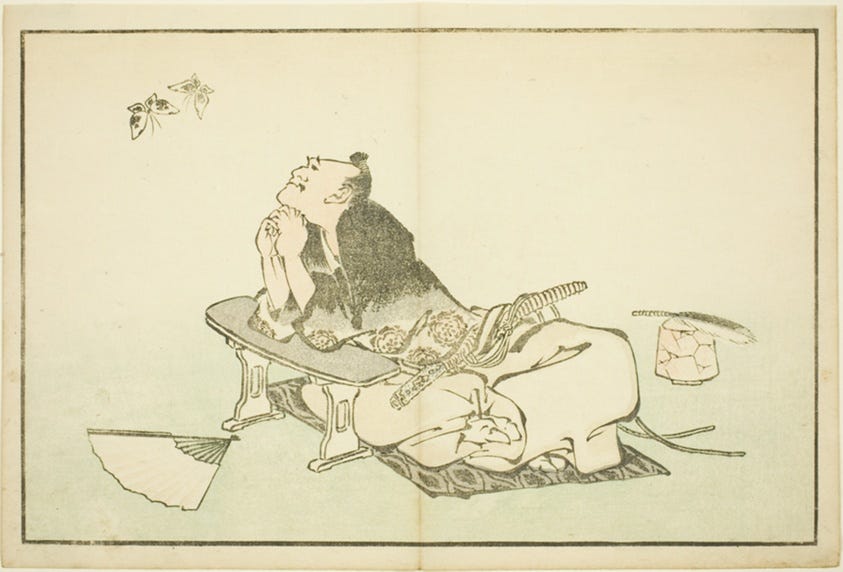
A Philosopher Watching a Pair of Butterflies, from The Picture Book of Realistic Paintings of Hokusai. Katsushika Hokusai, c. 1814. Art Institute of Chicago (public domain).
